Clodagh Finn: Hark! An overlooked Aladdin’s Cave of festive entertainment
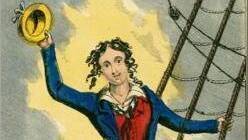
Anne Jane Thornton dressed as a seaman to cross the Atlantic in search of her lover.

I’ve been sailing the seven seas with Anne Jane Thornton, the Donegal teenager who, almost 200 years ago, dressed as a seaman to cross the Atlantic in search of her lover.
Her journey to the Americas and back again, not to mention her 31 months at sea, were considered “so romantic and so singular” that her contemporaries could scarcely believe it.
Yet it was true, and the 17-year-old woman at the centre of the story caused a sensation in London in 1835 when she was interviewed by the city’s Lord Mayor after her secret was discovered while she was washing in her berth on board the Sarah shortly before.
It is fascinating to read an account of that interview now because it tells us the Lord Mayor had asked his inspector of police to investigate claims that a female sailor had come ashore so that they might assist her.
His disbelief is evident in the report of the encounter carried at length in the of February 14, 1835.
HISTORY HUB
If you are interested in this article then no doubt you will enjoy exploring the various history collections and content in our history hub. Check it out HERE and happy reading
“Is it possible,” he asked the ship’s captain, “that this mere girl — for she cannot be more than 16 or 17 years of age — performed the duties of a seaman?”
Captain McEntire (or McIntyre in some accounts) replied: “It is, my lord; she performed them to admiration; she would run up to hand the top-gallant sail in any kind of weather, and we had a severe passage. Poor girl, she had a hard time of it; she suffered greatly from the wet; but she bore it all excellently, and was a capital seaman.”
In truth, the good captain was not quite as well-disposed to Thornton as he appeared. At first, he wanted to withhold wages because he said he had hired a man not a woman, while the other sailors often struck her while at sea because she couldn’t work as hard in a gale of wind.
Yet, she performed her duties “without a murmur”, and was later celebrated in verse as the ‘Female Sailor bold’ who braved the tempests, “weigh’d the anchor, heav’d the lead, and boldly went aloft”.
Readers were offered this evocative if questionable description of her: “She is of low stature, and her limbs are very firmly knit together. Her face is comely. Her eyes are dark and brilliant, and her teeth are extremely white. The hardships to which she has been so long exposed have completely tanned her face and neck; but the sailor who accidentally detected her secret declares that the natural colour of her skin is as white as snow.”
Anne Jane Thornton was also given a voice, though. Her own account is reported in detail in newspaper reports as well as in the autobiography that made her famous, .
To tell you the story in brief: This Donegal girl’s adventures started when, aged less than 15, she became “strongly attached” to the seafaring Captain Alexander Burke while he was in Ireland. When he was called back to his father’s house in New Brunswick, Canada, she hatched a plan to follow him.
Anne Jane’s own father, a widower and prosperous merchant, had moved to Ballyshannon in Co Donegal when she was six years old. He ran a number of stores in the town apparently. Without telling him, Anne Jane decided to leave.
Devastated, she had no choice but to support herself. That is how — and why — for 31 months she was “engaged in… remarkable adventures, and participated in the most severe toils of the [ship] crews of which she formed part,” to quote the newspaper again.
To find out about her return to Ireland and how she found love again, check out the Dictionary of Irish Biography ( www.dib.ie), where her story is one of some 30 new Irish lives added to this singular repository of personal histories.
At Christmas, people often binge-watch Netflix, earmark TV schedules and/or stockpile books, all of them excellent yuletide activities, but the Aladdin’s Cave of wonder that is just a click away in our vast array of digital archives is often overlooked.
In the DIB, for example, there are some 11,000 Irish lives, from earliest times to the 21st century, to explore. (It’s good to see an entry on Rena Dardis, publisher and one of the first female ad agency directors, has been included in time to mark the anniversary of her death on January 6, Nollaig na mBan.)
Another favourite of mine is the film archive at the Irish Film Institute ( Ifiarchiveplayer.ie). I never fail to be amazed, for example, by the innovative foresight of Cork filmmaker Flora Kerrigan whose surreal and playful shorts were internationally recognised in the 1950s and 60s.
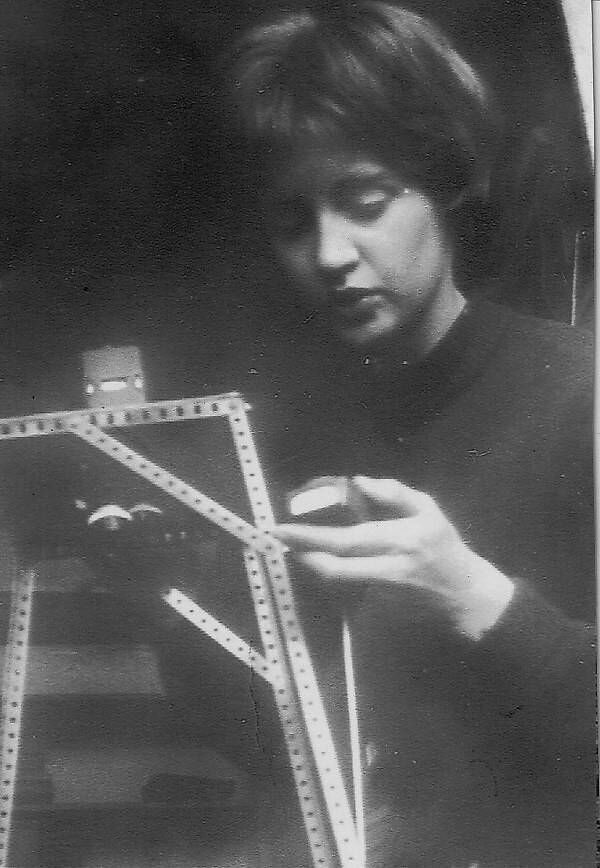
I’m delighted, too, to get a photo of her from her sister Frances which shows the tripod her brother Gilbert made out of Meccano and gave to her as a Christmas gift in the early 1960s. Innovation clearly ran in the family.
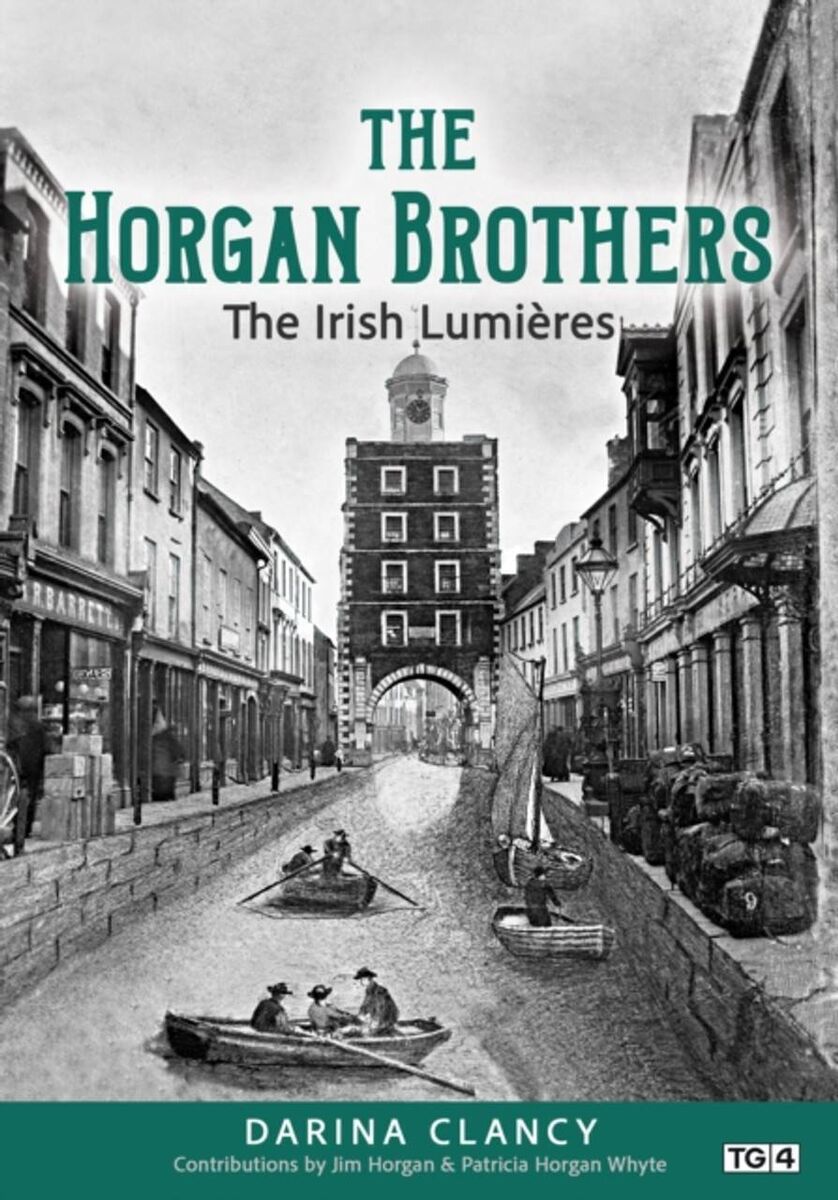
Speaking of a family of innovators, thanks to Jim Horgan, you can watch some of the films made by his predecessors, the epoch-making Horgan Brothers (also the subject of a terrific book by Darina Clancy, The Horgan Brothers: The Irish Lumières published by Mercier Press earlier this year).
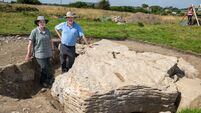
There’s a fascinating 1910 film made at Saint Declan’s Well in Ardmore, Co Waterford. On the saint’s feast day (July 24), pilgrims used to crawl under the stone to cure a range of ailments. Legend had it that you would get stuck if you had sinned too much. (Watch until the end to see what happens).
There are many other wonderful archives. I’ve been known to fall down many a digital rabbit hole from the online exhibitions available at Cork City and County Archives (corkarchives.ie) to the one uncovering the voices of ordinary women from early modern Ireland (c.1550-c.1700) ( voicesproject.ie)
“Ordinary women are not absent from the story of early modern Ireland. Rather, they were hiding in plain sight,” says the alluring opening page.
Our archives are endlessly fascinating but they are also particularly important at a time when fake news is the norm rather than the exception.
That was a point made by chair of the Archives and Records Association, Niamh Ní Charra, earlier this year as Dr Mary McAuliffe,ahistorian who has done stellar work retrieving so many forgotten narratives from our archives, was appointed Explore Your Archives ambassador for 2026.
And so, to the present. While social media is often weaponised to spread false narratives, it also has an important role in forming the records, or archives, of the future, says archivist Niamh Ní Charra.
Social media, she said, “has been used to track war crimes and the individuals who carry them out, provide witness to widescale loss of life and cultural destruction… These records, in ever changing formats and exponentially rising volumes, will become the archives that hold culprits, both individual and national, to account.”
And, of course, archives are not outside of ourselves. Every family holds a vast repository which so often slips away before it is recorded. Why not try to capture some of those moments this Christmas, or venture into the vast resources to see how others did it before you?
Happy festive exploring.
CONNECT WITH US TODAY



Be the first to know the latest news and updates