Paul Hosford: Why Sinn Féin’s decision not to run a presidential candidate may prove costly
With just three names on the ballot, questions loom over Sinn Féin’s strategy, voter choice, and whether the race is missing something vital
Paul Hosford: Why Sinn Féin’s decision not to run a presidential candidate may prove costly

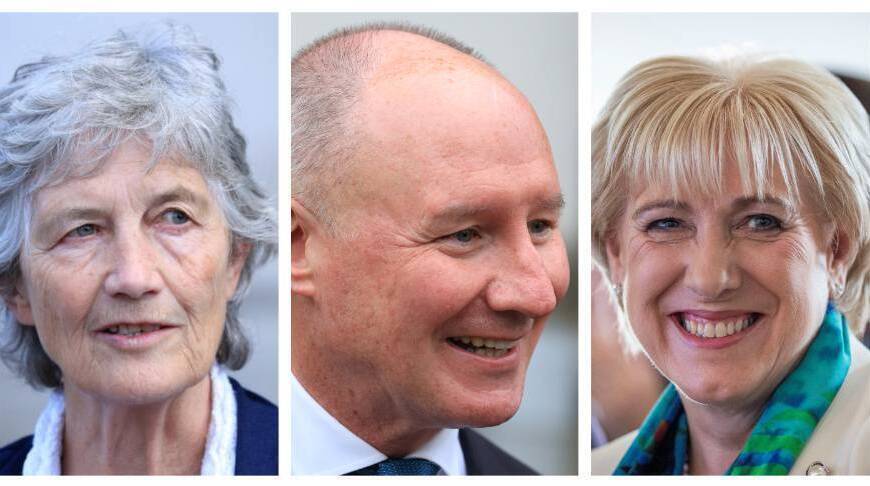
Catherine Connolly, Jim Gavin, and Heather Humphreys. The presidential election candidates have the backing of parties that received 77% of votes in total in the last election.

And then there were three.

For a brief moment, there may have been five, but as the nominations deadline passed on Wednesday, only three candidates were left as officially in the race to become the next Irish president.

Fianna Fáil’s Jim Gavin, Fine Gael’s Heather Humphreys, and Independent TD Catherine Connolly will provide an intriguing contest, one in which a path to victory is evident, if not obvious, for each.

But, with the finishing of the preamble, there is a reasonable question of whether the race might be lacking something, and if it is something that could have been easily provided.

Maria Steen's exit

Presidential Election

As she conceded that she would not make the nominations threshold of 20 Oireachtas members, barrister and anti-abortion activist Maria Steen told the press that she believed her failure had highlighted a desire for more names on the ballot.

Maria Steen speaking to media on Wednesday when she conceded that she had failed to get the required number of nominations to run as a presidential candidate. Picture: Sam Boal/Collins

“While I’m honoured to have received 90% of the signatures required from members of the Oireachtas, I regret to say that it’s not enough, and that time has now run out,” she said.

“I entered this race in the hope of giving voters a real choice.”

Speaking in Irish, she said she was disappointed but very proud of her progress. She continued: 

The response from the public in recent days confirms the hunger that there is for an alternative candidate.

“Sadly, that hunger will now go unsatisfied. Rarely has the political consensus seemed more oppressive or detached from the wishes and desires of the public.”

Is a section of Irish society unrepresented? 

There is much to discuss from Ms Steen’s potential candidacy, not least whether or not it leaves a section of Irish society unrepresented in a race for the highest office in the land, which is a question without a clear answer.

The three candidates who have made their way onto the ballot have the backing of parties which received 77% of the votes in total in last year’s general election.

If we assume that just less than half of the 13% of votes for Independents went to left-wing Independents, and we add in those Independents who might be minded to support Fine Gael or Fianna Fáil candidates, that could be as high as 85%.

That is a crude measurement, and it is absolutely fair to argue that 15% of those who voted in the last election being notionally unrepresented in a presidential election is far too high, and this is assuming that all of those who voted for the parties that are running or supporting candidates agree with their choice of representative and their views.

This is to say that it’s not easy to definitively argue one way or another how many people are or aren’t represented by the three people who have made their way onto the ballot until the turnout from the election itself is revealed.

Suppose Ms Steen is at the vanguard of a political movement which is broken away from the parties which make up the bulk of the Oireachtas: In that case, we may see that reflected in the turnout on October 24 but, until then, it is hard to be definitive that there is a movement being oppressed.

But Ms Steen’s attempts to get on the ballot — along with businessman Gareth Sheridan — did, for those in support and against, captivate members of the public in a way that showed there is interest in the race beyond the three candidates on offer. 

This is multi-factoral.

Sinn Féin's strategy

Some people haven’t connected yet with the candidates — many won’t until after Monday’s first TV debate on Virgin Media. 

Others have not tuned into the race at all yet. But, for a large cohort, this week was a time when a fairly staid political race looked interesting, if only for the almost sports-like drama of two political neophytes scrambling to court support from councillors, TDs, and senators.7

Mary Lou McDonald and Paul Hosford at Leinster House last month when the Sinn Féin president said the party hadn’t yet done enough to 'build and develop those relationships and that politics and that collaboration' with other parties. Picture: Gareth Chaney

But that interest does make one wonder if Sinn Féin, which last week announced it would support Ms Connolly, has missed a trick. 

If there’s a demand for something else, why not the Dáil’s second-biggest party?

SF had good reasons to back Connolly

The reasons for Sinn Féin finally deciding to back the Galway woman are many and persuasive. 

If the party has accepted that a Dáil majority is out of reach and, at the same time Fianna Fáil and Fine Gael have shut the door to coalition, Sinn Féin needs to build a coalition. What better show of fidelity to such an idea than to throw its lot in — including people and no small amount of money — with the parties of Ireland’s left?

If Sinn Féin wants to lead that grouping, what better way than to put its own brand aside to back Ms Connolly, along with Labour, the Social Democrats, People Before Profit, and a number of Independents?

As party leader, Mary Lou McDonald told this paper last month that Sinn Féin didn’t offer an alternative government in the last election.

“I think [the idea of a combined left government didn’t resonate with voters] for lots of reasons, not least because we have to accept responsibility for this, and we need to learn from it; we hadn’t done enough within Sinn Féin to build and develop those relationships and that politics and that collaboration at that point. We simply hadn’t,” she said.

For Sinn Féin, backing Ms Connolly allows it to build that groundwork but also have the distance that, should she not win, they don’t necessarily have to carry too much of the blame.

There is also the suspicion that Sinn Féin could have won a presidential election, but it would have required running Ms McDonald as its candidate. While some in the party would have accepted the sacrifice, others see her as too strong a performer and leader to give up for a presidential run four years ahead of a general election.

Then Labour leader Dick Spring and candidate Ann Gallagher conduct a phone interview with a local radio station in Killeshandra in the Cavan/Monaghan constituency during the 1992 'Spring Tide' general election. File picture: Frank Miller/The Irish Times

But that raises a question of how one of Ireland’s three big electoral forces, a party which is at the forefront of republican politics and one of the few real 32-county operations on the island, can’t find a candidate to run.

While Fianna Fáil had seen its grandee ranks thinned out by association with the financial crash, Sinn Féin has never been in government in the south and could have considered an outsider like Mr Gavin to carry its flag.

While the linking of Mary Robinson’s 1990 election victory to the 1992 Spring Tide for Labour in that year’s general election is somewhat simplistic, there is an argument that the entry into the race of Ms McDonald, or another Sinn Féin candidate, could have had the potential to electrify both the contest and the party’s membership, which rarely needs a jolt to knock on doors.

In the build-up to its final decision, opinion within the party was mixed, but definitely shifted in the days beforehand to supporting the Galway West TD.

In the end, there will be three candidates, one with the backing of a disparate group of parties, but the explosion in interest in someone outside the race this week makes you wonder if Sinn Féin has missed out on a winnable and important election.

x

More in this section

Revoiced

Newsletter

Had a busy week? Sign up for some of the best reads from the week gone by. Selected just for you.

Cookie Policy Privacy Policy Brand Safety FAQ Help Contact Us Terms and Conditions

© Examiner Echo Group Limited