Paul Hosford: Unprecedented political storm has not helped public’s perception
It is hard to imagine that anyone who tuned in on Wednesday to Dáil proceedings would feel better about the processes, the systems, or the main players across the political spectrum
Paul Hosford: Unprecedented political storm has not helped public’s perception

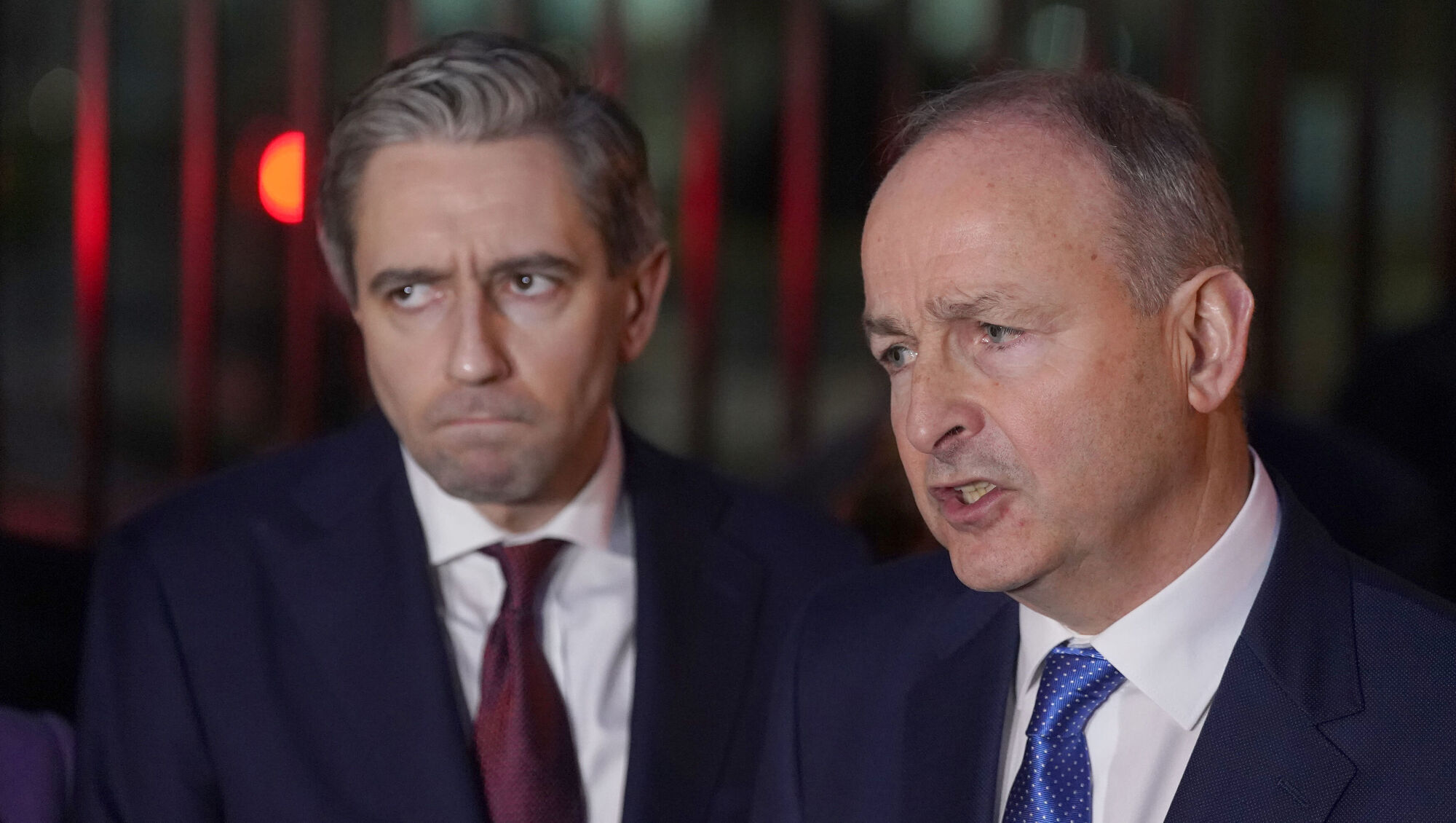
Simon Harris and Micheál Martin speak to the media after nominations of the taoiseach and other government members broke down in the Dáil following multiple suspensions. Picture: Brian Lawless/PA

The lights flashed for last orders in the Dáil bar around 7.50pm on Thursday.

Not that early on a Thursday, but notably premature for the day of the election of a taoiseach.

In truth, the bar — the one that caters to staff and visitors to the complex — was little more than half full, with workers and members of the Oireachtas based outside Dublin having largely bolted to avoid the onset of Storm Éowyn.

With warnings of an unprecedented storm in the air, an unprecedented political storm had swept across Leinster House in the previous 36 hours — one that brought the political system to a standstill and had fingers pointing in every direction.

Across the Oireachtas, there was blame being shared, shifted, and apportioned, with many in the government benches accepting that they, too, shared in the fault for Wednesday’s scenes.

To recap, during Wednesday’s planned election of Mr Martin as Taoiseach, opposition TDs angrily reacted to plans by Ceann Comhairle Verona Murphy to recognise a Dáil technical group — a group of at least five TDs who coalesce to gain access to speaking rights, committee positions, and private members’ time — which featured Michael Lowry, Danny Healy Rae, Gillian Toole, and Barry Heneghan.

All four had, at one time or another, discussed the programme for Government either directly with Fianna Fáil and Fine Gael or within their groupings — the other members of which will take up ministerial office.

As the Dáil was suspended due to the inability to progress the day’s business, government party whips scrambled, meeting in Government Buildings with opposition parties — who held their own meetings elsewhere in the campus — while journalists, TDs, and guests milled around wondering when the issue might be solved.

Around 4pm, there was word that peace would reign, that a solution had been found, and Mr Martin would end the day as Taoiseach.

But when government chief whip Hildegarde Naughton rose to tell the chamber that a deal had been reached, she was swiftly interrupted by Sinn Féin’s Donegal duo of Pádraig Mac Lochlainn and Pearse Doherty. No agreement, they said, had been made.

Regardless, and as Sinn Féin leader Mary Lou McDonald attempted to interject, Ms Murphy moved on to the nomination of Mr Martin, asking Galway East TD Albert Dolan to begin his speech.

This led to even more anger and, with numerous opposition deputies on their feet, Ms Murphy opted to adjourn the House rather than continue.

The now Taoiseach, the then taoiseach, and their party whips were straight out to give their side — though their on the hoof press conference had to be moved off the Leinster House site, with journalists and TV crews scrambling to Government Buildings along Merrion St, which had been shut off for the day. 

What the passing public, outside the metal barriers on the far side of the street, made of it is anyone’s guess.

That meant that rather than seeing Mr Martin in the Áras on the evening news, the public was treated to hastily reworked programmes that focused on the unprecedented events of the day and who was to blame.

The truth, as one freshman TD said, is that while there is blame to go around, there is a bigger issue in how the day’s events looked to the watching public. 

Last Sunday, Mr Martin told reporters that the public was “not excited” about the issue of Dáil technical groupings.

He said “the public isn’t as excited” about an issue that is so technical, stating: “The public is interested in the fundamentals that are facing us in terms of critical challenges facing this country.”

Simon Harris and Micheál Martin speak to the media after the furore. Picture: Sam Boal/Collins Photos

While the new Taoiseach is right in that vast swathes of the public don’t spend their days worried about Dáil standing orders, the same populace can also recognise a political stroke and it was clear from conversations with non-political members of the public they know at a base level that something was off with the agreement with Mr Lowry’s group of TDs.

While the public may not be versed in Dáil standing orders, they understand that you can be in Government — having created the outline for how the State will operate for half a decade — or you can be in opposition, holding that document and outline and those who drew it up to account. 

You cannot, under any circumstances, be both. This is a parliament, not the hokey-cokey.

While Ms Murphy received legal advice to assure her that the arrangement was legal, there was no addressing whether it was right.

It is important to note that the arrangement would not merely allow the TDs to speak, it would alter entitlements to committee memberships and chairs, and would fundamentally redefine what the opposition and government benches mean.

For that argument, the government parties had no real comeback. 

Last Sunday, Mr Martin said it was “not for me to adjudicate on that — that’s a matter for the Dáil itself” when asked if he thought the arrangement was appropriate.

It was clear throughout Wednesday that the Government was happy to pass this issue to Ms Murphy and say that it was a matter for the Oireachtas members to make Oireachtas rules. 

Ceann Comhairle, Verona Murphy.

It’s a defensible position if one ignores the reason why the opposition was so exorcised and, crucially, what was supposed to happen on Wednesday.

There are questions about the proportionality and precedent of the opposition essentially using a filibuster, refusing to yield the floor in a bid to halt proceedings.

Can this be deployed whenever the opposition doesn’t like a piece of legislation, for example? But, from a political point of view, there was little else that was ever going to happen. 

The opposition benches had one arrow in their quiver — obstructionism — and they used it.

For the Government and Ms Murphy not to countenance what happened as a possibility, let alone a certainty, shows either arrogance or naivety. 

While Mr Martin may not have believed it was an issue exciting the public, it was one upon which the opposition was united and adamant.

That the Dáil met, five weeks since its first sitting, without a clear agreement that the election would proceed without incident should see all sides asking if they did enough to avoid it.

They might also ask how much damage was done to the public perception of politics in Ireland.

On a personal level, it was impossible not to sympathise with Mr Martin. His 2020 election as taoiseach came at a time when inter-county travel was banned due to covid and his family was not present.

On Wednesday, the day of his father’s anniversary, his family was present — but the delay meant that they could not all be there on Thursday. 

He will not focus on it, but it was a shame because it was all entirely avoidable had someone picked up the phone on Monday or Tuesday and found the arrangement which was hastily arrived at on Thursday.

November’s election saw a decline in turnout. Many now feel less connected to the system than ever. 

It is hard to imagine that anyone who tuned in on Wednesday would feel better about the processes, the systems, or the main players across the political spectrum. 

Taoiseach Micheál Martin with party colleagues and his wife Mary O’Shea at Leinster House after the vote confirming him as Taoiseach. Picture: Sam Boal/Collins Photos

When a group of people who were elected nearly two months ago come together for just the second time, the public has a right to expect that it will execute its first constitutional obligation and elect a Government. 

When that doesn’t happen, it opens the door to a kind of cynicism about the political process that is genuinely not warranted but also completely understandable.

The Dáil from 2016 to 2020 was fond of the phrase “new politics”, which was shorthand for a more collaborative approach — necessitated by the Fine Gael Government’s Dáil minority.

We may hope that this week’s scenes were not a new kind of new politics.

x

More in this section

Revoiced

Newsletter

Had a busy week? Sign up for some of the best reads from the week gone by. Selected just for you.

Cookie Policy Privacy Policy Brand Safety FAQ Help Contact Us Terms and Conditions

© Examiner Echo Group Limited