Sarah Harte: Battling mindsets over women’s clothing leaves us a little ‘short’
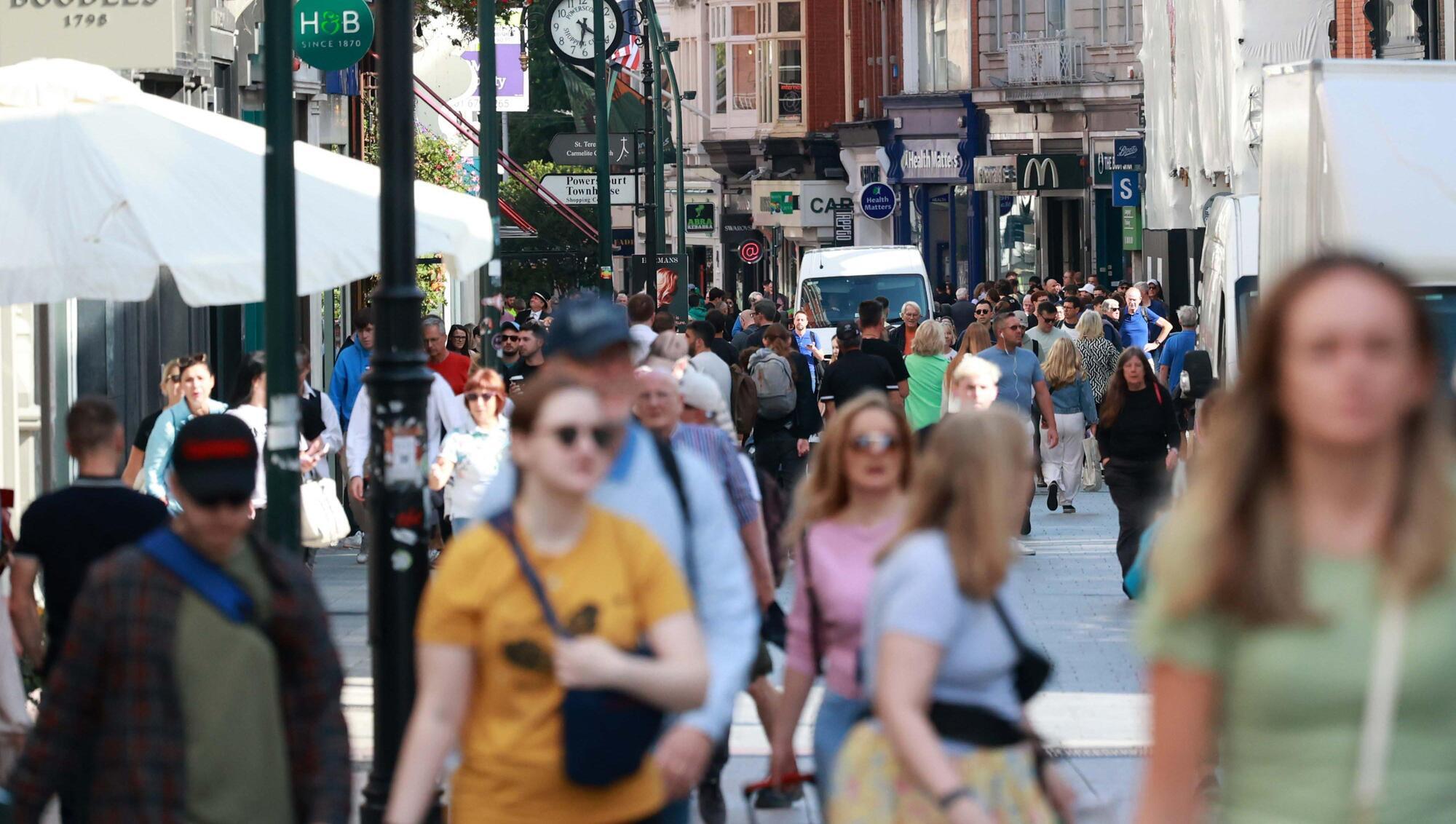
How women dress and how society views them has changed over the years, as Sarah Harte experienced on Grafton St in Dublin, recently
Sarah Harte: Battling mindsets over women’s clothing leaves us a little ‘short’

Tourists and locals on Grafton Street. File Picture: Sam Boal/Rollingnews.ie

In Dublin, I was bowling around in the sun, bumping a case behind me, and looking at the city through a different lens. There for work, I stayed on and found myself as a tourist in a city I had lived in for decades.

In my version of ‘Country Mouse Goes to the Big Smoke’ I crisscrossed the city, including taking the dart to Dun Laoghaire, and the Luas to Cowper, and tramped the streets people-watching in the way you might if you went to Paris or London.

One thing that stood out was the number of young women wearing shorts. Not a surprise, because they appeared on the spring catwalks in multiple different iterations. As one stylist said: “The micro short or no-pants trend is not only a statement but a trend that challenges notions of modesty in clothing, pushing us to embrace our bodies.”

So, how does that work out in real life?

Body positive

First impressions, young women appear more body positive than my generation, free to wear shorts when they don’t conform to the rail-thin, perfect body rammed down our throats.

What a relief. The ultimate compliment when I was growing up was to be told that you were too thin. This resulted in a lifelong disconnection for our bodies. We were also peddled the 'nice girls don’t dress like that' angle. Our bodies were primarily for attracting the male gaze; sex in the right, socially-legitimated context; and motherhood.

True, we played sport, but that was peripheral in society’s eyes. Female sports role models were scarce, and the dominant cultural archetype of an attractive woman was starved and submissive.

On Friday afternoon, one young woman, around 15 years of age, stepped off the Dart in Sandymount, looking fabulously athletic in micro red sports shorts with an oversized hoodie and tanned legs. You could imagine her batting a ball over a tennis net or running down a racetrack. She looked free, healthy, and independent.

Later that evening, at around half six, a very different vibe was coming from a tableau involving a young woman, also around 15. Staggering down Grafton St, wearing flesh-coloured skintight yoga shorts and bra top with a young man’s arm tightly wrapped around her waist in a kind of hold. It looked like he was claiming her and possibly holding her up too. Either way, she was firmly in the role of object rather than subject.

It was disturbing, because she looked slightly out of it, and his body language — including the look on his face — was jarring. She was curvy and may as well have been naked, and the word “safety” sprang to mind. Every fibre in my being as a mother and an older woman hoped that it would turn out OK for her, but I wasn’t optimistic.

On Saturday on Clanbrassil St, a couple who were in their late 20s walked along, happily scoffing ice creams. She wore form-fitting pale green yoga shorts that accentuated her vulva. There’s no other way to put it. It was eye-watering. At this point, my friend, who was driving me, laughed, and said: “I know what you’re looking at, because I nearly crashed the car myself, you’ll see more of that.” By Sunday evening I’d seen several pairs.

Pernicious ‘asking for it’ idea still entrenched

We discussed it. Coming from our generation, her shorts looked ‘indecent’, but we mocked ourselves because we knew we sounded like Victorian matrons wearing long-sleeved, high-necked flannel gowns. Because she looked happy, healthy, and clearly felt safe with the man she had by her side.

Keen to avoid body-shaming, it led to a larger conversation about not having a right to tell young women what to wear because young women shouldn’t be responsible for the signals they send out when they wear clothes.

In theory, we should raise our sons to understand women are not objects simply dressing for the male gaze, and wearing fewer clothes is not an invitation or permission to comment, harass, follow, or assault. Because a basic confusion persists that women who dress revealingly are doing so solely to evoke sexual responses from men.

This confusion spills over into our legal system where, in sexual assault cases, an unmistakable degree of victim-blaming continues. Depending on how they dress, some survivors are viewed as less believable, with the potential for more lenient sentences for perpetrators.

The pernicious ‘asking for it’ idea, which is deeply culturally entrenched, has not gone away. Women are treated differently based on what they are wearing. It makes having conversations with young women about dress exceptionally tricky. The last thing you want to do is to communicate that they should be ashamed of their bodies, to mute their self-expression, signalling that the responsibility not to arouse or seduce young men lies with them. That’s entirely the wrong way around.

As child and youth studies expert, Shauna Pomerantz from Brock University in Vancouver, says: “It’s saying that the male response is your fault, your body is causing negativity.” Teenage girls draw fascination, she says, as a symbol of virtue in society.

Self-objectification

Yet as parents, it is our job to keep our kids safe from upsetting or dangerous situations. And there is a relationship between dress and the objectivation process. American social psychologists Barbara Fredrickson and Tomi-Ann Roberts point out it’s not just who men objectify women. 

In a double whammy, a young woman who is repeatedly exposed to objectified, sexualised images of women, will internalise certain messages, and engage in self-objectification. So, her choice to wear what she likes is arguably illusory, because she is internalising an outsider’s perspective that is based on the idea that women are valued for their bodies and physical attributes, which is ultimately a rerun of what we were given, just packaged up differently.

In this context, a question my friend and I had is — who pushes the message that wearing vulva-accentuating shorts is in vogue? 

I’d be interested in other people’s views on this. Does it come from porn, which is ubiquitous and often denies women standing as human beings; from social media; or from questionable role models like the Kardashian family who monetise every aspect of their bodies in a nakedly (pun intended) capitalistic way? They dress up something dark, neoliberal, and ultimately anti-feminist as being a ‘girl boss’ and because they make tons of lucre that legitimises anything.

Taylor Swift 'in control'

The talented Taylor Swift is interesting in this context. She works ultra-hard, gets a new boyfriend, and enjoys herself, but stays focused, heading back into the studio writing new songs that are often lyrically interesting, and goes on tour. She wears spangly leotards but with a guitar strapped to her, belting out hits and positively connecting with young women while her boyfriend comes to watch her perform. 

Taylor Swift performs at the Friends Arena in Stockholm, Sweden. Picture:  Christine Olsson/TT News Agency via AP

She is in control, and it enrages a cohort of male republicans. On Monday, Newsweek reported that Taylor’s endorsement of Joe Biden could impact the November presidential election.

Meanwhile, the battle continues. Our sons need to learn how to interact with women healthily. But our daughters have a right to live a life where they love their bodies on their own terms so that they can carve out their sexual identity in a positive way as the free spirits they deserve to be.

More in this section

Revoiced

Newsletter

Sign up to the best reads of the week from irishexaminer.com selected just for you.

Cookie Policy Privacy Policy Brand Safety FAQ Help Contact Us Terms and Conditions

© Examiner Echo Group Limited