Joyce Fegan: Turn down volume on ‘free’ speech with only malice at heart
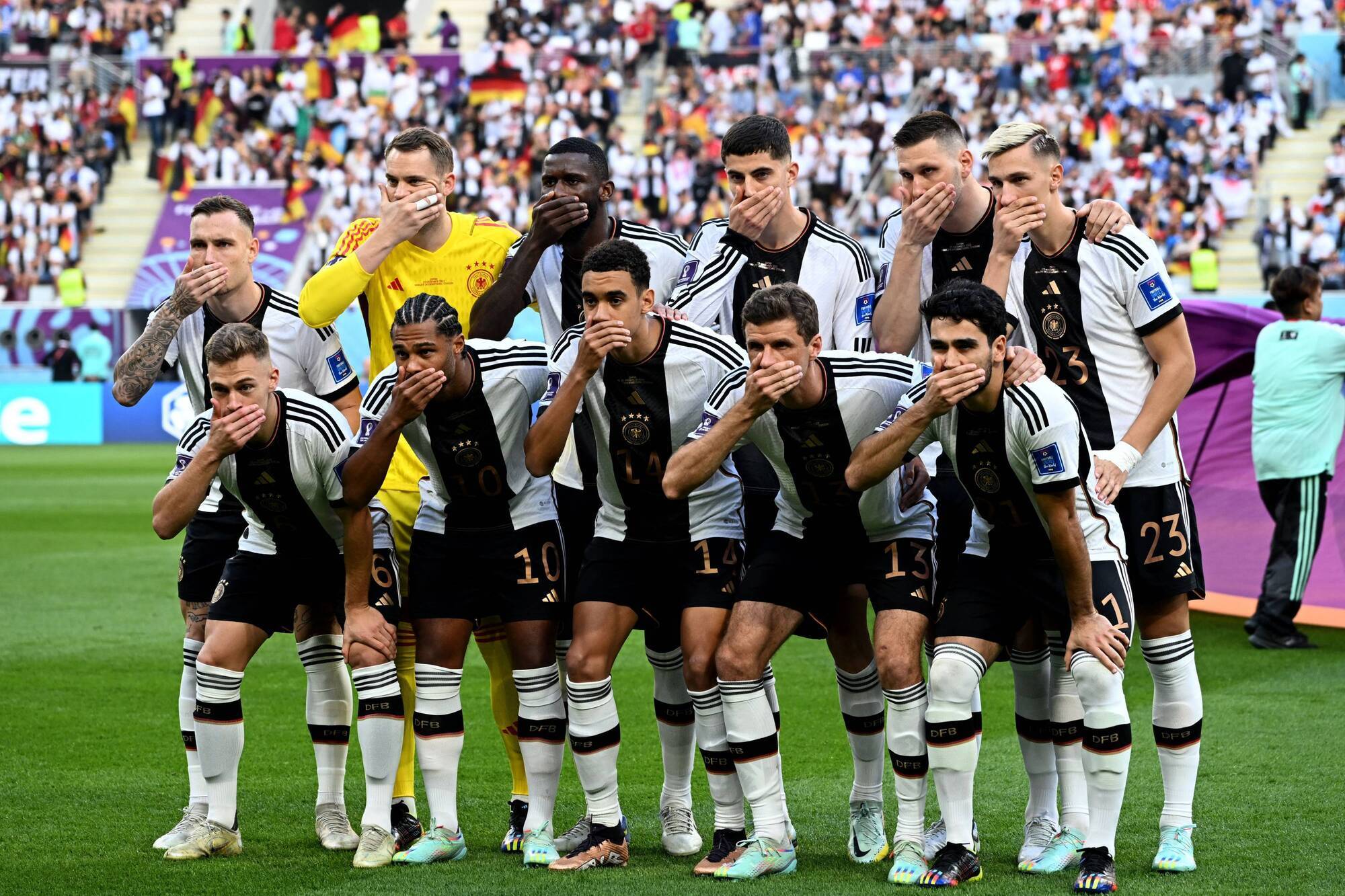
At the World Cup in Qatar, the German team covered their mouths during a team photo as a protest against Fifa restricting free speech over the OneLove’ armband. Picture: Ina Fassbender/AFP/Getty
WHICH kind of free speech is more risky: An international racing car driver wearing a Pride helmet for a race in Qatar, where same-sex relations are illegal, or the former presenter of a BBC motoring show publicly stating how he’d love to see a woman of colour paraded around a country to have faeces thrown at her?
Which kind of free speech is more risky: An international racing car driver wearing a T-shirt calling for justice over the murder of a black woman, or a man who earned his living dancing around a small cage in boxer shorts publicly trolling a comedian for detailing his mental health struggles?
There will be consequences for some, and none for others.
This week it was announced that Formula One drivers will be banned from displaying political or religious statements without prior approval from next season.
It has all the hallmarks of what goes on over at Fifa, where Article 11 of their disciplinary code states that anyone “using a sports event for demonstrations of a non-sporting nature” may face sanctions.
The Formula One thing has been a little while coming.
Mercedes’s seven-time world champion Lewis Hamilton, long known for using his global platform to elevate the marginalised, wore a T-shirt at the 2020 Tuscan Grand Prix with the words “Arrest the cops who killed Breonna Taylor”.
The T-shirt also carried a photograph of the black medical worker, who was shot dead in her Kentucky apartment by police officers.
Right after that race, the powers that be at Formula One set out new pre- and post-race rules for driver attire.
There was more from Hamilton. He went for the Middle East next, a place where Formula One, among other sports, is currently being rolled out.
At the inaugural Formula One race in Qatar in 2021, Hamilton had his helmet painter incorporate the Pride flag onto the lid. A year later, drivers are told they’re to be banned from making political or religious statements.
World Cup controversy
Then at the 2022 World Cup, also in Qatar, the football sporting body Fifa, threatened several European teams, who were planning to wear OneLove pride armbands, with sporting sanctions. The armbands, a year in the planning, never got worn.
You can spend up to seven years in jail if you engage in same-sex relations in Qatar.
These raps on the knuckle for footballers and Formula One drivers alike, almost makes it feel like that those using their global platform to improve the lives of others are the baddies.
This same week we saw another, entirely different form of free speech where grown men used their large platforms not to improve the lives of others, but to do the opposite.
One was a former BBC Top Gear presenter telling the world how he’d love to see Meghan Markle publicly humiliated and have “excrement” thrown at her. This particular speech was published in a national newspaper, getting past several layers of editing.
The man in question, the next day, said he was “ horrified to have caused so much hurt”, as if it was all just an unfortunate accident, a surprise that slipped from his own hand.
There were lots of complaints to the UK’s press regulator and that’s about it. No other consequences. No sanctions. No having to tell his employers about statements he plans to make in advance.
Meanwhile, violence against women, and violence against black women, whose names we will not know until it’s too late, will continue.
There are consequences to words, they just affect some far more than others.
This week, in Ireland, a guy who used to dance around a small caged-in ring in a pair of boxer shorts and hit other human beings for a living, took a public pop at one of our country’s most talented comedians for detailing his mental health struggles.
Other celebrities got dragged in. It became a story. It started on social media and played out over that medium, so there is no watchdog to complain to.
The consequences for the guy in the boxer shorts is nil; no, that is incorrect.
He earned lots of column inches for his tirade and used the controversy to try and instigate some kind of triple duel between himself, the man he insulted, and an Irish sporting legend. Such a suggestion earned him even further free national media coverage.
But just like in the UK, there will be no sanctions for him and no rules applied around what he can and cannot say on his public platform.
Silent mental health struggles
Meanwhile, there will be people in Ireland who will continue to suffer in silence with mental health challenges.
There are always consequences to words, especially when spoken by someone with a large audience, or by someone who used to be a role model.
It’s just that those with the power, be it in Qatar, Kentucky, England or Ireland, seem to never be the ones facing any consequences.
We seem au fait with silencing certain speech or voices, in the name of decorum, to not offend, and then the voice that has been silenced, be it a global sports star, a murdered black woman, a person who happens to be born gay, must obediently play along lest there will be consequences.
As the year draws to a close, we have seen two large international organisations with millions of fans enact silencing decrees without us so much as batting an eyelid. And we have trash talk via a social media spat being elevated, time and time again, to national and international headlines.
We pay the latter so much more attention with our very monetisable outrage and ignore the former altogether, letting the real powers that be totally off the hook.
In 2023, maybe we should review the kind of speech we amplify and the silencing we mostly ignore.

Continue reading for €5
Unlock unlimited access and exclusive benefits
Already a subscriber? Sign in
Cancel anytime
CONNECT WITH US TODAY
Be the first to know the latest news and updates