Michael Moynihan: A burning passion for brigade history ignites a fire in the soul
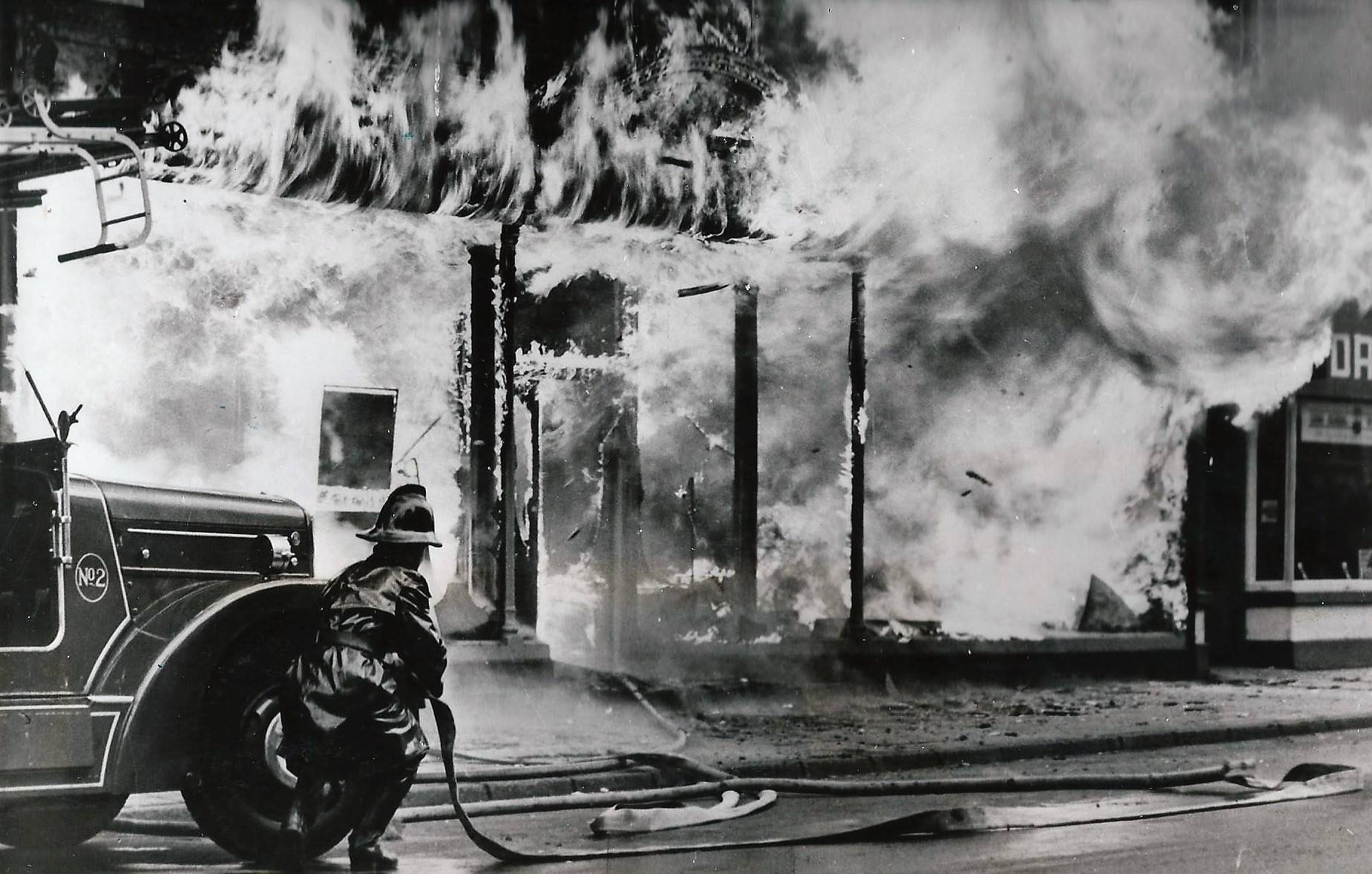
Pat Poland, author of this article, having just exited Scott’s Showrooms on MacCurtain Street, waits for water from the fire engine - note the water snaking through the hose
Kudos to begin with for an old friend of this column, Pat Poland, on completing his trilogy of histories of Cork Fire Brigade.
His new book, Cork City Firefighters: A Proud Record. A Visual History From 1950, follows two earlier volumes to complete a comprehensive account of firefighting on Leeside down the centuries.
A declaration of bias: having grown up in a fireman’s house I have a natural prejudice in favour of the breed, as well as a long-engrained habit of unplugging everything at night before going to bed, but never mind.
I enjoyed the latest book because a lot of the names were familiar to me, but you don’t need that familiarity to appreciate it. It’s an account that seems at first glance to be a deep dive into a very specialised field, but on closer inspection reveals a great deal about the city itself.
The photographic record shows, as the book progresses, a city spreading and developing, growing upwards as well as outwards.
HISTORY HUB
If you are interested in this article then no doubt you will enjoy exploring the various history collections and content in our history hub. Check it out HERE and happy reading
At a time when encouraging people to live in the middle of the city is a matter of some debate, for instance, Pat told me during the week that he was reared close to Cork city centre. And close to the old fire station.
“My father was a member of the brigade and he and the family occupied 23 Sullivan’s Quay in 1947 on his promotion. I was actually born in Grattan Street Fire Station, and when that closed for good, we transferred over.
Our house had bells and lights on every landing. When the General Alarm sounded for a fire or other emergency in the station next door, the bells went off all over our house as well, and at night, the ‘Emergency Lights’ would all come on.
There’s another hidden value to the book, though, in that it promotes an interest in local history, something that should by right be taught in school. Instead, we’re reliant on committed individuals to develop an interest in their home place on their own.
Take Pat’s own development as a historian.
“When I was young some of the older firemen — Jimmy Buckley, Teddy Brady, and Denis ‘Din Din’ Carey were Old IRA men. Mickey Murphy, of the Fire Brigade dynasty of Murphys, had waltzed with a Black and Tan around Cook Street during the Burning of Cork with a rifle stuck under his chin.
“Later, when I was in the job and they’d retired, they would sometimes call into the station for a cuppa and we’d try to goad stories out of them about what it was like in the old days.
“My only regret is that I didn’t pay enough attention, or hadn’t the knowledge to ask the right questions, at the time.
“But what I was told, I (mostly) retained, and it proved useful as a primary source when I was doing the books. Other than one or two long-forgotten interviews in the press, those old guys’ testimonies were never written down, never documented. The whole emphasis was, of course, on the physical force movement while there was little interest then in social history.”

Poland had other advantages. Even as a kid he enjoyed collecting photographs of the Fire Brigade and when he joined the brigade himself, the man in charge was a great source of material.
“Station Officer Billy Ring was reputed to have had his own armchair in a corner of the old Examiner Office in Academy Street where he had many buddies – Steve Coughlan, Louis McMonagle, Tommy Barker, Walter McGrath, to name but a few.
“Billy spent his off-duty hours chin-wagging away with them and he built up a vast portfolio of brigade-related photographs contained in several albums.
“When he saw I was interested, fair play to him, he used to get a copy printed for me, too. More recently Jim Coughlan in the Examiner was very helpful in allowing me to reproduce pictures from the newspaper’s archive in the books.”
When Pat retired, he determined to research the story of the Fire Brigade in Cork once and for all, so he enrolled for an MA in Local History in UCC, graduating in 2007: “Several days a week thereafter, I went to the Cork City and County Archives in Blackpool where the Minutes of the Waterworks and Fire Brigade Committee from earliest days are deposited.”
The going was slow — another lesson for the local historian — but he transcribed every single reference to the brigade from the period, filling 10 large notebooks in doing so.
Going further back brought him to the Church of Ireland Representative Body Library in Dublin, because that church was responsible under a 1715 Act, for maintaining fire engines (“the ubiquitous parish pumps”).
In time he learned that for most of the 19th century, firefighting in Cork was undertaken by three insurance companies who had their own brigades and uniformed firemen.
Another lesson for local historians: never give up on the prospect of ferreting out new material.
“It had long been assumed that the Minutes of the Waterworks and Fire Brigade Committee had been lost in the old City Hall during the Burning of Cork in December 1920.
“But a few years ago, Dr Colman O’Mahony — without whom none of my early research would have been possible — was at the old Waterworks on the Lee Road. In some decrepit old out-buildings he spotted a stack of old bound ledgers, green with mould. He checked them and found the complete set of minutes supposedly missing from 1920.”
More takeaways for the historian: even the unflattering material goes in, otherwise the picture is incomplete.
“The most surprising — and shameful — thing I came across while doing the three books was the way Chief Officer Liam Monaghan was shafted after the Grant’s fire [a large department store on the site of the former Capital Cinema] in March 1942,” says Poland.
“[Future Taoiseach] John A Costello was representing Cork Corporation at the Public Inquiry, and, by extension, their Chief Fire Officer, and his limp-wristed defence beggars belief.
“During my research, I had access to the various documents and reports in which the chief had consistently complained in writing about his lack of resources, manpower, training facilities, etc, to the City Manager — to no avail.
“Yet it was he who was hung out to dry. Why weren’t those reports and complaints produced at the inquiry?

“This is why I dedicated the second book to the memory of Chief Officer Monaghan by way of some small semblance of reparation for what was done to him — an honourable man who found dishonour in Cork.”
The last lesson for the local historian? Find your subject.
“I’d love to see other great Cork institutions — and I number the Examiner foremost among them — publish their respective histories.
“To quote Maya Angelou, ‘If you don’t know where you’ve come from, you don’t know where you’re going’.”
Cork City Firefighters: A Proud Record. A Visual History From 1950 available: at www.buythebook.ie; on eBay; Bookstór, Newman’s Mall, Kinsale; and on wider release soon.

Cancel anytime
CONNECT WITH US TODAY
Be the first to know the latest news and updates