Clodagh Finn: It’s a travesty to base redress on flawed mother and baby homes report
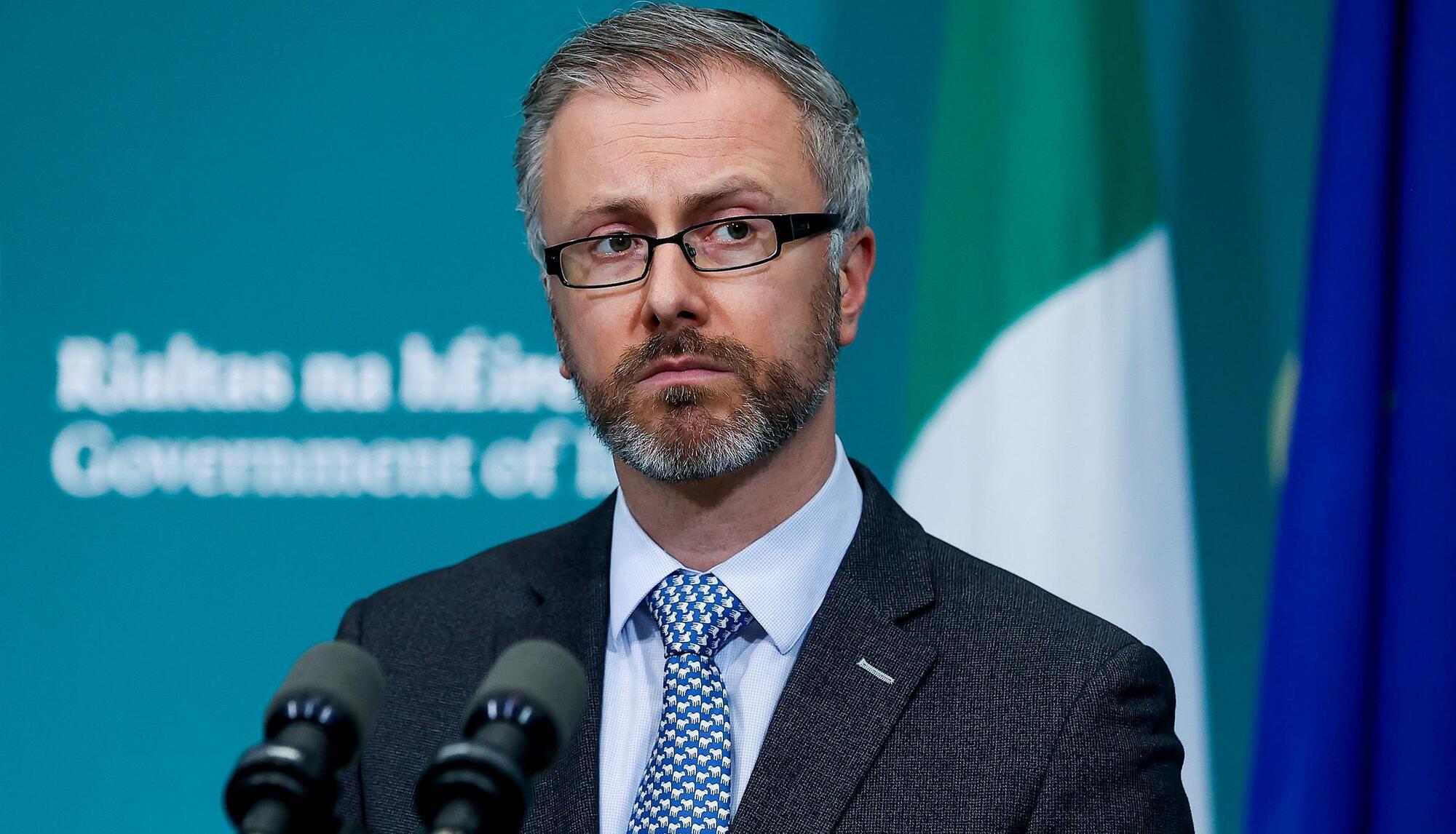
Children's Minister Roderic O’Gorman publishes An Action Plan for Survivors and Former Residents of Mother and Baby and County Home Institutions last November. Picture: Maxwells
Children’s Minister Roderic O’Gorman has said rejecting the final report of the Commission of Investigation into Mother and Baby Homes would have “huge consequences”, as if that were a bad thing.
Surely, that is exactly what we need right now — huge consequences for the myriad wrongs done to mothers and their children, not only in the decades of the last century, but as recently as yesterday when the minister brought a draft memo on redress to Cabinet.
As was pointed out by Deputy Political Editor Elaine Loughlin earlier this week, the €800m redress scheme will be open to only about 40% of survivors, according to campaigners’ estimates. That might even be overstating it, as so many people have been omitted from the stuttering measures to address a deep wound in Irish society.
Imagine the “huge consequences” if we started to put those people first. And included all of them. And recognised that it was not the time spent in those institutions that should be the focus of redress, rather the enduring wrong of forced family separation.
If survivors came first, there might even be a softening around the hard edges of bureaucracy. The minister in charge might stop talking of the “legal complexities” of overturning a flawed and partial report and start the (admittedly difficult) process of developing an inclusive mechanism to compensate for the trauma that continues to reverberate in Irish society.
To be fair, Minister O’Gorman has acknowledged some of the issues.
“The commission’s report is by no means the final word on what happened in this shameful period of our past,” his department said in a statement yesterday.
Yet, a report that dismissed the testimony of more than 500 survivors as “contaminated” will largely inform the redress bill which is now going through the Oireachtas.
The minister has acknowledged the frustration and anger of those who gave evidence to what was termed the confidential committee, only to find that their experiences were not reflected in the final report.
Worse than that — the testimony of their pain and trauma was deleted, and only retrieved after a public outcry.
By then, however, it was clear those lived experiences were not given the same weight as the evidence given to a second committee, the investigation committee. It heard from 64 survivors, 36 of whom gave sworn affidavits.
Whose testimony informs the redress bill then? It is certainly not shaped by the experience of the tens of thousands cast out of Irish society in the last century. It is not even influenced by the hundreds who spoke to the Commission of Investigation but, it seems, by a tiny number who gave evidence to a committee many survivors did not even know existed.
We were promised an independent review of testimony, but that proposal quietly slipped off the agenda.
The minister’s department had this to say yesterday: “An attempt by any Government to repudiate the outcome of such an independent statutory inquiry could have significant and unintended consequences.”
And yet, the State admitted in the High Court last year that the rights of nine survivors were breached when they were not given a draft copy of the report.
It should also be said that a team of 25 academics examined the evidence in the report through a human rights lens and came to vastly different conclusions about the nature and seriousness of human rights abuses at the homes.
Those academics — and many more willing experts in the field — would surely be able to find a way around the “legal complexities” of repudiating the report and crafting a fair redress scheme. It is simply not enough to develop a new initiative, as the minister has promised, to record survivors’ words and have them stand as part of our national record. By doing that, he is consigning a still-live issue to history before its time.
And note that he has spoken of “words” and “voices”, rather than testimony. How can you even consider a redress bill without hearing and heeding that vital evidence?
The State has yet to bear witness to the enormity of what happened. It has yet to acknowledge the scale and the lasting impact of incarcerating unmarried pregnant women and effectively effacing the traces that linked them to their children.
The damage inflicted by the State, Church, and society is still with us. It runs through the lives of those affected like a fraying tear in a bolt of silk. When you peel away the first layer of material, the rip is still visible in the piece below — and below that.
Last week, the Birth Information and Tracing Act came into force, purportedly removing all blocks to an adopted person’s right to information. I hope that it will provide long-denied information for some, because going through life without access to your birth details is a little like the pain an amputee describes feeling in a long-severed limb.
The bill, however, leaves people behind (many mothers and relatives) and, like so many measures in this area, delivers a sharp kick to adoptees by putting up a discriminatory roadblock. They are obliged to attend a mandatory information session on privacy rights if either parent has said they don’t want contact.
It’s interesting to note that twice as many adopted people as parents expressed a no-contact preference on that register, yet they are the ones obliged to attend the information session.
Also, let us recall that an attorney general once said that such legislation was impossible; but here we are with a new bill, if flawed. That just goes to show what can happen if there is political will.
Laws are manmade. (I use the term advisedly because many of those on our statute books have been made by men ignoring, perhaps unconsciously, their effect on women and children.) In the same way that laws are made, they can be unmade, or amended to create a society that allows space for the experience of all its people.
Everything starts with people, or so it seems to me, but it has been a grinding uphill struggle to get the Government to recognise that when it comes to mother and baby homes.

Little wonder Claire McGettrick, co-founder of Adoption Rights Alliance and Justice for Magdalenes Research, describes the State’s recent conduct in this area “as a war of attrition, designed to dilute the energies of the people most affected by these issues”.
And what of the Church? It emerged this week that six religious institutions have yet to agree to pay into a redress scheme, a year on.
It is exhausting and dispiriting and demoralising, but it is too important to stop now.
We cannot allow a half-digested version of the truth stand. By doing so, we are not only failing this generation, but also the next one.