Joyce Fegan: Fixing our great, great housing failure
“We need a mindset shift whereby we collectively believe that everyone deserves a safe place to rest their head at night, regardless of their take-home pay“
Joyce Fegan: Fixing our great, great housing failure

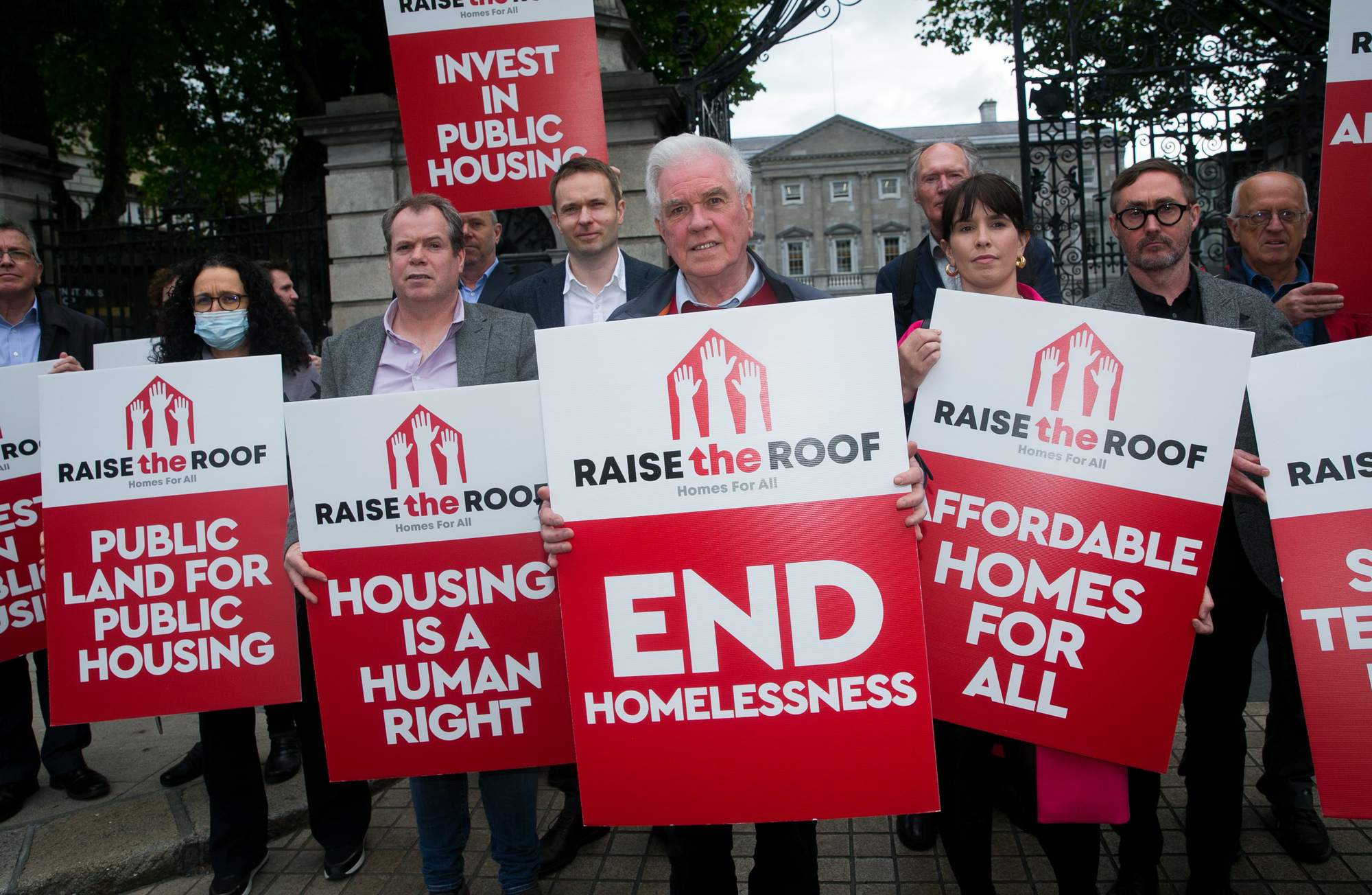
Father Peter McVerry during a relaunch of a Raise the Roof Housing campaign in May. It was the first in a series of regional and national public meetings on the housing crisis outside Leinster House on Kildare Street, Dublin.

This is going on so long.

Far from being helpless victims to an out-of-control mind-of-its-own beast, it’s almost as if we have actively created this housing crisis. We’ve been using that word “crisis” going on 10 years and the word has done little to catalyse change.

This week, a few things came to a head in the world of Irish housing.

Evictions have more than doubled. Between April and June, 1,781 renters were given notice to quit, compared to 841 during the same period last year.

Where will these people go?

This question gets even more pressing when you look at more housing news from the week.

Taking a national snapshot on August 1, there were just 716 homes available to rent across the country, with fewer than 300 in Dublin, as reported by property-listing website DAFT this week.

It’s a record low. And with record lows in availability and supply, come record highs in demand and rents.

The average market rent between April and June was €1,618 per month. In Dublin, it was €2,170, up 12.7% year-on-year, and in Cork city it was €1,670, up 11.8%. It’s up 12% nationally, but up 17% in Waterford and Limerick city.

Winners and losers

With every crisis there are victors and victims: there are citizens getting high rents for their second, third, fourth, and fifth properties; and there are citizens unable to afford high rents, rearing their children in hotels, living at home as an adult, commuting cross country, or else spending their entire income paying someone else’s mortgage knowing full well they’ll never have the privilege of servicing one of their own.

In America, they might say: “Well I worked hard to get where I am” or “You just need to work harder.”

In this current housing debacle, there are plenty of hard workers locked out of home ownership and the private rental market.

One example: there is currently a Ukrainian man who has secured professional employment on the east coast, while his accommodation is in emergency refugee accommodation in a rural location on the west. The job was not hard to come by, but the housing is. He is also the father of two small children with another on the way. His current options, having fled war and secured a professional role, include buying an old car to commute coast to coast or live out of a tent near his new employer. He cannot even find a room for a single male.

How has it come to this? How did a stable democracy, lauded internationally for its social progress, ever end up with a housing crisis such as this?

It’s certainly not the fault of the citizen who finds themselves as accidental landlords contributing to the State’s housing supply, the same way it is certainly not the fault of the hardworking taxpayer who simply cannot afford high rents and to save to buy at the same time.

Legacy issue

It’s a multi-factorial problem and a legacy issue.

Between 2010 and 2016, 300,000 social homes were not built. If they had been built it would have freed up space in the private rental sector. This is from Irish Council for Social Housing (ICSH) in 2019.

Then there is 2013, “ground zero” where very little private or public housing was built.

Funding, not money, is a huge factor too.

Take the example of the Peter McVerry Trust which builds homes for the social housing market. These housing associations can source the money to do so via a mix of state capital and private loans or other means, like fundraising.

The State might lend up to 30%, you’ve got to raise the rest yourself.

This mixed-funding model was first introduced here in 1984, with housing associations receiving up to 95% of the cost via State capital. In 2010, this amount was drastically cut.

But the whole idea behind it internationally is one of stability: using the mixed-funding model of social housing makes it less susceptible to the boom and bust cycle, as it is not reliant on State capital expenditure.

In other words, we don’t stop building social housing overnight and for years on end, with the knock-on effect of pushing people into homelessness in their thousands. We don’t inundate the private rental market, which has the effect of increasing rents no end too

It’s all dominos but it’s no game because it’s boys and girls and single males and women fleeing domestic abuse who are bearing the brunt of all of this.

And there are no winners. Because like everything, it actually is a rising tide that raises all boats.

Housing shortages lead to economic instability and intensifies inequality, according to the 2004 Barker Review of Housing Supply in the UK.

Inequality is actually bad for economic growth.

Housing, lots of people in secure predictable homes, is also one of five key factors that contribute to economic stability.

Housing for all is good for all.

It’s not ideological, it’s just basic business sense.

Stop for a minute and think about the 10,000 plus people in homeless emergency accommodation in Ireland, the doubling in evictions, the 12% increase in rents, the fact that there were only 716 properties available to rent in Ireland on August 1, and despair.

But if policy got us into this mess, then policy, of a different ideology, can get us out of it.

There is the cost-rental model where the State or housing associations build high-quality homes and the rent is used to cover the cost of construction over the life of a long-term building loan.

We’ve already done this here.

There are also creative ways to raise funds where large companies make equity investments in housing associations, therefore allowing them to access State capital to build permanent rent-producing homes. There is at least one project of this kind already in Ireland.

These are all win-win scenarios. They might sound complicated when we start using words like funding and phrases like “State capital” but it’s basic. It’s about a roof over your head, nothing more, nothing less.

The core issue is accessing the will to find the way.

There is no silver bullet, no quick fix. Instead, we need a multi-pronged approach that includes a mix of public and private housing solutions. 

But most of all, we need a mindset shift whereby we collectively believe that everyone deserves a safe place to rest their head at night, regardless of their take-home pay. No one should have to earn their right to safety.

More in this section

Revoiced

Newsletter

Sign up to the best reads of the week from irishexaminer.com selected just for you.

Cookie Policy Privacy Policy Brand Safety FAQ Help Contact Us Terms and Conditions

© Examiner Echo Group Limited