Bríd Stack: 'The quick turnaround means it’s feasible to squeeze in another season. Will I be back? I don’t know.'
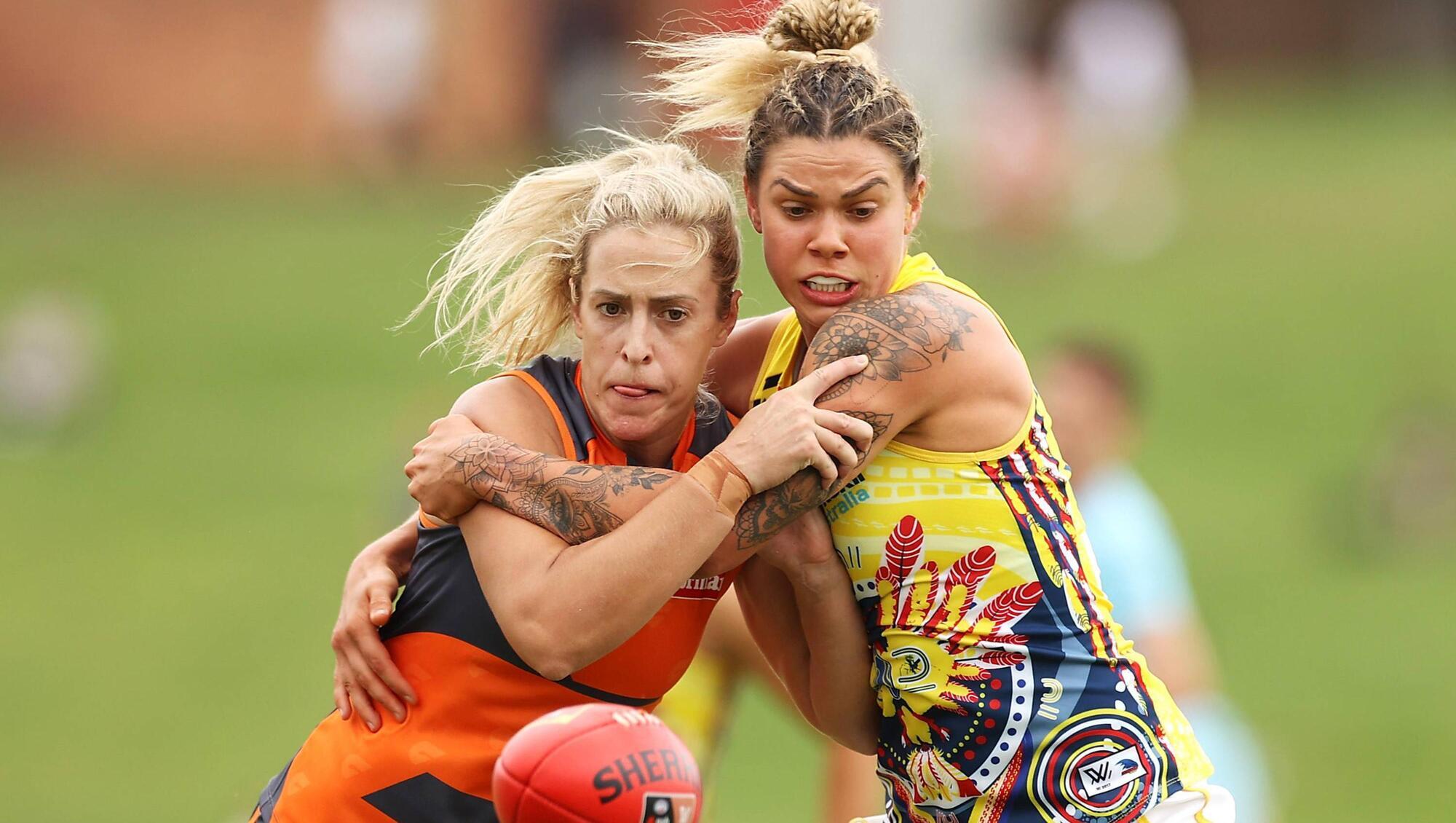
Getting to grips with it: Bríd Stack of the Giants and Anne Hatchard of the Crows compete for possession at Henson Park last month. Pic: Mark Kolbe/Getty Images
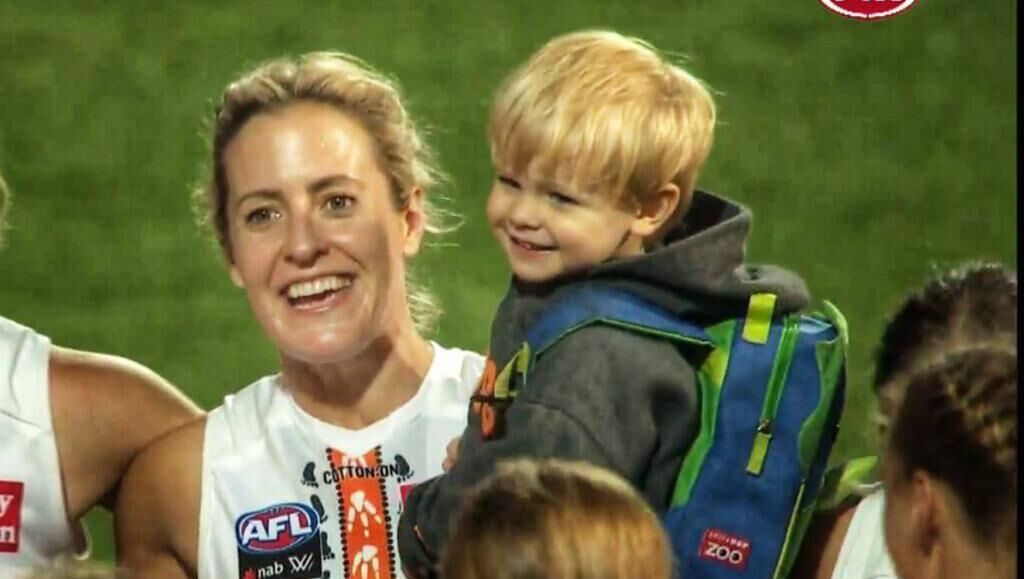
At the end of our last match of the season against Geelong, Cárthach dropped Ógie into my arms for us to sing our team song one last time in our circle. It was a wonderful moment. Nearly two weeks on, the tune is still in my little boy’s head — on Monday night, I heard him trying to sing it on his own around the apartment.
Sitting in the dressing room after the Geelong game, I found myself pensive when I started to process the last few months, and the journey undertaken. I had played all ten games. To be honest, I wasn’t sure if my body would hold up under the rigorous schedule. There were always question marks coming back a year older. Would I avoid injury? Would I be selected? Would I be up to the required standard in my first season? I know now that I was.
I was very happy with my lot at that point. I was content that I had that box ticked until the news broke last week about the restructuring of the AFLW, which will see the season start in August, with pre-season beginning in June.
I suddenly found myself weighing up stuff that I thought I had made my peace with. If the season remained as it was, there was no chance I was committing to another year, but this change has stirred things up.
The quick turnaround means it’s feasible to squeeze in another season without too much downtime. And there’s no doubt about it — once you decide to retire, you’re a long time retired.
Was I fully happy with my performance this season? Far from it. There’s always room for improvement and now that I have developed some confidence at the sport, you want to see can you push on. I now know what is expected of me out here, I know the set up and I know my teammates. With the new season only around the corner, could I give it one last shot?
But the reality check arrives swiftly after this idyllic way of thinking. There have been substantial loss of earnings for both Carthach and I. We both have two very patient school principals, and two even more patient business partners. Our loving families would also despair at the thought of us going away again.
We have three sibling weddings in the next year, with my sister Muireann being one of them. The organising has been done over WhatsApp video up to now but the summer was pencilled in for some elite wedding dress shopping and all that goes with it.
And most importantly, we’d love to extend our own family with a little brother or sister for Ógie. Please God it will happen. It’s not always a given. So, there’s is a lot to weigh up.
*****************************************
Another part of me is asking myself why would I even consider going back? I found this year very challenging from a team performance point of view and trying to juggle all that comes with being so far away from home with a small child.
I also found out just how institutionalized I am from the GAA and especially from my time with the Cork ladies. I struggle sometimes to fully understand the professional way of thinking, and that this is a business at the end of the day.
I’ve definitely been given a greater appreciation of what we have at home. Our Gaelic games are like nothing anywhere else. That is obviously tinged with bias and love, but I don’t think anyone outside of Ireland would ever fully understand what it means to play GAA and represent your people in the process.
Maybe I find when you’re losing at home that it’s easier to galvanise and rally people. There’s a real sense of purpose and pride attached to Gaelic games. But when you’re losing over here, it can become very individual orientated. Once the win is going away from you, it’s easier for players to start thinking, ‘Right, what can I get out of this for myself’.
A lot of that is heightened by the stats culture that exists here, which for me, has a massive capacity to promote individualism within a team environment. Immediately after the game, the stats on every single player on the ground are made public. For me, unless there is a strong team culture which has a collective buy in from all players with clearly established goals, comparisons are inevitable.
No matter what way you dice it, the top stat here in the AFL is the number of disposals. A disposal is when the ball is moved by either hand or foot from one player to another player.
AFL is very much a territory game due to the high level of pressure that surrounds a player in possession of the ball and the need to get ball out of dangerous space quickly. However, the efficiency or accuracy of disposals for the most part, is irrelevant when media, coaches and almost everyone else lauds players for their numbers.
This in itself leads to players chasing numbers, whether they like to admit it or not. The MVP after every game is usually the player with the most disposals, and not the player who scored the most or tackled or worked the hardest. This never sits well with me, but that’s easily said having come from a possession-based game that doesn’t allow an aggressive tackle.
Don’t get me wrong, there are plenty of selfless players in the competition. I’m lucky to play alongside a lot of with the Giants. And against them too - Sinead Goldrick from Dublin, is the epitome of a selfless player with Melbourne.
Yet the exploits that scream of selfless team play such as a block, a spoil or the creation of space, that Goldie and a lot of the Irish do so effortlessly, do not carry numerical value. Being a team player at home is rewarded far more, but it’s a totally different mindset here.
Numbers talk. The media are obsessed with stats and as we come to the end of the season here, already the individual awards far outweigh any team-based awards.
Of course, there are so many perks to being a professional athlete. Front and centre has to be the time that you can allocate to rest and recovery. Getting used to a full contact sport, playing week in, week out, while also balancing being a parent, meant I needed every bit of recovery I could get.
There’s no denying you have wonderful access to state-of-the-art resources and I made sure to avail of all the additional help I could get in the form of extra coaching sessions, feedback sessions, use of recovery equipment, access to vision and thorough medical care. I was even lucky enough to have a sponsored car this year, which I would never have gotten at home.
I can safely say I’ve never received so much feedback in my life. Prior to every game, you do an opposition team review and an opposition line review. My line review was with the backs and meant we discussed best match ups and game plans. Following a match, you have an individual review with your line coach, as well as a review with Alan the head coach, on top of team review to discuss what went right and what needed improvement.
At home, we don’t get anywhere close to that level of feedback, predominately because you just don’t have the time in an amateur set up. To be honest though, I didn’t mind it during my career with Cork.
You knew yourself when you got the better of your opponent and you certainly knew when they got the better of you. You don’t need stats to tell you that. Feedback is obviously essential to improve standards and improve players, but sometimes less is more. You don’t get too many pats on the back during a playing career at home but when you do, you know you earned them. And they mean so much more.
However, in any professional sport, feedback and reviews at this stage of the season are inevitable and part and parcel of such an employment. It’s especially understandable when the club are trying to get to the bottom of why we underperformed as a playing group.
*****************************************
The last few days have involved a flurry of reviews and exit meetings, from medical, to S&C, to physio as well as the all-important coaching exit meeting with Alan, the head coach, Bri, head of operations, Lloyd, our assistant coach and Gail, the welfare officer.
We knew the start of the season was always going to be a big challenge coming up against four of the big guns in the competition, but we still expected to finish much better than we did.
Our tendency to get off to poor starts raised its head often and we found ourselves consistently under the pump and always chasing matches. A disappointing loss to Carlton meant we were ruled out of a final six spot and the mindset of the group was beginning to be seriously questioned.
The poor start epidemic continued into our last two matches against Richmond and Geelong. We gave ourselves a mountain to climb in the first quarter against Richmond going behind by 32 points. Thankfully, the grit was there to claw it back to eight but the damage was done.
By the time we got to Geelong, a lot of the squad were fed up with how the team was functioning, especially around contest. We did change it up but that was more out of necessity than any intentional structural change; two midfielders were out with concussion while another was unavailable due to suspension.
It took the young replacements a while to get to grips with the pace but once they did, they brought so much energy and cavalier attitude to our game, which spread all over the field.
We stormed back to record one of the club’s greatest comebacks, which was also our biggest winning margin all season. It was a great way to end the season, especially after how the team had underperformed for so much of the campaign.
You can find all the excuses in the world to dole out the blame for so many underwhelming displays; 11 new players, significant injuries, Covid withdrawals but none of that sits easily with me.
Every team experiences difficulties and setbacks, but your mindset, and how you respond to those obstacles, determines how well you react. I feel that really needs to be worked on with this group, especially growing team culture and developing consistency, because lack of talent isn’t the issue.
Big change is needed but big change is coming with the AFLW set for expansion from fourteen to eighteen teams. The introduction of the Sydney Swans AFLW team has the potential to dilute the talent pool already available in New South Wales.
Time will tell too for the Irish interest going forward. It’s going to be a massive headache for those currently playing and those that have aspirations to play AFLW. A pre-season starting in June would mean girls having to miss county and club commitments at home if they decide to commit, which is a massive decision to have to make.
Will I be back? I don’t know. We have our apartment here in Sydney until the end of April, so we’ll head back home then. I have two close friends’ weddings in May so I’d be excommunicated if I didn’t show up for those. It was bad enough having to miss the hen nights.
We definitely missed home a lot more this year, especially at Christmas and St Patrick’s Day. The fact that Cárthach Óg is getting older and brighter too has made us reassess what is really the best for all of us.
He really misses his grandparents on both sides. When we rang my parents on Paddy’s Day, we were on the phone for close to an hour. At the end he said, ‘I want to go to Nana and Gaga’s house’.
Not yet Ógie but soon. Soon.