Alison O'Connor: Armagh service was meaningful, and President Higgins should have gone
Feelings would already have been running high on both sides — understandably — but this unforgiving attitude that currently pervades across almost all societies has certainly heightened the response to this ceremony and shown the real need there was for leadership, writes Alison O’Connor.
Alison O'Connor: Armagh service was meaningful, and President Higgins should have gone

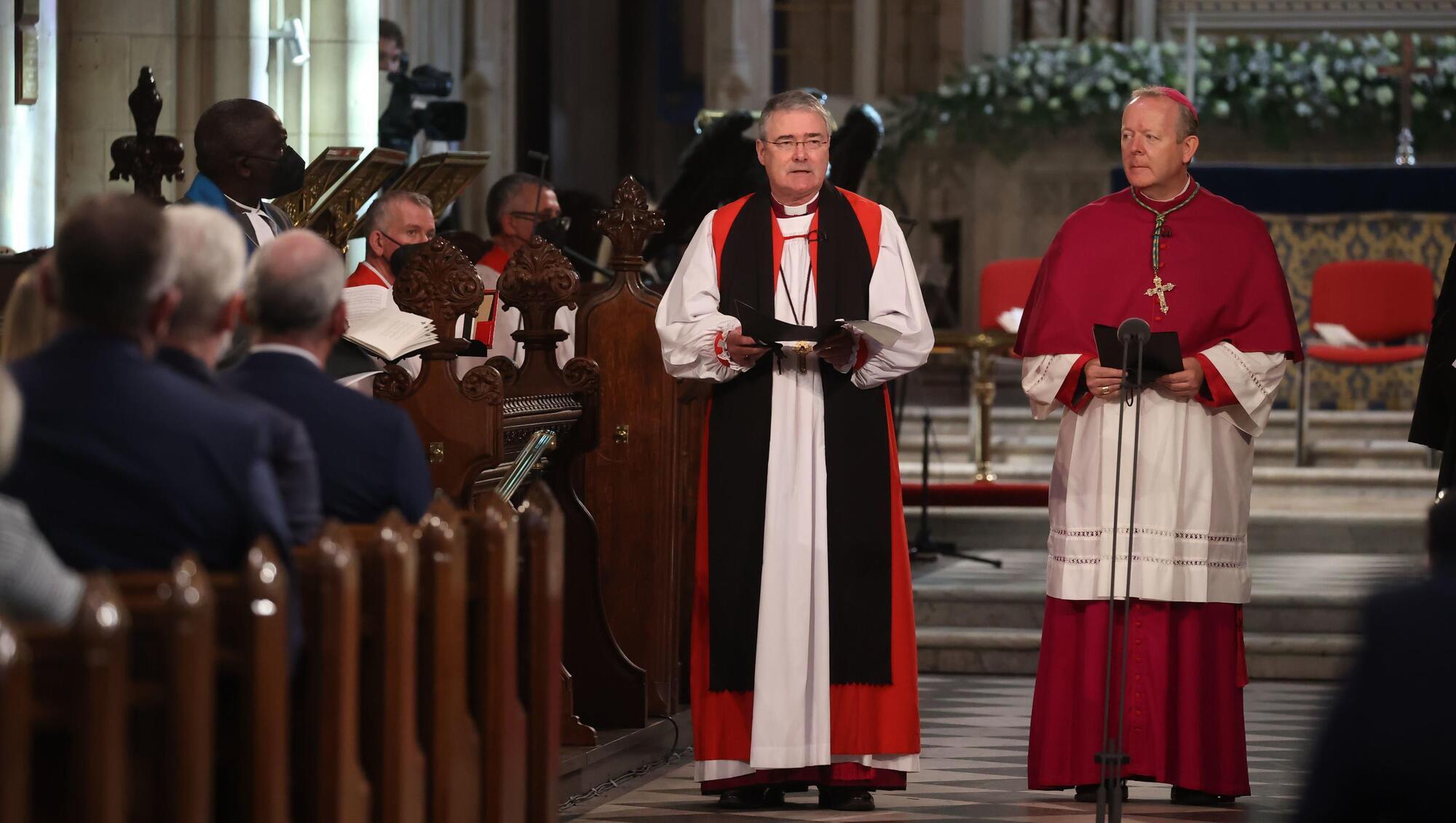
Archbishops Francis John McDowell and Eamon Martin during a service to mark the centenary of Northern Ireland at St Patrick's Cathedral in Armagh. Picture: Liam McBurney/PA Wire

Even homer nods. For all you Michael D Higgins fans out there, even a very good President can make a mistake. Ours did so in not being present in St Patrick’s Church of Ireland Cathedral in Armagh today for the service to mark the centenary of partition and Northern Ireland’s foundation.

On a crisp but lovely morning, people gathered on what the Dean of Armagh, Rev Shane Forster, described as “this ancient hill of Armagh” in “this ecclesiastical capital of Ireland” where St Patrick established a faith community and church over 1,500 years ago.

To say there was many the slip between cup and lip ahead of this service hardly does the situation justice. We do not know exactly the circumstances of what occurred once President Higgins decided he was unhappy with aspects of the event, especially the description of it being a “service of reflection and hope to mark the centenary of the partition of Ireland and the formation of Northern Ireland”.

Just ahead of proceedings yesterday, the Church of Ireland representative said there was no guest list to issue to the media as “a lot of these people are involved in quiet peace-building work”. Not to mention that no journalist would be able to tell if yet another significant invitee did not turn up.

The news had previously broken that Queen Elizabeth would not be attending after getting medical advice to rest for a few days, but that British prime minister Boris Johnson would be. 

After so many decades of service, Queen Elizabeth — at 95 years of age — needs to make no apology to anyone if she needs to put her feet up.

But in any case, it would have been a protocol anomaly to not have had her equivalent, our President, had she been in attendance. Instead, we got that man so well known for making things better when it comes to Northern Ireland — Boris.

Foreign affairs minister Simon Coveney, British prime minister Boris Johnson, and Archbishop Eamon Martin. Picture: Liam McBurney/PA Wire

It was President Higgins’ prerogative not to go, but I’ve no doubt that if he had attended, along with the queen, the photograph of the two of them would have been on the front of this newspaper tomorrow morning. In this depressing Covid-laden week, such an image — let’s imagine them both smiling — would have brought a much-needed moment of optimism, as well as being of wider importance in the current, very edgy, situation in the North.

His refusal of the invitation resulted in a domino effect where Sinn Féin — despite attending similar events — stayed away. It also resulted in some objections from the rank-and-file in Fianna Fáil at the attendance of chief whip Jack Chambers, who accompanied foreign affairs minister Simon Coveney. Both were seated together at the front.

Those who pointed to the self-serving responses of loyalists to all this hardly brought news to any of us. It did nothing to back up the non-attendance argument, indeed it served to only emphasise the value in such a service taking place.

Even those who pay the most casual of attention to the situation in the North will know that the political situation has been rockier of late than it has been for a very long time. The edges of the Good Friday Agreement are becoming frighteningly frayed. Surely a group of church leaders — from across the community — who were making a serious effort to co-operate on a “collective programme of engagement with the 1921 centenaries” deserved the benefit of a few doubts.

Children from local schools sing during the service. Picture: PA Wire

During the service, there were prayers in Irish, involvement of children from “local, maintained, controlled, and integrated schools”, as well as a choir of children from different backgrounds from the local area.

There was mention of “memories of hurt and injury”, and how we might “set aside divisions of the past, celebrate our shared present and re-commit ourselves to working for a future of common understanding, respect and peace in this land, in these islands and throughout the world”.

President of the Methodist Church in Ireland, Rev Dr Sahr Yambasu, gave the sermon. 

He acknowledged that we have been blighted by sectarian divisions, terrible injustices, destructive violence, and win-lose political attitudes. 

"And for this, we have cause to lament," he said. 

"So this service provides us with an opportunity to give thanks and, also, lament; to imagine what could be, and to choose the way forward that can be mutually beneficial.”

Bringing an interesting and relevant perspective to all that has gone on, he mentioned being born and raised outside of the island of Ireland in Sierra Leone — on the continent of Africa. He spoke as one whose people “were bought, sold, and used for profit; whose continent was partitioned without any reference to or consultation with its inhabitants and owners; and whose colour is seen as sufficient excuse to ignore their equal humanity with others”. 

President of the Methodist Church in Ireland, Rev Dr Sahr Yambasu speaking the service. Picture: Liam McBurney/PA Wire

He continued: “Consequently, I have spent the last 26 years on this island negotiating my acceptance as of equal value with Irish people.”

In his contribution, Archbishop Eamon Martin spoke of growing up in Derry and how his home city was cut off from its “natural hinterland in beautiful Donegal” where they would travel to visit his granny.

The archbishop, who has been bruised by the controversy surrounding the service, and subject to some horrible abuse on social media, also spoke of loss and sadness because for the past 100 years partition has polarised people on this island, institutionalised difference, and remains a symbol of cultural, political, and religious divisions between our communities.

As a Church leader now reflecting on the past 100 years, he said that perhaps those in the Church had “to face the difficult truth that perhaps we could have done more to deepen our understanding of each other and to bring healing and peace to our divided and wounded communities”.

On first hearing that President Higgins was turning down this invitation, I thought about it for a little while and decided he had a good record in this area and it was the correct decision. I said so publicly on a radio programme. 

A few weeks later though, after thinking about it further — a lot further — I said on the same programme that I had got it wrong and had changed my mind. 

It says a lot about where we’re at now that even the fact of having a change of mind on something and stating it in public was deemed remarkable by some. 

Feelings would already have been running high on both sides, understandably, but this unforgiving attitude that currently pervades across almost all societies has certainly heightened the response to this ceremony, and shown the real need there was for leadership. 

It is not a straightforward situation — perspective is everything here — but surely we are mature, and indeed sophisticated enough to recognise the importance of being seen to mark this event through a contemporary lens.

There was much bungling behind the scenes on this one. Where did it all fall down between Áras an Uachtaráin and the Department of Foreign Affairs? Was it felt the President might be persuaded to change his mind on not going, but no proper effort made to bring this about?

Not marking something does not erase it, or mean it never happened. It’s all in the manner in which it is carried out. 

There was nothing to criticise about yesterday’s meaningful event as it happened. President Higgins should have gone.

More in this section

Revoiced

Newsletter

Sign up to the best reads of the week from irishexaminer.com selected just for you.

Cookie Policy Privacy Policy Brand Safety FAQ Help Contact Us Terms and Conditions

© Examiner Echo Group Limited