Women’s football is finally coming home
In many households, I’ll wager, it’s no longer the ‘Women’s World Cup’; it’s just the ‘World Cup’ now. Thanks to unprecedented levels of coverage on RTÉ, TG4, and the Beeb, the 2019 tournament in France has taken up residence in people’s lives, become part of the summer furniture, a highlight of the daily football fan’s routine.
For Lisa Fallon, steeped in the game, late of the Cork City coaching staff and someone whose astute and engaging analysis for RTÉ has added hugely to the impact of the station’s extensive coverage, this tournament feels like a game-changer.
“When I was growing up, I never got to see women’s football on television and I think this is an incredible opportunity for a whole generation to see female players and have new role models,” she says.
“Just to have that in people’s front rooms is a whole different experience. It feels quite powerful at the moment but it’s only with time that I think we’ll see just how much of a legacy this World Cup will leave for girls in this country and everywhere else.
"It’s hard to quantify it now but I think in four years’ time, when the next World Cup comes around, we’ll know then the real significance of what’s happening in France and the significance of the coverage that it’s getting.”
But the signs, she believes, are encouraging.
This is the first time, really, that people have had an almost relentless opportunity to see women’s football. People used to say that there was no demand for it but now it’s there and people are watching it. It’s reaching people.
“One thing I’m definitely noticing is that any time I get into a taxi they’re talking to me about the women’s game. Now, that’s never happened to me before!”
While much has been made of the gulf between the elite nations and the minnows in France — as exemplified by the USA’s controversial 13-goal demolition of Thailand — Fallon insists that people should never lose sight of the obstacles so many female coaches and players have had to overcome to get to where they are now in the world game, even if, by the highest standards, they still have a long way to go.
She cites the “endurance and resilience” of a trailblazer like South African coach Desiree Ellis as just one inspirational example of girls and women who had to “fight for their right just to be involved in the game” long before they could ever dare to dream of participating in a World Cup.
She also points out that the gender discrimination case over pay inequality and working conditions currently being taken by the American team against the US Soccer Federation could ultimately have worldwide ramifications for the women’s game.
“That raises the bar for all the other nations, for the likes of Thailand when they do catch up,” she says.
“The significance of this World Cup in not just on a football level, it’s very much on a sociological level too. They are contrasting legacies but every team involved in the tournament is leaving a legacy in their own country.”
As for the controversy sparked by the Americans’ unfettered celebrations as they racked up goal after goal against the Thais, Fallon is clear where she stands.
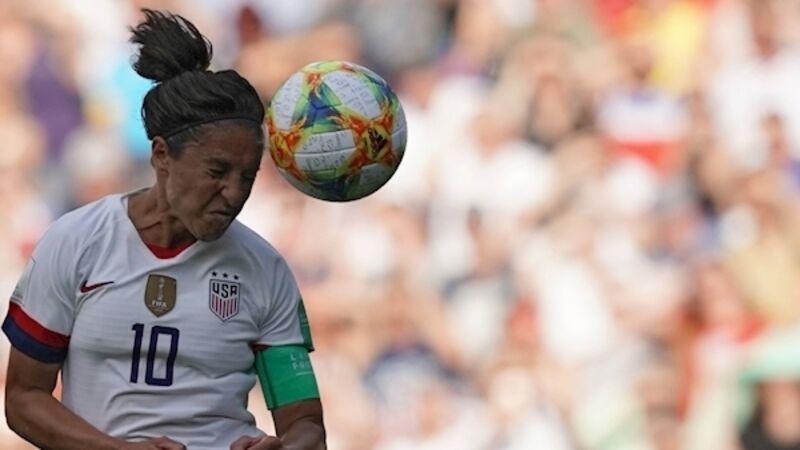
“When you play at the very highest level of the game,” she says, “the ultimate respect you can give your opponent is to be at your best and not relent. When the USA got goal number nine, to some people that goal might have been irrelevant. But they had the world record of 11 as a target and when they broke that record how could they not celebrate that? And goal number 13 was scored by Carli Lloyd — and there’s no way she wasn’t going to celebrate that either, coming off the bench to score in her third World Cup.
“That point can’t be lost: each of those goals meant something to those players for different reasons. And I think you have to celebrate those moments because they don’t come around very often.”
For all that the World Cup in France is helping to put flesh on the bones of the notion that “you have to see it to be it”, Fallon accepts that probably the biggest game-changer for women’s football in Ireland will only come with the senior team’s longed-for first-ever qualification for a major tournament.
That quest resumes again in September as the girls in green set their sights on the finals of Euro 2021 in England, with Colin Bell’s team looking to qualify from a group containing Germany, Ukraine, Greece and Montenegro.
For now, some of the people who will be expected to play key roles in that campaign — the likes of Bell himself and established internationals Stephanie Roche, Megan Campbell, and Louise Quinn — are lending their expertise to the television coverage of this World Cup, something which Fallon believes is also a positive step in promoting interest in the national team.
“The fact that people are seeing the Irish manager and some of the current Irish players involved in the punditry and the analysis is important,” she suggests.
“In an indirect way, it means there’s still an Irish involvement in this World Cup. And, having spoken to Colin and some of the girls, I’d like to think that Ireland qualifying for one of the big tournaments is not too far off. They genuinely believe it can be done. And, not that they didn’t try before, they certainly have, but I think this tournament has really whetted the appetite.
“Colin was saying he wants Germany to win it because he wants Ireland to be in the group with the world champions for the next Euros. He wants to take them on.
“There are girls out there, and Irish players, listening to that and that’s what you want them to hear. I’ve no doubt that it can be achieved. I just hope it’s sooner rather than later.”
Meanwhile, Germany are certainly serious contenders to lift the trophy in France and while Lisa Fallon would also add the hosts and European champions the Netherlands to the shortlist of potential World Cup winners, she thinks the current holders and three-time winners, the USA, remain the team to beat.
“But it’s not an easy one to call, which is good,” she says. “And it’s only now that we’re into the last 16 that the
competition has really kicked off and we are getting to see some of the heavyweights going up against each other. It’s cup football now.”