You have to hand it to great apes
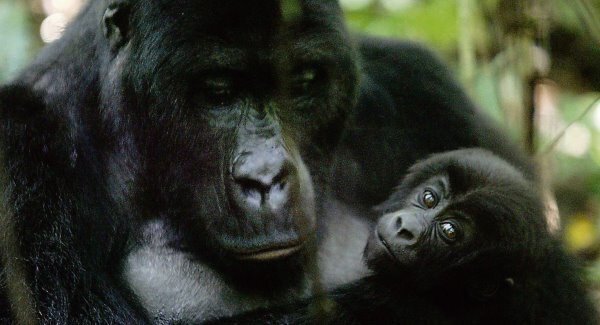
Mothers cradle their infants with the left, rather than the right, arm. So do daddies. Babies too, seem happier when on their parentsâ left. Why is that side preferred? Some candidate explanations come to mind.
Most mothers are right-handed; cradling to the left frees the more dextrous right limb to minister to the child. Against that, it would be easier to carry an infant with the stronger right arm.
Perhaps the position of the motherâs heart is the crucial factor; its beating, heard for months in the cosy security of the womb, might reassure the little one. Do cradled babies feel their mothersâ heartbeats?
Great apes, our nearest relatives, also hold their babies on the left, so the cradling preference probably has an ancient evolutionary lineage. How far back does the trait go? Karina Karenina and colleagues at St Petersburg State University looked for side-of-body preferences in adult-young relationships among a range of mammals. Their results appear in a current edition of Nature Ecology & Evolution.
The team concentrated on âfollower-typeâ species, in which mothers and young travel side-by-side. Such parents donât cradle their babies, but reunions of pairs following short separations might reveal preferences for a particular side of the motherâs body.

This was one of five mother-infant behaviours examined. Another was the relationships adopted when pairs were resting or moving.
Almost 11,000 position choices by 175 âslow-travellingâ mother-and-baby pairs were logged. These included observations of horses, sheep, reindeers, whales and kangaroos. In 11 species, âthe majority of infants (74%-90%) preferred to keep mother on one side (left or right) rather than the otherâ.
There was âa preference to keep mother on the left side, compared with right side, in infants of all speciesâ. Suckling foals and antelope calves generally approached from the motherâs right. Young horses engaged in more bonding behaviour, and became separated from their mothers less often, when on that side. This was true also for walrus mother-and-baby pairs.
The sex and age of a youngster didnât matter and the âbias existed in infants, not only in routine behaviours, but also in stressful situations, such as fleeingâ. Although primate mothers, including human ones, hold their babies on the left, they interact with them on the right. Resting reindeers were an exception to the left-side rule.
âLateral preferencesâ are not confined to mother-baby relationship. Musk-ox calves usually approach other calves from a particular side and bias is also found in interactions between adult animals.
Great apes like to keep other adults on their left side. Long ago, people everywhere travelled on the left side of the road, keeping the right arm free to ward off highwaymen and muggers. A leaderâs âright-hand manâ sits on that side; should he decide to stab his boss in the back, heâll have to use his weaker right arm.
Five out of six young Australian magpies, in a 2006 study, consistently presented their left side when food was offered. There are many such examples of animal handedness. The St Petersburg research shows that lateral bias is present in mammals but the trait may well pre-date them. More research is needed on this.
Why did the mother-baby bias arise in the first place? The eyes of creatures such as deer horses and whales are located towards the sides of the head, giving them limited overlapping vision; an infantâs behaviour would be monitored using one eye predominantly.
Calculation and rational thinking are carried out in the brainâs left hemisphere. Social and emotional matters, âfor example visual recognition of infant facial expressionsâ, are handled by the right hemisphere. By accessing the baby from her right, the researchers claim, a mother is better able to âoptimise maternal monitoringâ.