Dear Sir... Readers' Views (3/12/16)
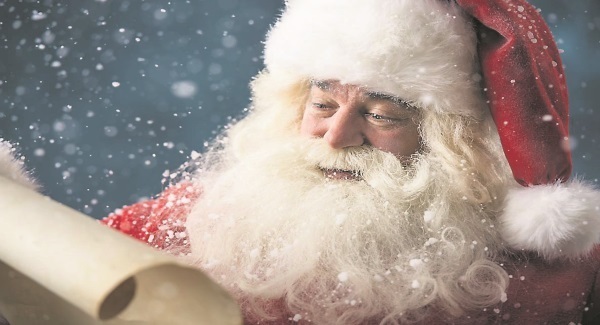
Santa’s waiting for your letters
Greetings from the North Pole!
Christmas is fast-approaching and the elves are working at full pace to get all the toys and gifts ready to load onto the sleigh this Christmas Eve.
Letters are pouring in from all around the world, so I would like to remind all the boys and girls in Ireland to write and post their letters to me as soon as possible.
All that the boys and girls need to do is:
Write their letter and pop it in an envelope addressed to ‘Santa Claus, The North Pole’;
Write their own name and full postal address (in clear handwriting) on the top left-hand corner of the front of the envelope;
Stick on a 72c stamp and post it in any post box, or at your local post office.
It’s that easy! My good friends in An Post will make sure your letter reaches me safely, and they’re helping me to reply to as many children’s letters as possible, before Christmas.
I wish all your readers a happy and peaceful Christmas.
A cautious welcome
Welcome Pope Francis to Ireland in 2018, but conditionally and in a spirit of respect for the intelligence of the Irish people to debate and question Catholic Church doctrine.
The laity are the Church — without congregations there is no Church. Irish Catholics are no longer the sheep, but rather a well-educated congregation of a la carte Catholic believers, who will no longer be preached to as an unquestioning, servile herd. As the Pope plans to host a Catholic Church family congress in Dublin, let the Catholic Church show much greater equality to women and mothers as equal stakeholders in Catholicism, at every level.
We want the Catholic Church, which Pope Francis leads, to reciprocate our welcome, by apologising unequivocally for the Church’s misdeeds in our country.
Perhaps what has changed in Ireland since the now canonised Pope John Paul I’s 1979 visit is that the Catholic Church’s history in our country has been exposed and involved a gross breach of trust. Our welcome this time will be rather more muted and conditional.
Human cost of alcohol
Once again, the alcohol industry has had the Public Health Alcohol Bill deferred by portraying the small retailer as an innocent who would suffer greatly as a result of product separation.
The bill was said to be cost-prohibitive. Closure and job losses were predicted. The alcohol industry, along with IBEC, RGDATA, and ABFI, continuously repeated the message that this measure would mean the end for small retailers and they convinced politicians that this would be the case.
The bill was never meant to prevent anyone from selling or purchasing alcohol, but to protect young children from exposure to alcohol and to reduce consumption. The sale of alcohol in small shops would continue even if this bill was implemented, but the industry fears that sales will decrease. This is the first part of the bill to come under attack.
At no stage in the arguments supporting the small retailers do we hear a mention of the other innocent victims, the three people who die every day as a result of alcohol abuse, the 50% of suicide victims in whose death alcohol is a contributing factor.
These are all real people, who leave behind families whose suffering is far greater than any retailer’s loss of revenue.
Five years ago, my family lost our only son, David, to suicide, after he attended a house ‘party’. The coroner said that the level of irresponsibility at the party, which was fuelled by alcohol, was damning and it was a sad reflection on society. David was 19. Our last duty as David’s parents was to organise his funeral and his burial and to erect a headstone in his memory.
The monetary cost of that was probably greater than any incurred by small retailers as a result of product separation. We didn’t lobby any TDs or senators and tell them that the cost was prohibitive. We paid what was due and got on with dealing with our loss. If there is one thing I have learned in the past five years, it is this: In politics, sympathy does not always mean support.
Irish Water stupidity
It was crazy to say we should not have to pay for water. Rain is free, but water has to be treated and distributed. This all costs money. However, the way the previous government tried to introduce water charges was stupid.
The political squabbling over water charges left us without a functioning government for many months after the general election.
But water charges were relatively small compared to property tax, the universal social charge, and many other austerity measures. We have all suffered from nine years of austerity, but the root cause was the disastrous decision of 2008 to bail out the banks. Whatever about helping out Bank of Ireland and Allied Irish Bank, there was absolutly no reason to bail out the toxic Anglo Irish Bank.
This bank did not lend mortgages to ordinary people, but just to the elite.
To date, only three bankers have been jailed, albeit with light sentences, and of the two bankers mainly responsible, one is before the courts, at present, while the other is stiil awaiting trial next year. This individual, while hiding out in the United States, was imprisoned there as a dangerous criminal. Now extradited back to Ireland, he is free to do another runner.
We should have taken to the streets en masse when our government bailed out toxic bankers. Where did we all think the money would come from, except from our pockets?
The introduction of water charges was just too much to take on top of all the other austerity measures. Finally, the people woke up and realised they were being robbed by the political elite and took to the streets in protest.
To this day, I fail to understand why we had to bail out one, small, toxic bank. Ireland’s GDP is less than 1% of the GDP of the EU. Why, then, were we told that the failure of one, small bank would lead to the downfall of the whole European banking system? It beggers belief that the mandarins in the Department of Finance fell for this blatant lie.
Kilvere
Kindness of hospital staff
I would like to say a very big ‘thank you’ to the staff of Cork University Hospital’ for being kind to me yesterday. I was very nervous for the pre-op, so they could put chemo into me today. The doctor, surgeon, and nurses were so reassuring. I am so grateful to you and want to say thank you.
Historic links with Cuba
As someone who has travelled around Cuba, I’m disappointed with the reaction of so-called moderates to the death of Fidel Castro. A number of Irish immigrants have made Cuban history, from Spanish colonial times to the early republican era.
Names such as Byrne, Madan, O’Donnell, O’Farrill, and O’Ryan all have streets named after them throughout Cuba.
In Havana, the name O’Farrill is prominent in the old city.
The surname O’Farrill, whose roots can be traced back to Co. Longford, appears in the family tree of almost all the Havana families with noble titles.
One of the main streets in Havana Vieja (the old city), Calle O’Reilly, gets its name from General Alejandro O’Reilly, who was born near Oldcastle, County Meath. General O’Reilly is best-remembered for having organised the military forces on the island and particularly the black militias in the latter half of the 18th century. In his honour is a wall plaque on Calle O’Reilly, inscribed in Spanish, Irish, and English, with the words: “Two island peoples in the same sea of struggle and hope, Cuba and Ireland”.
One of the general’s descendants, Robert Maitland O’Reilly (1845-1912) was surgeon general in the US army from 1902 to 1909, and was also personal physician to US president, Grover Cleveland, who served two separate terms.
I believe the words of US president, Barack Obama and of Ireland’s President Michael D Higgins, and of Canadian prime minister, Justin Trudeau, were tone and pitch appropriate and neither disrespected the living nor the deceased, as Cuba mourns its loss.
Assortment of politicians
‘Charisma’ is a synonym for being able to lie to the masses with ease, and politicians, by and large, are very much like overgrown, spoiled children.
Like Veruca Salt, the girl from the Roald Dahl novel, Charlie and the Chocolate Factory, they want it all, and they want it now.
Trouble is, most politicians have the backbone of a chocolate éclair. The great political divides of our times are between milk and dark chocolates. Milk chocolates are sugary and sweet, and dark is bitter and tasteless. It is only when crisis strikes that we discover whether politicians have a tough or a squishy core.
Maybe we need look no further then President ‘Forrest Gump’, alias Donald Trump. “Mama always said politics was like a box of chocolates. You never know what you’re gonna get.”