Surfing the wave is great — just don’t forget the inevitable crash
IT IS strange what shakes the world. Joining the queue to shake down the exchequer is the Irish Medical Organisation. It wants restitution of a “living-out” allowance to cover doctors on call; accommodation is not provided. Lots of people are on call in jobs that do not provide accommodation. A “living-out” allowance doesn’t arise.
But if the IMO, led by Dr John Duddy, gets its way, then you will have to pay for what you have no hope of ever having yourself.
I met Dr Duddy once, on the Marian Finucane Show. He was personable and arrived on air after a long night in Beaumont Hospital. Brain surgery is his thing, I believe.
I hadn’t thought of him again until he appeared on TV, looking for the living-out allowance. Then I remembered the one thing he said on-air, when we met. He is against water charges; and didn’t want to pay.
So there you have it. The IMO is led by a brain surgeon who wants a living-out allowance but doesn’t want a water charge.
Being a dedicated doctor and being against water changes aren’t incompatible. I just have a fundamental difficulty getting my head around opposing an expansion of the tax base including water charges on one hand and leading the charge for living-out allowances on the other. The sums don’t add up. Shrinking the tax base, avoiding the consequences by failing to invest sufficiently in capital infrastructure, and simultaneously aggravating the original sin by turning the taps on for public spending, which is largely public-sector pay; it’s astonishingly stupid stuff.
What shakes the world elsewhere won’t be long coming here either. The minister for finance arrives in Silicon Valley today. It’s a planned visit, not an emergency response. And, of course, nothing will happen immediately anyway. The message as we now know, because we have been told and retold, is that those tech companies are here not because of our low taxes but because of our talent.
Don’t snigger, because luckily there is some truth in that. It’s just not as truthy as its told. Taxes do matter. What matters too is that between Trump and Brexit, there is more uncertainly now in geo-decisionmaking for multinational corporations than in living memory.
Brexit will take longer to play out. We’ll possibly know by next summer if Trump can land real change. It will be February really before Congress, with its Republican majority in the House and Senate, gets to work. The issue in the first instance is whether long-talked-of tax reform happens, and how it affects us.

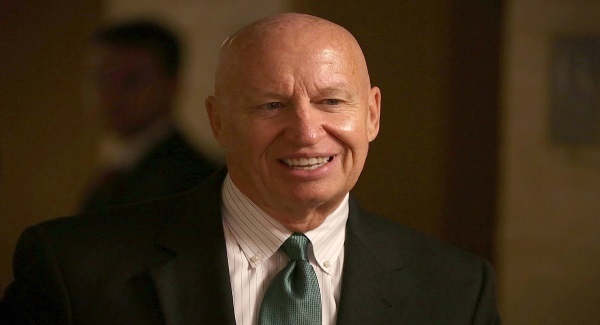
As Kyran Fitzgerald reported in this newspaper on Monday, a key player is the chairman of the House of Representatives’ ways and means committee, Kevin Brady, who represents the 8th district in Texas. His committee derives its enormous power from the constitution, which declares: “All bills for raising Revenue shall originate in the House of Representatives.”
It has jurisdiction over taxes, healthcare, social security, medicare, international trade, and welfare. Brady was chairman of the health and trade subcommittees, respectively, before he succeeded Paul Ryan, who vacated the chair to become speaker.
He understands not just tax but how it interacts with trade. On that, his plan is simple. It is to “obliterate” the tax barrier on US companies bringing home earnings from overseas and to reduce the tax rate on repatriated profits to zero. Speaking to the Economic Club of Minnesota on October 14, that’s what he said, and more.
He also advocates “immediate expensing” which means that all businesses, regardless of size, can write off expenses on buildings, equipment, and software in the year they are incurred, and to carry those write-offs forward. On corporate tax, he wants “the lowest tax rates on job creators”; thus he proposes to cut US corporation tax “by nearly half” to 20%.
That’s above Donald Trump’s promise of 15%. But taken all together, if it happens, it turns the dial on one factor that does matter for Ireland.
The thing about waves is they are biggest just before they crash. It’s knowing the moment and judging the consequences that counts.
Kevin Brady may be about to be the most powerful chairman in 30 years of the most powerful committee since the Reagan tax reforms, but he is also arguably lucky to have been re-elected last week. A congressional stalwart of nearly 20 years, he came perilously close to a primary run-off against Steve Toth, a Republican Party rival, last May.
He survived that cut because an intense presidential primary season boosted turnout. He spent nearly $2m (€1.86m), or ten times his rivals’ combined $200,000, and did just enough to survive. In two years, there won’t be a presidential primary. Turnout will be much lower.
When I spoke to Steve Toth this week, his message was clear. It isn’t gridlock in Washington that is the problem, it’s a “phony narrative” that finds excuses to spend taxpayers money, and balloon the deficit. How President Trump and Chairman Brady can square big tax cuts with big spending increases remains to be seen. More to the point, it’s an open question how it will play in Texas in an off-year election in 2018.
Everything in Texas may be bigger, but fundamental truths are remarkably similar. The living-out allowance in a small country, where those most prominent in the higher professions won’t pay a water charge, says it all. What doesn’t make sense, as we know from our own crash, ultimately implodes.
Toth summed it up for me Texas style. It’s time to tell the vested interests to get their “snouts out of the trough”.
Remember, Kevin Brady replaced Paul Ryan as the ways and means chairman because colleagues to their right hounded speaker John Boehner from office, hence the shuffle up the line. Two years ago, Eric Cantor, the Republican majority leader and Boehner’s No 2, was taken out by a party rival in Virginia. That was the bell tolling for Boehner. Trump is now more of all that.

And that’s just in the US. In France, Marine Le Pen is almost certain to make it to the second round of the presidential election.
If she makes it to the Elysee Palace, the EU is probably over. That’s the things about timing and waves: It is about timing the crash and minimising the damage. In Silicon Valley today, it could be reasonably said that an Ireland which could manage its own affairs is well placed in Europe and offers relative certainty. And when waves crash, they recede.
As an alternative to the living-out allowance, I propose battening down the hatches.