Anthony Foley: Reaction of Axel’s peers says it all

There is a thing that binds together people who play sport with each other that cannot be shaken by time. It is more than sharing a field, more than sharing a dressing-room. It is related, in part, to remembrance of a time in your life when you were young and fit and able for everything.
The shadows cast on a life by the passage of years, by the inevitable struggles, by the things that go wrong, the failures, the disappointments, the frustrations do not darken the joy of that time as it recedes into the past. Instead, those shadows cast that joy in even starker relief.
When a team or a group of players and their opponents strike a chord unlike any other, the remembrance is all the more moving. And in that group of players there is always one who comes to epitomise the inherent spirit more than the rest – the outpouring of grief over the last week makes this point more eloquently than any words might.
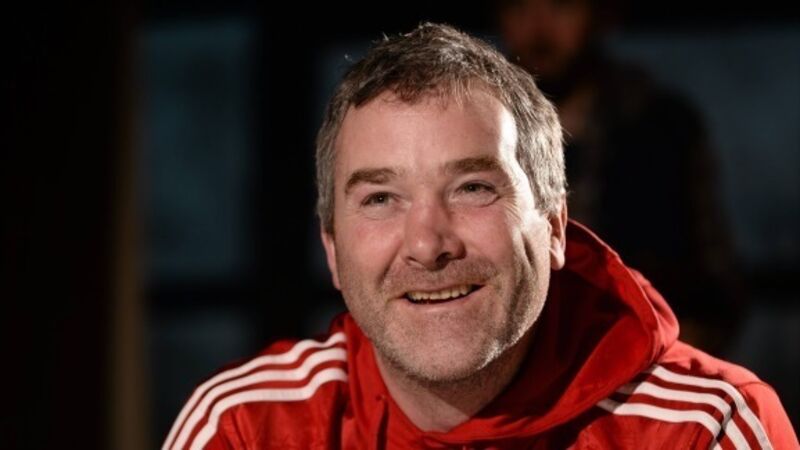
Too often, when sportspeople die, their deeds are accorded a significance that can be a little strained. This is not the case with Anthony Foley. The way he has been spoken about reveals the manner in which he was truly loved by those who played with him. This tells more about his qualities as a sportsman than anything else could ever do.
The truth of this is revealed not just in the tears that have been shed, but also in the quiet reverence in which he is held by anyone who had the great pleasure to tog with him.
The cruelty of his early passing means parallels drawn with other great and iconic players are limited in many respects. He was himself – and nobody else.
But there are some resonances from the past which merit consideration. That he was the central figure in creating the possibilities for everything that has happened in Munster Rugby in this new millennium is now understood. And in this he bears some resemblance to the role played by Mick Mackey during Limerick’s great era in hurling.
In the 1930s, the Limerick hurlers won four Munster titles in-a-row and played in four All-Ireland finals: they won two of those finals – 1934 and 1936 – and, of course, came again in 1940 to win a third. They also won five National Hurling League titles in a row.
Mick Mackey was the foundation of this success: an icon who was feted for his determination, his intelligence, his selflessness and his absolute dedication to the cause.
His reputation was related to how he played the game – and he played it hard. Just as with Anthony Foley, Mackey’s was an inherited hardness. His father, John – better known as Tyler Mackey – was the captain of the Limerick team that won the 1910 Munster championship. Tyler’s style of play was euphemistically described in the newspapers as ‘direct’ and ‘robust’. A noted referee of the period, Willie Walsh, described Tyler as being ‘of impetuous nature.’ Tyler, himself, said that the toughest man he ever played against was one Jim Spud Murphy from the Barrs in Cork. Tyler said of Spud that he was ‘never one to bother overmuch with rules’ – and he didn’t mean that statement as an insult.
In the case of Mick Mackey, his physical approach was coloured by the presence at wing forward of his brother, John. Brothers playing on the same team changes the usual dynamics. In this case, as in many others, it meant a lot more timber being broken. As Mick Mackey said: ‘With us, it was hit one, hit two.’ His physical prowess should not, of course, diminish the hurling skill which Mackey possessed. One without the other would not have allowed him develop into the crowd favourite that he became. The fondness with which Mick Mackey is remembered is also related to the fact that he was renowned for playing with a certain humour. The brilliant Tipperary hurler, Tommy Doyle, recalled a tournament match between Ahane and his own Thurles Sarsfields down in Newport in 1947. He recalled how a huge crowd turned up to see a game that was billed as the unofficial Munster Club Final.
Such was the importance of the game that the local parish priest decided to throw in the ball. As was still the norm eight players from each team lined up in the middle of the field. As the priest stepped back to roll in the ball, Mick Mackey shouted out: “Remember lads, this is not the real throw in!’ Several of the Thurles players stood back as Mackey swept up the ball and set off on a trademark solo run through the defence before shooting a point. Doyle knocked great amusement out of the trick.
It was this sort of thing that led Mackey to recall later: ‘I suppose I was a cool class of customer. It was good crack. Even if you were beaten, somebody would say something and you could laugh about it. Maybe [Christy] Ring didn’t get the same fun out of it.’ Central to this was an unshakeable love of his game. He played as long as he could and when he finished playing he stayed in the game as a coach and an administrator. He actually played his last match in 1955 when – well into his 40s – he stood in goals for his employers, the ESB, in an inter-firms match. It was reported in the press that he made a series of outstanding saves.
That same year he trained the Limerick team that won the 1955 Munster championship. It was an entirely unexpected success. Clare had entered the final as strong favourites. Dermot Kelly, one of the players on the Limerick team, recalled Mackey’s input on the day, saying: ‘He got up on a table and spoke to us like I have never heard anyone speak since … It was so moving we knew we had to win.’ As the years passed the hurlers of the 1930s – the Limerick ones and the ones they played against – were brought together at occasional reunions and awards ceremonies and at golf outings.
Mostly, though, and increasingly, they met at funerals, as they buried the men whom they had played against. In 1975, when John Keane, the great Waterford centre back who regularly marked Mick Mackey, knew he was dying, he set off for Kilkenny and stayed the night with the great Jim Langton, another star of the 1930s. He went then to Cork to hurlers he had played against and on to Tralee where the old Limerick hurler, Jackie Power was living. The following day he set off for Limerick to meet Mick Mackey. He died on the way.
Just a few years later, Mick Mackey, indestructible in his prime, also died, On the day in September 1982 that he was buried in Castleconnell, a minute’s silence was held at the Markets Field in Limerick when Limerick United were playing the Dutch side Alkmaar in the European Cup. Around the soccer field, all flags were flown at half-mast, just as they were across the county of Limerick.
Five of Mackey’s teammates from the great Limerick teams of the 1930s, including his brother John, were at the funeral. The rest had already passed on.
The men from Christy Ring’s club – Glen Rovers – arrived in a mini-bus. Ring had himself already died but out from the minibus stepped men such as Fox Collins who had played in the 1931 All-Ireland final. Men who had played against Mackey from Kilkenny, Tipperary, Waterford, Clare, Galway, Dublin and beyond travelled to the funeral. There were representatives from the government, the President and the Army.
The chief concelebrant at the funeral mass was Fr. Liam Kelly, whose father had played with Mackey and who had himself won a county championship with Ahane in 1955. Fr. Kelly remembered what it was like to grow up in a parish where Mick Mackey was a god.
Quoting from Yeats, he noted that Mackey’s was one of ‘the names that stopped our childhood play.’ He finished his sermon with a call to bring the past into the future: ‘The dedication and self-sacrifice of Mick Mackey and his men is now folklore and can still serve as an inspiration to us all … Are we going to continue pursuing a comfortable and easy life? When we are in doubt do we just do nothing? Do we ask what everyone else is doing before committing ourselves? … If you are inclined to settle for a colourless, selfish conservatism, remember Mick Mackey. He tells us what human beings were made for and are capable of.’
Those words echo across the years into this week. The loss of Mackey as the emblem of an age was keenly felt in Limerick and beyond, but he had, at least, lived into his 70s. The cruel loss of Anthony Foley – a man whose deeds defined so much of what was great about Munster Rugby as it played the pivotal role in shaping the newly-minted world of professional club rugby in the northern hemisphere – is lightened by no such caveat.
The unspeakable loss for his boys and his wife and his parents and his sisters is something that is hard to even think about. And in a purely sporting sense, this man who had given so much to the cause yet had so much left to give, is bitterly lamented. If it is true that you can judge a player by the respect and admiration in which his team-mates hold him, it can truly be said that Anthony Foley had no peer.