Dear Sir... Readers' Views (14/10/16)
Government must halt pay increases to politicians
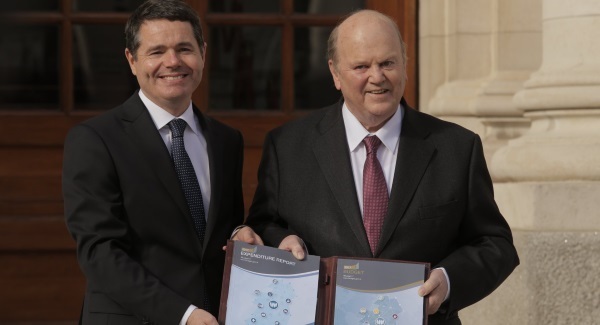
The Budget, finally unveiled on Tuesday last, was a long drawn-out drama, verging on farce.
Ministers and other spokespersons got easy interviews from the media and all the cracks were papered over.
The pensioners are to get a whopping €5 per week extra. What a giveaway!
The real budget was sanctioned, by the Government, some weeks before, with the bringing into being of the final phase of the current national agreement. Under this, all TDs will receive a minimum of €2,500 extra per annum on their basic pay.
All of them will now receive over €100,000 per year. The Taoiseach’s salary will go up by almost €7,000 per year to reach €285,582.
Senators will be given a corresponding increase.
The basic pay of county councillors will keep pace with that of senators.
The income of senior civil servants and others is tied to that of the ministers. To top it all off, the political pensions will rise accordingly.
One lone Independent TD, Michael Fitzmaurice, complained that these increases are immoral.
All I can state is “Well done, Michael. Now where are the rest?” I’m an Independent Co Councillor in Co Leitrim. In my opinion, the Government is guilty of double standards.
The Government, so miserly in its treatment of pensioners, social welfare recipients, the disabled etc, must withdraw all these increases being given to politicians and thus lead the restraint by their own example.
Not radical to want access to abortion
As the campaign for the repeal of the 8th amendment comes closer to an inevitable referendum many are asking: what sort of legislation will follow repeal?
For us at the Abortion Rights Campaign this is not a new question, and was discussed at our first meeting in 2012, in which the aims of the Abortion Rights Campaign were laid out: Legislation for the X and C cases, Repeal of the 8th Amendment, and the introduction of free, safe and legal abortion in Ireland for all who need one.
By this we mean:
Free: available under the HSE in line with all other aspects of maternal care in Ireland.
Safe: carried out by trained professionals in line with best medical practice.
Legal: full decriminalisation to allow people to make decisions without fear of punishment.
It isn’t a radical notion to want to be able to decide what happens to your body, and it isn’t radical to want real and realistic access to abortion, here, in Ireland. We have never tried to hide that we want free, safe and legal abortion. Free safe legal is our tagline. Our ideal legislation, then, would see the introduction of abortion on request to any person who wants one, without legal time limits or caveats.
While this may sound radical, later abortions are extremely rare where abortion is legal and accessible. In the US 92% of abortions happen before 13 weeks, with only 1.2% happening on or after 21 weeks. The vast majority of women, once they’ve decided they want an abortion, want to have it as early as possible. Restrictions on abortion law cause later abortions: Irish women typically have later abortions than their European counterparts because they are delayed by having to travel and save the cost of the procedure.
Where later abortions do take place it is typically due to extremely difficult circumstances: Fatal Foetal Abnormality diagnosis, threat to the life of the pregnant person or (most rarely) very young girls who are unaware they are pregnant.
Opinion polls show that the vast majority of people already support abortion access in these circumstances. Restricting access to abortion only results in making difficult cases even more difficult.
The vast majority of women who need abortions are simply women who have become pregnant and do not believe it is the right time for them to have a child. Be it because of financial reasons, health reasons or circumstances are just not right for them. These are not “extreme” cases, these are the majority of the 10 women who travel every day. With restrictions in place, thousands will still travel.
When people talk about restrictions we would like them to consider: what would abortion access with restrictions actually look like?
How would a reporting system for abortion in cases of rape, for example, work? Given what women who seek abortion on grounds of suicide are forced to go through (examination by up to 6 doctors), in what way and to what extent would a woman need to “prove” she was raped in order to be granted an abortion?At what point does a “good”/legal abortion become a “bad”/illegal abortion?
Forcing any woman to prove she is worthy of medical care reinforces a culture that views women as either incapable or undeserving of having informed consent about what happens to her body.
We trust women to make the decisions that are right for them and their bodies, and we hope when the time comes, you will too.
Once pregnancy exists, a baby does
There is absolutely no doubt that the sole purpose of those leading the campaign to repeal the Eighth Amendment is to have the British model replicated here which is ‘Abortion on Demand’.
Britain’s cut-off point is 24 weeks, whereas unbelievably (or maybe not) members of our People Before Profit/Anti Austerity Alliance actually support no upper limit and want abortion made available up to birth.
Anyway the aforementioned, and other purveyors of doom and gloom, got a fatal and resounding body blow last week when 73% of the electorate polled rejected their callous and heinous movement, as they have acknowledged that once a pregnancy exists a baby exists and therefore has the right to life.
Of course 55% of those polled (who recognise the right to life of the baby when the mother’s life is not endangered), and are therefore Pro-Life, are understandably empathetic when pregnancy results from crimes of rape and incest and when the baby has a life-limiting condition.
However while the above crimes are horrific, even the 19% who want abortion on demand cannot dispute that two wrongs never make a right and the baby conceived is no different in form from any other conceived so why should it be punished by ending its life. Our pro-abortion politicians, which includes Katherine Zappone and Frances Fitzgerald, Ministers for ‘Children’ and ‘Justice’ respectively would be better served in introducing severe sentences for those who commit such crimes, rather than pandering to those pro-abortion groups, which now include those in the medical and legal profession.
The aforementioned are also calling for babies with life-limiting conditions to be, in effect, euthanised.
Normally those who support assisted suicide would have the option to ‘grant’ their consent but same cannot be granted by the innocent pre-born baby.
Having got their unequivocal answer last week it is now time for the Repeal The Eight brigade, which consists of mainly journalists, media groups, celebrities, artists and those in the creative sphere to slink away and fold their tent and tag onto some other ‘cause’. They have been found out!
Whilst we still wonder how men/women can inflict so much pain suffering and atrocity on their fellow human beings currently across the world and throughout history we need look no further than within our own shores to witness their ilk.
We own the water
Don’t be fooled by the emphasis on debating who pays for that precious resource vital to all our citizens — water. This is a ‘red herring’, but cleverly shifts the focus and is typical of successive government parties who favour abdicating responsibility and handing over vital Irish resources to private business, their boardrooms and shareholders. Already huge energy resources have been given away. All this whilst the hospital corridors are overcrowded and the homeless and vulnerable lists growing.
What kind of democracy is it which allows a government, mandated to govern for a finite period of five years, to hand over control of that which is the right of all, to private individuals and businesses for an indeterminate number of generations to come and which saddles incoming elected governments and the citizens with a problem not of their choosing? This breaches all the principles of democratic accountability and rides roughshod through our Constitution.
The real water issue is that of ownership and control. That basic human right, the right to water, must be held in public control and protected by our Constitution.
This should shake us out of that malaise of complacency which has so afflicted the people to the extent that, somehow, we have even accepted the Government line that it is in the interests of the people that the public purse be denied billions of euros in tax revenue, even while the hospital and homeless lists grow.
Public ownership of this vital natural resource is the proper platform for an equitable and co-operative approach to the establishing of na efficient water supply infrastructure. The abdication of government responsibility in this matter is a non-starter.


CONNECT WITH US TODAY



Be the first to know the latest news and updates