Adonis: Europe's oldest living tree
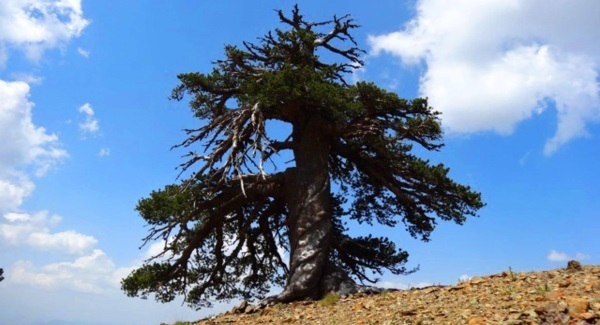
The Bosnian pine, one of a dozen very old specimens in the area, was examined by scientists from Stockholm University.
A core sample taken from the tree had 1,075 rings, giving a seedling date of around AD941. Having lived through the entire 2nd Millennium, this remarkable survivor has been named ‘Adonis’, after the ever-youthful Greek god, represented as a handsome young man.
According to the Tree Register of Ireland, published in 2001, a yew in County Wexford is between 800 and 1,200 years old. Experts think that the Fortingall Yew in Perthshire may have lived for 2,000, possibly even 3,000, years.
Some European trees have seen their 10,000th birthday.
These have reproduced clonally, however. Genetically identical to the parent of which they are offshoots, they are not considered to be individual trees.
The root system of an aspen in Utah is said to have about 47,000 such offspring and its genetic identity has been preserved for 80,000 years. Adonis is the oldest ‘officially dated individual tree’ in Europe.
Spain’s so called ‘millennium’ olive trees were studied recently. The oldest one, growing in Catalonia, was found to be 627 years old.
In a world context, of course, Adonis is just a teenager. California’s General Sherman, the mightiest tree in the world, is thought to be 2,500 years old.
A bristle-cone pine, growing in the mountains bordering Nevada, has been alive for 4,900 years.
The Stockholm team was led by Paul Krusic, whose speciality is dendrochronology, the science of dating past events using tree-ring patterns.
A horizontal slice through the stem of a tree reveals a series of dark rings against a paler background. Leonardo da Vinci was the first person to realise the significance of these.
In his Trattato della Pittura, he wrote that ‘the rings around the branches of a tree that has been sawn show the number of its years and which ones were wetter or drier the more or less their thickness’. ‘Early-wood’, produced during spring and summer, is light in colour.
Dark ‘late-wood’ forms when growth is reduced in winter. A growth-ring’s width, therefore, depends on how favourable the climate has been during the year.
Tree rings are most prominent in temperate latitudes where there is greater weather variation between winter and summer.
A ring is formed in most years but anomalies occur.
Over several years, a common ring pattern is formed among trees in the same region.
This enables the ring profile of a particular tree to be corroborated with those of others and its age can be inferred accurately.

Growth rings, reflecting the climatic conditions of the past, yield valuable data for scientists such as Krusic studying climate change.
Core samples from trees such as Adonis are effectively time-capsules.
The region in which the Bosnian pine grows has been inhabited for centuries. Wood has always been in demand for tools and fuel.
The scientists think it remarkable that a tree living in this area managed to survive, unscathed, for so long.
The inhospitable mountain environment where it lives may have been its saviour.
Austere conditions also gave rise to another factor affecting tree longevity; stress.
To us humans, stress can be a killer; it tends to shorten our lives. With trees, the opposite seems to be the case.
In a book published in 1995, Dick Warner wrote: ‘It seems that stress promotes long life in trees, rather the opposite of what it is supposed to do in humans.
The bristle-cone pines grow in an icy desert well above the tree-line, over 3,000m up, where the only moisture is a little winter snow; a place full of stress for a plant’.
Congratulations, Adonis!
- Dick Warner. Trees. The Collins Gem series. 1995.