Refugees with no idea of what the future holds still offer a warm welcome

YOU can see the moving sign in neon from the gate of the Diavata refugee camp in the industrial hinterland of Greece’s second city, Thessaloniki.
The letters flash by first in English, then in Arabic: “It is against European Law to abuse animals and incurs a penalty.”
It’s not till later that massive irony hits me that the only sign in a camp housing thousands of refugees in tents is an instruction not to mistreat animals.
This camp took part of the influx of 16,000 refugees when the temporary Idomeni camp at the Macedonian border was cleared a couple of weeks ago.
Most of these Thessaloniki camps are closed to outsiders. This one has admitted them in the past but today its gate has shut too.
It’s for our own safety, says the army. This morning an aid worker was threatened with a knife. My Syrian contact says he wants to see friends and the army tells him to meet them under the trees at the fence.
It’s 32 degrees and there’s already two groups sheltering from their boiling UNHCR tents.
Ahmed, aged 46, from Aleppo, has health problems and they told him he’d get an apartment but it hasn’t happened.
He hands us his records. He has cancer of the intestine. The Medicins sans Frontieres doctor writes that he can’t read the reports Ahmed got done on his journey because they are in Turkish.
He pulls up his shirt and injects himself in the gut with something — antibiotic, steroid, pain killer? It’s hard not to look away.
There are two breast-feeding mothers: one is Doha from Deralzour, who has an eight-month-old baby, the youngest of her eight children. Her husband’s second wife has just given birth to her first baby and they are in hospital.
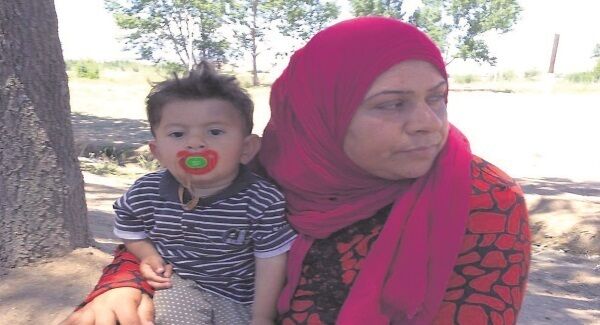
She can’t cope with life in this camp which the UNHCR describes as “sub-standard” and says make-shift Idomeni was better because it was open and people came out to help.
The mosquitoes are driving them crazy and they have already killed one snake.
A second, younger woman is breast-feeding a seven-month-old baby and is very thin. Her husband says she needs to eat to feed the baby but she has a stomach disorder and can’t eat the food.
By this point I’m surrounded by children, touching my clothes, my shoes, my earrings, as if I am a thing of beauty because I come from the real world.
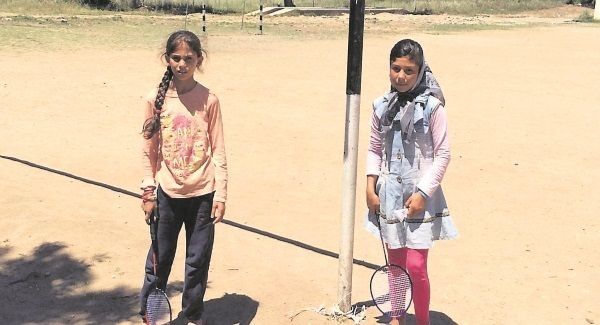
Twelve-year-olds Noor and Menan learned some English in Syria and here they are learning Greek.
“Tomorrow, tomorrow, tomorrow, Macedonia”, is how Menan describes her time in Idomeni.
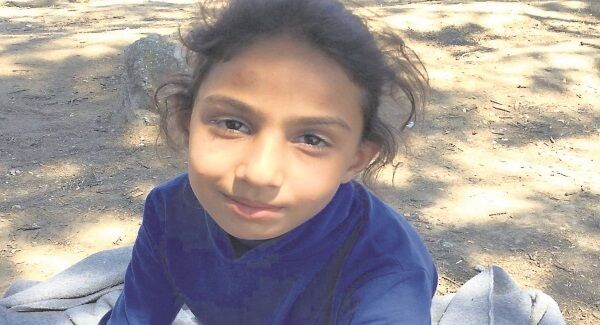
Along come Nahla, aged 10, and Ara, aged 7, who are cousins. Ara draws a picture on my notebook of what she is “thinking, thinking” and it is a picture of a house with a little girl inside sitting at a desk.
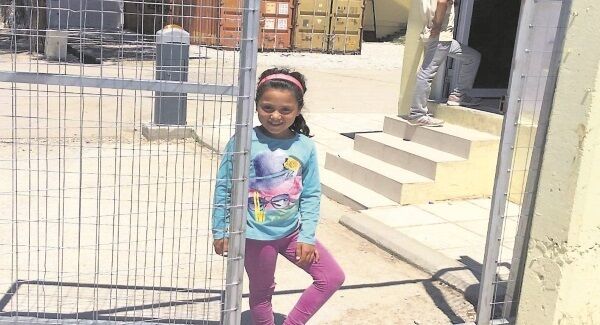
That is all she wants, this little girl. A home.
I will never see you again, Ara, but I will never lose your drawing and I will never forget your dream.
It’s so hard to say “goodbye” to my new refugee friends because they don’t know when, where, or if, they will be resettled.
It breaks my heart that I may never be able to repay the hospitality they have shown me.
Back in Athens, at Skaramagas, the best and the last open camp, the relative cool of evening has brought out hundreds of children enjoying games organised by volunteers and, as usual, there’s a tea party going taking place on the terrace carpenter Ahmad made from United Nations HCR sacks and wooden pallets.
These Syrians are among new friends too but they might as well be family because of what they have been through.
It’s too painful to think about friends and family left in Syria.
Mustafa, aged 27, from Aleppo, a medical student, formerly had 26 close friends and 25 of them are now dead.
The last one of them is in Syria, and has just witnessed his brother being shot dead. He was threatened with death if he tried to take the body.
“Why am I still alive?” he asks and his Greek friend tells him he must survive for the sake of those who didn’t.
I think he will.
In my week in refugee camps I met people with such strong survival skills that they won’t only survive, they’ll thrive. But some of the less robust will never recover.
As I’m saying my final “goodbyes” a little boy grabs me and bursts out crying. He has neither mother nor father in the camp and is in the care of a female relative who beats him. He has bite marks on his arm.
“Mamma, Mamma!” he shouts as I drive away feeling like a delinquent mother but unsure where to report the abuse of a child for whom no country accepts responsibility.
READ MORE: Meet Khadija, Theena and Sara. They fled the horrors of war in Syria
CONNECT WITH US TODAY



Be the first to know the latest news and updates