Divided Dáil: ‘New politics’ has back seat in same old Dáil
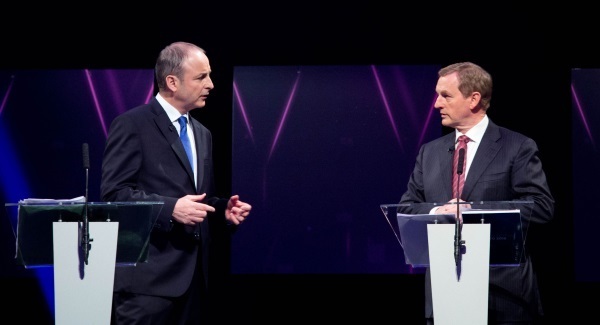
Whether that involves the formation of a government or another election remains to be seen. As is so often the case in Irish politics, the real action was happening away from the Dáil chamber.
Over the last few days, the pending meeting of Enda Kenny and Micheál Martin had taken on the character of the kind of build-up that used to be norm when Ronald Reagan broke bread with Mikhail Gorbachev in the days of fresh detente.
Maybe the two party leaders should have organised a sitdown in Reykjavik, or somewhere else cold and uncomfortable and far from the maddening crowd.
Back in Leinster House though it was politics as usual. In the hour before the Dáil reconvened, one wizened deputy who was patrolling the corridors had this to offer: “The place has the smell of death about it.”
He was talking about the feeling of quiet desperation that often permeates the air of the building when the Dáil is in the throes of some crisis or other that looks like it is going to precipitate the fall of a government.
We have been there a few times over the last two decades.
This time around though, there is no government to fall. The smell to which he was referring was generated by the fear that no positive resolution will emerge from the talks about talks on who will govern, which are only really getting under way now.

The smart money still says that a government of sorts will be formed, but with each passing day the bookies consider shortening the odds that everybody will be back out pounding their constituencies, irrespective of a desire to find a resolution.
In this environment it’s a case of keep your friends close, but your posters closer.
The main business of the day was the charade of attempting to elect a Taoiseach. This was the first indication that the fabled “new politics” which everybody professes to desire hasn’t a snowball’s chance in coming to pass.
The process was a charade, but under the circumstances it would have been best to just get it out of the way and move on.
Instead, there was a 45-minute hiatus to accommodate some play-acting which was posted as objections to other play-acting.
Mary Lou McDonald was first to her feet to call for a motion to set up a committee to tackle homelessness. The subject is of the upmost importance, but surely it’s putting the horse before the cart.
“The impression [among the public] is that the members are elected but not yet carrying out their democratic function,” she said.

She was followed by Richard Boyd Barrett. He said the “political establishment is engaged in a deliberate political charade” while there is “an escalating crisis in housing”.
Again, he was correct, but delaying the possibility of the formation of a government was hardly going to tackle homelessness.
John Halligan (Ind) spoke for many when he pleaded that “the preferred option would be that a government is elected”.
Still, the disruption continued.
Ruth Coppinger of the Anti Austerity Alliance said there is an “urgent” need to address the eighth amendment, an issue that has never attracted urgency and is unlikely to do so now.

Seamus Healy (Ind) rose to make mention of a trolley crisis in South Tipperary General Hospital, which is a serious issue but there is a time and a place to attempt to address that.
And on it went as a harbinger for the kind of disruption that is likely to inform the 32nd Dáil, however long that may last.
Eventually, they got around to nominations.
Sinn Féin president Gerry Adams had announced earlier that he would not take part in the charade and would not be nominated. And then there were three.
Noel Rock and Catherine Byrne didn’t labour over Kenny’s nomination and neither did Lisa Chambers and Thomas Byrne for Martin. Boyd Barrett nominated Coppinger, and managed to give a five-minute speech without once referencing the attributes of the deputy in question.
Her seconder, Mick Murphy, did point out that Coppinger is a woman, but otherwise used the occasion to decry the eighth amendment, the housing crisis, and water charges.
Eventually, the house got around to completing the charade with nominations and votes that confirmed the predestined inconclusive outcome. Kenny lost the vote 51-80, Martin by 43-95 and Coppinger by 10-108.
As Boyd Barrett pointed out, it is now 40 days and 40 nights since the election.

In that time the two big parties have been engaged in the political equivalent of what a Gaelic football manager once termed “arse boxing”.
Kenny and Martin now have a major responsibility to fashion an agreement that will allow this Dáil to function with an executive. A failure to do so will reflect badly on both men and those around them.
If they do come to a positive conclusion, the most likely outcome remains a Fine Gael-led minority government. That will ensure the executive will no longer be in a position to bully the Oireachtas as has been the case in successive Dáils.
Such a rebalancing of power between the two arms will be welcome, but it will also oblige the opposition to take up the mantle of responsibility.
Sinn Féin and the smaller entities can use the occasion to further their own policy agendas. Or they can take advantage of the greater opportunity to disrupt and grandstand.
Yesterday’s Dáil sitting acted to drain any confidence that the elusive “new politics” might turn up alive and well in the Dáil chamber.