Rising attracted the good and the great for ‘Ireland’s opportunity’
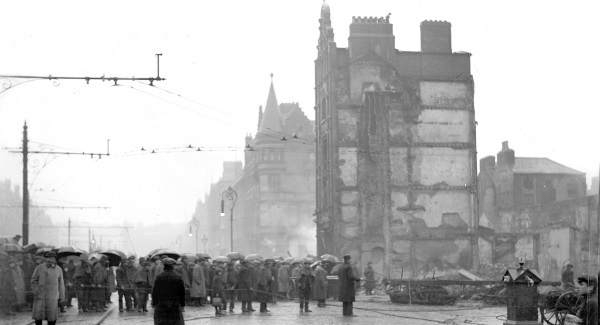
They came from all over Ireland but were also from Liverpool, Manchester, Glasgow, and like Joe Good, from London.
He was involved in the Rising with Michael Collins. He wrote his memoir, Inside the GPO, in 1946 for his 13-year-old son Maurice who published it in 1996. It was re-published by O’Brien’s Books for the 1916 Rising’s 100th anniversary.
Good wrote of Michael Collins’ feelings at the Rising’s end: “Poor Mick: He had more knowledge — of what had happened and would happen — and had more hopes of what might have happened, and he had a far greater disappointment than any of us. But I did not know that then.”
He saw James Connolly carried on a stretcher from the GPO through a window of a house in Moore’s Street, where the leaders present decided to surrender. Good wrote: “At some time before Connolly left our building, I was sent to find a barber. I was unable to locate one. But Winifred Kearney (Connolly’s secretary) and Julia Grenan (actually Sheila Grennan), the only other young woman still with us, had combed his hair, washed him, redressed his wounds, and were making his stained, dusty uniform as presentable as was possible. Four men in uniform arrived. Connolly was taken from the room by these 4 volunteers. They were washed, shaved and polished as if for a parade. The insurrection was over...”
A brigadier inspected a line of prisoners and asked Joe his name. ‘Good’ he replied. The brigadier wasn’t impressed. Joe then said ‘G.O.O.D. Good’ to which the brigadier sarcastically said ‘Come on, you are not dead yet!’ and Joe replied ‘No bloody fear I am not!’
The prisoners were scorned on the streets.
The Volunteers were first held in Dublin, where Good shared Michael Collins’ overcoat and their British army guard asked; “What has you here, Collins?” and Mick replied “England’s difficulty”. There was a pause before the Sergeant repeated “England’s difficulty — and what’s the hell is that?” Mick lightly completed the old adage: “England’s difficulty is — Ireland’s opportunity.”
They were freed in December 1916.
Joe Good was not involved the Civil War until the death of Collins. After it was over he raised a family and was a mechanical electrician in Dublin. His 1962 funeral saw half-mile of cars behind the hearse to the graveyard at the foot of the Dublin mountains, where the hillside was covered with people.
CONNECT WITH US TODAY



Be the first to know the latest news and updates







