Refugee issue could scupper the entire EU
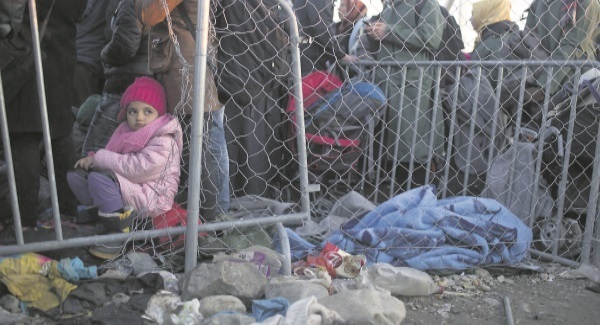
‘WE ARE the richest continent in the world — 500m citizens — and seem not to be able to cope with one to two million refugees reaching our continent,” says Jean Claude Juncker, president of the European Commission.
He and others warn that this is not just a tragedy for the thousands of women, men and children sleeping in the cold and wet on Europe’s borders, hungry, sick, even tear-gassed, as they pray to be let through.
Médecins Sans Frontières, one of the charity organisations working in Greece and Italy, paint the picture: “The winding road across the wheat fields near the Greek village of Idomeni is full of people shouldering large bags, carrying babies in their arms and putting one step in front of the other. The stream of people continues day and night, but only 150 people each day, on average, can continue their journey out of this place.”
Mr Juncker warns that if the EU fails to cope with this humanitarian crisis, then the survival of the union is at risk, a union so carefully built up on humanitarian values, that has delivered greater equality in terms of wealth and human rights and the best chance of surviving the globalisation happening all around.
“We are running out of time, and strong leadership and vision are urgently needed from European leaders to deal with what is, in our view, a situation that can still be managed if properly addressed,” UN high commissioner for refugees Filippo Grandi warned, presenting a six point plan that he says is essential.
The points are in fact all part of the EU plan to deal with the tragedy, but despite the numbers arriving doubling every year, prime ministers of the member states are still dragging their feet and arguing about what to do.
The traditional method of moving the EU along is failing the refugees and Europe’s citizens. Persuading, pushing, taking the small steps the most reluctant are willing to tolerate has proved to be the only way of getting consensus. It usually produces policies that are enough to get by.
But they were found severely wanting during the euro and banking crisis, and now they are equally unfit to deal with the refugee crisis.
The migrant crisis is pitting countries whose governments are partly xenophobic — many from the newer EU countries — against the rest.
The latest news from Slovakia where the right wing government has lost support to a party promoting hate against foreigners, their own Roma and everyone else bodes ill for today’s summit where its hoped to find a workable solution.
German chancellor Angela Merkel initially welcomed the influx. But other leaders were silent, showing no interest in dealing with the crisis. Except the most viciously reactionary among them, Hungary’s Viktor Orbán, who extended his views on keeping Hungary for the Hungarians, to keeping Europe for the Europeans.
His vision, promising such a continent, became the only policy decision agreed by the leaders.
Months have been wasted as the borders became the focus, but how do you stop a tide of desperate people fleeing for their lives, urged on and facilitated by a multibillion-euro smuggling operation, and countries like Turkey happy to see them move on?
The single big idea became Turkey — the country caught in the middle — hosting more than 2m Syrians, about 200,000 in UN camps but the majority fending as best they can in the cities and rural towns.
With the help of EU aid, Greece managed to close its land borders, but then the focus switched to the sea — the islands of Kos and Lesbos were swamped.
Greece initially refused to request help in case it would mean it could not push on these people to other countries. Because, under the unfortunately named Dublin Convention, the country where a person first lands must deal with them — either send them back if it’s safe to do so, or give them asylum.
Italy has long dealt with their influx from North Africa by moving them along and this worked as long as the numbers were not too great.
But the war in Syria changed all that, and last year 1.2m arrived. Suddenly Hungary became the country experiencing the biggest influx — few wanted to stay; the majority wanted to transit to Germany or Sweden, the two countries willing to take them.
Hungary shut its borders, and gradually other countries along the route have too — including Austria — now trapping them in Greece, creating as its prime minister said, “a warehouse of souls”.
Plans for countries to share the burden, taking small numbers of genuine refugees, has collapsed and looks like being buried.
Now the big answer is to send back all those that do not qualify — despite the fact that the vast majority come from war-torn Syria, Iraq, and Afghanistan.
Turkey is central to all this — despite the fact that for many Turkey is not a safe country.
The deal with Turkey — which EU leaders hope to finalise soon — is that it will stop the smugglers at the coast from launching the rubber dinghies and boats full of refugees, and it will take back those that make it through to the EU, including those picked out of the water by Nato vessels.
In exchange, the EU will provide €3bn to help care for the refugees in Turkey, agree to take refugees into Europe from its camps, and extend visa-free travel for Turks to include business people and students.
New money, €700m, has been earmarked to help Greece and other countries look after refugees who now, under Schengen rules, must be fingerprinted, identified, formally request asylum, and go to whichever country will take them. And that too is a problem as many countries do not want to take any.
The European Commission says all the blockaded borders must be lifted by December and believes, or hopes, that by then the flow across the Turkey border will be no more than a trickle, that everyone will be identified, allocated to a country or sent back if they are not entitled to asylum.
But not everyone believes this master plan will work. Guy Verhofstadt, leader of the liberal group in the European Parliament, is among them: “The commission says we only have 10 days left to save Schengen but then proposes a set of measures which need 10 months to be implemented.”
He is not wrong, but this package of shreds and patches seems to be the best they can come up with. But many fear the only outcome will be disaster.