Irish Farmers’ Association caught in crosshairs and a no-man’s land after losing its way
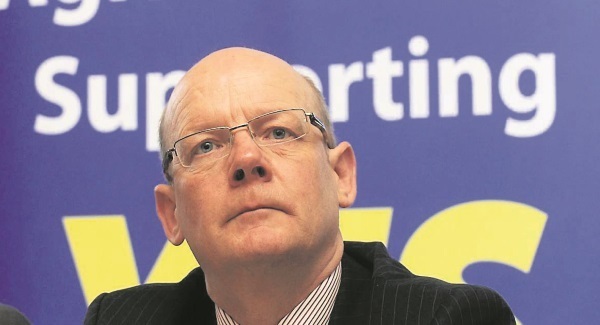
AFTER the well-buttered exit of Pat Smith from the IFA, sympathy will be scant. It’s the problem of representative associations and most charities, that the people working in them are invariably considered underworked and overpaid by some of their membership. ‘Head-office’ is code for euphemisms from useless, to uppity and unaccountable.
‘Our subs pay their wages’, members say openly and more frequently under their breath. ‘They’ are living in clover on our hard labour. Doubtless there is truth in all of this, some of the time. Appreciation is seldom the perfume from bouquets thrown at full-time paid staff in head office.
There is an endemic tension in representative bodies. The power, and in theory the mandate, rests with members. That fundamental truth was re-arrived at in the IFA last week. The problem is that the power of the mandate, to be exercised coherently must first be delegated.
In any membership organisation there are circles, within circles, of influence and access. Until they are aggravated, many members are relatively passive payees. They pay up, they shut up and they expect the organisation to get on with the work without bothering them unduly. Then there is the active membership.
Those who show up, speak up and go on committees. Finally there are those who, either out of passion, altruism, commitment, contrarianism or simply the lack of something else to do with their lives, are most prevalent and important.

Mostly, the actual membership a full-time paid executive has to deal with is the relatively small, activist base. Meeting their expectations, understanding the sometimes internecine politics that go on in committee elections, and either buttressing or containing the ambitions of those who arrive as elected members of boards, is a key survival skill. Once unrivalled in its application at the Farm Centre in Bluebell, at some point it was lost — with terminal consequences — for its chief executive.
All representative organisations are coalitions but, not always coalitions of the willing. A successful full-time executive synergises different agendas and holds competing personalities together in a coherent whole.
It is herding cats, and then some. What are they paid? Are they overpaid? Should we know what they are paid? And maybe the most important question is regardless of the rights and wrongs, whether it is tenable in a membership-based organisation for the salary of the CEO to be undeclared.
The answer to the last question is the simplest. This is 2015 and if you noticed or not, there has been a culture change. You cannot have accountability without transparency. Fog may have been what you could hide in, now if you are caught in it, is can asphyxiate. Best to come out for fresh air.
The funny thing about the IFA furore and the ring-around to bodies asking what their main people are paid is that, of those who declared, some are shockingly underpaid and most seem perfectly reasonable.
I was taken aback that SIPTU’s Jack O’Connor is reported to be on a modest €108,000.

That is a lot of money compared to many he represents but, compared to the responsibility of leading such a complex organisation, it seems relatively little.
And looking at trade union bosses’ salaries generally, considering how they shanghaied the Exchequer through social partnership in good times, and successfully muscled up to the font of the queue at the first inkling of economic recovery, it has to be said they are underappreciated by their members. Proportionate to their delivery of largesse of pay, pensions and conditions, they, and the social partnership process, — now National Economic Dialogue -— are the ultimate Irish lobby machine.
Trade union leaders are underappreciated, that is, by any utilitarian measure. What complicates the picture is that for the vast majority of membership-based, representative organisations it is not the money that ultimately counts; it is the organisation’s mores.
Good causes are not penny Plc’s.
They have a moral fibre that if frequently flaccid, and always self-justifying, is none-the-less their point of reference; the magnetic north.
In internal disputes, the sharpness of the moral point gets reemphasised and it is often the paid executive who is on the receiving end of it. Never fully accepted as one of ‘us’, ‘them’ in head office are always suspected of having sold out, or as being about to do so.
The mandate of members, delegated to a paid executive, to be exercised effectively, is dependent on engagement with the powers-that-be and continual re-energising of the membership base. In this small, oddly-governed country with its multi-seat system of proportional representation an active base that can deploy nationally is a key asset.
Turning out volunteers locally, not just for protest but more effectively for engagement with TDs and sustaining that over time requires focus and effort.
When it’s done well, systematically, it immensely strengthens the hand of the representative body. And here is the point of departure from the grassroots. Engaging at the top is essential for delivery. It means your peer group is as likely to be masters of the universe or at least senior public servants and politicians.
Your new normal is very different from the reality of people you represent. So who exactly are you measured against for the purposes of remuneration? The key criteria going forward is that there is a reasonable comparison in place, it is public and defensible. You can’t bring all the begrudgers on board, but nothing annoys people more than not being told. Paddy likes to know.
The professions and representative bodies of business are a different kettle of fish. They are membership-based bodies as well but, the people they represent are certainly not penny Plcs. They are moneyed interests where the bottom line is the only yard stick.
In a sense, the IFA has lost its way and got caught in a no-man’s land between the mass membership body, which it is, and a lobby for a business elite, which it also is. The coalition fractured and what is at stake is its capacity to articulate a convincing narrative that will reunite a formidable force.

It once ranked alongside the Catholic Church, Fianna Fáil and the GAA as one of the Irish power houses. Only the GAA unquestionably still enjoys that status and an ever diminishing number of full-time farmers means the IFA will never fully recover it. But a lot is at stake in a still very important sector.
On the professions, it is a nearly inevitable outcome of Irish professional education that solicitors, barristers, doctors and more graduate with an A+ in self-regard. If you have to spend your life inhaling those exhaust fumes, should you settle for much less that is the going rate at the top of the relevant profession?
The Irish Medical Organisation has been in this space and its internal cohesion has never fully recovered. The below stairs staff got above themselves and those above in the committee room were mortally offended.