Gender is a measure of diversity in Ireland, but not of fundamental difference
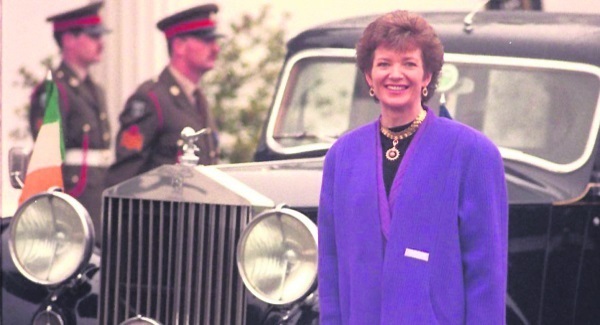
The paltry representation of women on-air today belies the fact that from the foundation of the State women were fully equal and indeed a majority among electors, writes Gerard Howlin

Gender is a measure of diversity in Ireland, but not of fundamental difference

AT THE 11th hour on this the 11th day of the 11th month the unknown soldier will be remembered in silence. The unknown soldier is the invention of societies shook to their foundations by mass mobilisation and the onslaught of the totality of modern warfare.

Long-suffering women, like unknown soldiers, are the constructs of powerful men. They are necessary responses, disquieting accommodations by elites, of forces that must be co-opted if they are to survive.

Women share a common destiny with unknown soldiers. In the antiphon of Armistice Day, “at the going down of the sun and in the morning, we will remember them”. The subtext is that individual identity will be submerged into anonymity; the laudatory will become unnameable. Authoritative voices, when female, still unsettle and remarkably remain unusual.

Yesterday the Broadcasting Authority of Ireland with Dublin City University published a study Hearing Women’s Voices: Exploring women’s under-representation in current affairs radio at peak listening times in Ireland. Though a majority of the population, the lack of women’s voices on-air in current affairs is stark.

Across three national radio stations RTÉ, Today FM and Newstalk 72% of voices in prime time slots are male. This study is a timely parallel to the discussion about gender quotas.

There is a great history, certainly a familial, oral tradition of strong women. Almost invariably they are in domestic settings. He is feckless or drunk but, she holds house and family together. Widowed, and left with young children she, on a shoe string and in tough times, rears them well. These are some of the stereotypes. Women of course were never themselves drunk and if they were, it could not be mentioned. In the 1970s many pubs in Dublin did not admit women into the bar, unless there was a snug. When I was of an age to go into pubs myself in the 1980s, I still remember a few relics of that auld decency. Of course speaking out and taking drink were closely associated. Neither were desirable characteristics in women.

Interestingly most politics and a lot of journalism was done in pubs. Invariably local party meetings were held there — an almost exclusively male space. Simply appearing, let alone persevering, was for any woman an act of audacity. Most women present, and they were a minority, were older. The sense of out-of-bounds for young women, was twofold.

Firstly as women and then as young women, they had to deal with the condescension and the sexism of their elders. My own experience of local party meetings did not continue past the 1980s. But one memory remains vivid. Amidst the culture wars of contraception, the eight amendment and divorce, it was the women present who led the charge against what they decried as filth and pollution. I can see their faces, still, animated with outrage at the idea that any of this could happen. They were proud and glad then that it didn’t. They made sure of that.

Curiously, whether out of uncharacteristic inhibition or slyness, auld fellas who were not shy about having their say, said a lot less. And they were no liberals. But on those “women’s issues” the sandwich makers and sometimes cumann secretary, let rip. A disconcerting undertow of the social current which wrote women out of history, is the actual extent to which Irish women were co-operators in their diminished destiny. The paltry representation of women on-air today belies the fact that from the foundation of the State women were fully equal and indeed a majority among electors.

There were few if any women’s voices in the public space. The pulpit as well as the cumann meeting was male-dominated and the former was far more powerful. Nuns were a primary role model. Respectable married women only secondarily so. Spinsters were slightly pitied and any other sort of woman was beyond the Pale.

There was intense, claustrophobic conditioning. But there was also ultimately freedom of choice in a secret ballot. The choices made over decades, include the choices made by Irish women, albeit in a specific historical context.

There is a self-satisfying but untrue version of Irish history between the Rising and the War of Independence up to the election of Mary Robinson to the Seanad in 1969 and the departure of the contraception train in 1971 that sees Irish women as faceless, nameless victims. Uniquely on the electoral register, every Irish woman of age was named. Voter turnout was routinely significantly higher then. It is condescending to speak of empowering women now, without interrogating the power and responsibility of Irish women then, over decades.

It was an unequal, unfair society. At every level the reality of women’s lives was some measure of disadvantage. But if their power was less, it was not negligible. The unsaid preamble to Mary Robinson’s innovation of Mná na hÉireann on her election as President who “instead of rocking the cradle, rocked the system” was that Irish women were in-part staunch upholders of the system that was so circumscribing. If ultimately she won the war, most of Robinson’s career in the Oireachtas was characterised by lost battles. Fought for women; women were not always on her side.

Robinson was one of several political women who emerged in the 1970s, independently of familial connection. Gemma Hussy, Monica Barnes, Nuala Fennell in Fine Gael and Mary Harney in Fianna Fáil were others. It seemed then, briefly, that a new beginning was in the offing. To an extent there was. But over time it under-delivered on expectation. Gender quotas and the demand that women are heard on-air are a response to a sense of unfulfilled promise and continuing inequality. Clearly, over time the prominence — or lack — of women on-air is important cultural conditioning for our society. Stereotyping on the basis of gender is not limited to current affairs, however.

Yesterday’s excellent study does not include any overview of lifestyle programme? Is there under-representation of men on personal health, cookery and interior decoration programmes and if so how pernicious is that cultural conditioning? Reading print media, I have the strong sense that female victims of crime proportionately receive much more coverage. Why? Presumably that is what sells newspapers to both women and men.

People do not come as an amorphous mass, in either gender. All stereotypes are a demeaning projection of the patina of anonymity onto real people. It is always the personal story, the identifiable voice that is most influential. Gender stereotyping cuts both ways. It is just part of a complex, insidious filtering of influence through the media. In a multicultural society, where are the voices and faces of other ethnicities? On-air is the ether where regardless of gender, a discernibly middle-class, slightly left-of-centre smugness gathers like algae on still water. Gender is certainly a measure of diversity but, not necessarily of fundamental difference.

More in this section

Revoiced

Newsletter

Sign up to the best reads of the week from irishexaminer.com selected just for you.

Cookie Policy Privacy Policy Brand Safety FAQ Help Contact Us Terms and Conditions

© Examiner Echo Group Limited