Beware the worm casting its opinion as the election looms
THE worm may not be Fianna Fáil’s major problem, coming up to the General Election, but it is up there among the cluster of stinkers with which it must deal.
It’s not Fianna Fáil’s personal worm. It’s not even a worm native to Ireland, but, like the grey squirrel and the striped mussel, it is on its relentless way and it will play hell with the native species.
The worm is that moving strip of data that trails across the screen beneath the main picture, as it did during the contenders’ debate on British television last week. This was the one involving Ed Milliband and three women: One the leader of the Green Party, another the leader of Plaid Cymru in Wales, the third the leader of the SNP, who has won the TV contest in the way Nick Clegg won it last time around.
The contrast between Milliband and the three women was eerie. In proper sisterly mode, they referred to each other’s contributions as the programme went along.
Referring to a rival’s contributions in this context derives from two situations. The first is where the other speaker is genuinely thought-provoking and agenda- setting, and referring to them is a tacit and sometimes unintended acknowledgement of their primacy within the programme.
The second is a form of passive/aggressive defensiveness. It seeks to placate the first speaker by use of their name (the ultimate flattery, evocative of an instinctive unwilled positive reaction): “How could you hate me, now I’ve quoted you?”
The end result was a unifying warmth among the women demonstrated by a tripartite hug on stage at the end, and a victory for Milliband, who watched the three of them embracing as if they were a complete new politican genus. Which, of course, they are.
Where the worm came in was to express the positive to negative reactions of viewers as the debate progressed. It was so structured as to give the viewing audience a blow-by-blow, issue-by-issue, statement-by-statement temperature-guage of a chosen segment of the viewers.
In other words, if Candidate A made a point or a claim, within seconds this modern clapometer would visually establish just how much the audience liked or agreed with it or, alternatively, just how much they hated it or disagreed with it.
If David Cameron was watching the debate, he must have been thanking his lucky stars the worm wasn’t worming across the bottom of the screen during his non-debate with Milliband. The real contender for the prize, in that first debate, was Jeremy Paxman’s ego, and both Milliband and Cameron should have received a merit award for tolerating Paxman’s sneering, self-regarding theatricality.
The problem with the worm is that it loves promises. The worm has never seen a promise it didn’t like. Not only that, but — worms being worms — it hasn’t the capacity to say to its vermicile self: “I’m becoming ecstatic about the promises made by this candidate.
If this candidate gets in, I’m made for life. This candidate is going to cut tax, do away with water charges, pump money into the health service, and make my life cool and groovy, which is what any self-respecting worm wants.”
No fearless journalist leaped up and said “Whoa. We should have a truth process in place so that every time a promise is made we can put onscreen the words ‘No money for this’ or similar.” Nobody said: “The worm is an instantaneous demonstration of how voters fall for empty promises. Always have.
"Always will. With the small subtle difference that these days, you have a candidate making promises they cannot keep, and instead of a reality check, we in media have instead installed the opposite: We have added to the screen a reinforcement of the original lie.”
Now, the powers-that-be in the TV station will always claim this worm is in the interests of transparency.
If you have the capacity to deliver extra data to the public, they say, why not use it? For the very good reason that it influences voters based on nothing but peer pressure, is the short answer.
Of course there’s a chance that neither RTÉ, TV3, nor UTV will import the worm for their election debates, but breath-holding on that possibility would be unwise. If they do, then Fianna Fáil stands to lose more than any other political party.
In the old days, Fianna Fáil would and could promise whatever seemed like a good idea at the time.
Now that they’re in a permanent defensive crouch over the economic meltdown, not only are they less freestyle in their promises, but every time they open their mouth to make a future tense claim, someone stuffs a recession-based objection right down their throat.
Other parties are less inhibited. Figuratively, Fine Gael are going to promise that we’ll sometimes be able to go to M&S instead of Lidl. Sinn Fein’s going to promise we’ll pay neither tax, water charges, nor USC.
The Independents are going to promise whatever feels right on that day and Peter Matthews, if he runs, is going to decline to make any promise but will do so at such discursive length, we’ll all take out Australian citizenship or buy noise-cancelling headphones.
If the worm is a feature of the general election, it will complicate what ails Fianna Fáil, which is a political version of post-traumatic stress disorder (PTSD).
PTSD typically happens in politics when the traditional habits of a party suddenly stop working, with catastrophic impact on internal morale.
It happened Fine Gael more than a decade ago, although its version was not nearly as bad as that currently being suffered by Fianna Fáil. But the symptoms of PTSD, evident in Fine Gael for many years, are precisely the same as those now affecting Fianna Fáil. The main symptoms?
Calls for leader-amputation.
The centre will not hold and it’s every man for himself (or woman, in the case of Mary Hanafin).
The first of these makes no sense. In Britain and Ireland, only a weak correlation can ever be found between leader popularity and party success at polls.
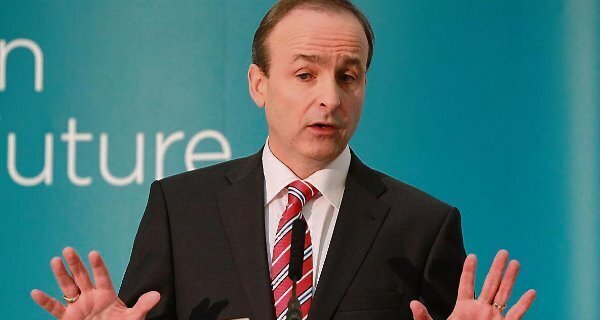
Enda Kenny suffered years of negative polls, related to his personal popularity, before coming to power and creating a solid government. Micheál Martin’s poll results are consistently ahead of those of his party.
Yet people within Fianna Fail who should know better keep surfacing, suggesting that, because he is Old Guard, he should be removed.
This belief that the economic meltdown hangs over Fianna Fáil like the Grim Reaper’s scythe is belied by the experience of Barry Cowen, the previous taoiseach’s brother.
The demonstrable fact of the matter is that someone who is well-prepared, clear, and cogent can make it into public consciousness and acceptance even if his brother lies athwart his progress like a speed bump.
Fine Gael came out of its PTSD thanks to its leader, thanks to the youth and promise of its front bench, and thanks to circumstances. It helped, too, that the worm wasn’t a factor in the last election.