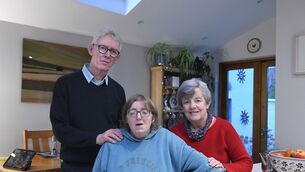
My rugby career is a game of two halves: bad player and ardent fan
Iāve read reports of booze-fuelled riots on trips like these, but there was no danger of that. Just much nodding and sighing as you passed one another, an unspoken acceptance that this year had passed us by.
It was all about the match. Thousands of us had travelled in hope, and thousands of us had come home in a sort of despairing resignation. Joe Schmidt had a plan, and it was going to guarantee the Grand Slam. The plan had reckoned without the most extraordinary resilience Iāve ever seen from a Welsh defence (and a few of our own set-pieces going astray).
I had felt pretty confident heading off to Wales. In my day, I easily qualified as one of the worldās worst rugby players, but Iāve always been lucky in picking the few matches I have seen live. In that sense, my rugby life has been in two parts. Actually, three: dreadful player, life-long fan, and, for a period in between, devoted enemy.
It doesnāt take long to dispose of my playing career. Have you read At Swim Two Birds, the funniest book ever written? If you have, youāll remember the description of Finn McCool. āFinn MacCool was a legendary hero of old Ireland. Though not mentally robust, he was a man of superb physique and development. Each of his thighs was as thick as a horseās belly, narrowing to a calf as thick as the belly of a foal. Three fifties of fosterlings could engage with handball against the wideness of his backside, which was wide enough to halt the march of warriors through a mountain pass.ā
Perhaps it would be an exaggeration to compare myself to Finn McCool, but at school, in Presentation Brothers College, Bray, Brother Malachy decided that I would be a passable second row forward, because of the wideness of my backside. Brother Malachy was a warm and decent man, without a bad bone in his body, but, said he, āwith a behind like that Finlay, at least you can push!ā
And push I did, though seldom to much effect. I got picked the odd time (itās one of the reasons I have a bent nose ever since) because Pres Bray, as we called it, was never a premier rugby school. In fact, when I was there (a long, long time ago), the legendary hero of the school was a man called Aidan Bailey. He had helped to win the Leinster Senior Cup for Pres in 1932, and had been capped for Ireland two years later, at the age of 18 ā the youngest player ever to play for the country. Nothing much happened in the next 30 years, until I came along. And then nothing at all happened.
Then, to make matters worse, I transferred out of Pres Bray into Pres Cork. A different kettle of fish entirely. Pres Cork was a place that seemed to produce a new rugby legend every week. In the class ahead of me was a player called Barry McGann. McGann played soccer and rugby for Ireland, and, in 1973, he kicked a conversion for Ireland that should have beaten the All-Blacks for the one and only time in our history. Tragically, although every single person in the stadium saw that kick go over, the referee disallowed it.
In my own class, when I was in Pres, one of our heroes was Donal Canniffe. Iāll come back to Donal in a little while. Suffice it to say that in a school where there was genuine and real talent ā children half my age could push twice as well as me, and run and catch and pass as well (skills that had always eluded me) ā my rugby-playing career came to a premature end. Simply put, I never got picked again.
Iām not bitter, you understand. Well, I was bitter for years, but I did eventually come to terms with the fact that if you want to be good at a game like rugby, and you have no natural talent, you have to work bloody hard. And I was always much better at complaining about being left behind than I was at getting stuck into the work.
It was the visit of one foreign team that turned me off rugby, and the visit of another that made me fall in love with it again. Thomond Park was a grey, bleak, concrete place back in January, 1970, when the Springboks came to visit. It was an all-white team, at the height of the apartheid regime, and it had been greeted by strong protest everywhere it went.
By the time they came to Limerick, dozens of people had been arrested throughout the UK and in Dublin.
Limerick was different. Limerick made the Springboks welcome ā and went to very considerable effort to do so. Four hundred gardai were on duty to protect the team and its loyal fans from any disruption, and barbed wire was put up on top of the walls around the ground to prevent any of the protestors from climbing over.
In the event, 10,000 people went to the match and a couple of hundred protested outside. While the protest was led by the late Jim Kemmy, the team was made welcome by another member of the Labour Party, the mayor of the city, Stevie Coughlan (the row that ensued ultimately led to a split that saw both of them out of the Labour Party).
Along with a tiny group of friends from UCC, I was one of the little band of protestors. We had been described, a couple of days earlier in the Limerick Leader, as ādangerous thugsā and been warned to expect rough treatment from the gardaĆ.
If you saw us, shepherded into a corner by actually very respectful Gardai, and huddled against the biting cold, youād have thought us more pathetic than dangerous.
We were mocked, jeered, and spat at by the crowd as they passed. There were a couple of priests, in particular, who seemed incensed at our presence, and they came right up to us to shout their anger into our faces. You wouldnāt say it was scary, but I will always remember it as a deeply unpleasant experience.
I couldnāt understand how the game I loved had descended to that level. It was bad enough that so many people were willing to turn a blind eye to something as destructive and pernicious as apartheid, so they could go and watch a football game.
But Thomond Park went further than that. It welcomed the ambassadors of apartheid, and spat at their protestors.
But then, eight years later, Thomond Park redeemed itself forever. I went back for the first time, to see a no-hope Munster team take on the invincible All-Blacks. That history takes no telling.
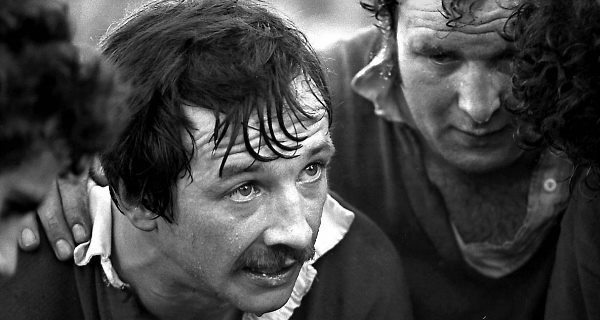
Captained by the great Donal Canniffe, Munster did what no Irish team did before or since. And I was there, not protesting this time, but cheering myself hoarse. And Iāve been in love with the game ever since.
The visit of one foreign team turned me off rugby, and the visit of another made me fall in love with it again
More analysis and comment here