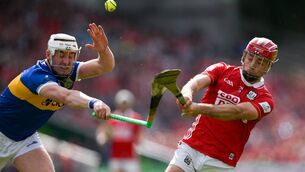
Gaelic games the loser when players can’t express personality

The telephone is okay, and can sometimes be excellent. But the phone has its limitations, particularly if the journalist has never met the player before.
There is nothing like seeing the whites of someone’s eyes. Once trust is established, a player will usually relax and that’s when the journalist can delve beyond the clichés.
The truth is, readers aren’t overly concerned about ‘the mood in the camp’. People like to know about people. It’s the personality behind the player which really fascinates readers.
When I met Down’s new captain Conor Laverty last Wednesday, I was hoping to get a glimpse at the man behind the beard. While I had spoke to Laverty a few times after games, I’d never had a proper sit-down chat with him. After about 20 minutes, most players will start talking freely. Laverty was different.
After meeting him in a café in Belfast city centre, he never veered off script. He was always concentrating. The eyes remained focused.
The cogs never stopped spinning. It wasn’t actually Laverty’s fault. He was answering the questions. I was just asking the wrong ones.
Most footballers have a wide interest in sport and it’s always interesting to discover their interests beyond the GAA. With Laverty, this line of enquiry drew an absolute blank. “I would have no real interest in watching a full soccer match,” he said. A 90-minute game. Laverty made it sound like a five-day Test match.
It was only as the interview drew to a close and the photographer was about to arrive I hit upon the topic which got Laverty to open up. Family. Laverty and his wife, Roisin have two sons, Conlaoch (3) and Setanta (1). Conlaoch is football crazy.
“You want to see him filling the gear bag,” said Laverty. “He puts the foam roller in. Then he puts the boots in, the gloves in, the shorts in. He is dynamite.”
It was the foam roller grabbed my attention. For clarification, I asked: “Is that your bag he is packing?”
“No, no,” came the instant response. “That’s his own bag. He sees me doing it. He knows the craic,” said the grinning father.
Already a fanatical footballer, Conlaoch Laverty is also a devoted fan. The three-year-old never misses a Kilcoo match.
“When the band starts playing, he stands up for the national anthem. And he stands with his hands by his side. Then at the end of it, he shouts: ‘Up the Magpies’.”
By this stage, Laverty was no longer answering questions. The interview had finally become a conversation. Outside of sport, it emerged the 29-year-old likes farming. Not surprisingly, Conlaoch likes farming too. “He is football and farm mad. Everyday, that’s the truth. He would rise with me at half six and away we’d go.”
Sports journalists who cover Gaelic Games are very fortunate. The players we meet are real people who live in the real world.
Phil Neville revealed recently that when an agent came to his house, he had to ring his wife to find out how to make a cup of instant coffee.
After rising at 6.30am to walk the fields with his son, Conor Laverty drives to Dublin. He is the GAA Development Officer at Trinity College. His life is family, football and farming. A firmly rooted individual.
I am not trying to curry favour when I state I have nothing but admiration for the overwhelming majority of players. Given the choice, it’s always preferable to praise the players and they games they produce. However, that is becoming increasingly difficult.
The man who took me to Derry games once described soccer as “a good game to watch while you’re reading the papers”. While sitting in his armchair, he liked to dip in and out of the action. He could read a few stories, maybe study the form of a few horses, and when he lifted his head again, it would still be 0-0.
When Derry played Tyrone in Healy Park a fortnight ago, I could have brought the newspapers. Last Sunday, Donegal and Monaghan produced another dog of a match in Letterkenny. It was another celebration of hand-passing. Another festival for fans of a 15-man defence.
As ever, even though the whole country is engaged in this ultra-defensive muck, Mickey Harte was the only manager asked to explain his team’s style of play. “I like to see quality defending,” said Harte who refused to apologise for his tactic of taking 15 men behind the ball.
“Many other teams get all their players behind the ball. In fact, in Premiership soccer — I know teams have 11-a-side — but sure how often do teams have everybody behind the ball, make a break and score.”
Harte indicated his tactics were designed to serve a purpose. “The game will be played as it needs to be played. If people like that, they’ll come along. If they don’t, they’ll vote with their feet and won’t be there.”
As Tyrone manager, Mickey Harte is perfectly entitled to devise whatever game plan he wants. And in a results-driven game, it’s his prerogative to coach the system which he believes will garner the best outcome for his team. The same applies to all the managers who are sending teams out to play basketball on a bigger field.
But that’s not the point. On the same weekend when the World Games were played in Dubai, the GAA must consider one pertinent question: would the football witnessed in this year’s league inspire anyone to start playing the game? Croke Park likes to believe the inter-county game is the GAA’s main marketing tool. That theory is beginning to look increasingly suspect. It could just as easily be argued the global expansion of Gaelic football is happening in spite of inter-county football. It’s the enthusiasm of the Irish diaspora and innocence of the game abroad driving the development of clubs across the globe.
Our players deserve be celebrated. Ideally, our game should provide them with a platform to demonstrate their character, skill and courage. It should also allow them to express their flair and individuality.
Sadly, they are playing a game that has become downright mundane.
While outlining his suspicions about Lance Armstrong, the journalist David Walsh wrote that “we reserve the right to applaud”.
Managers should take note. Yes, by all means, your entire team can play in one half of the field. And yes, your team can spend the entire game running in circles and hand-passing across the pitch. If it delivers the desired result, you will keep your tribe happy. Just don’t expect the rest of us to look up from our newspapers.
— Twitter: @HeaneyPaddy