If male TDs had wombs they might have more balls when they vote

The festive season just past is all a bit of a blur now, but one thing I can’t get out of my head is the image of another woman who had no involvement at all in getting her family ready for Christmas.
No, this woman was ill, seriously ill, in fact she should have been dead. She was lying in a hospital bed with her brain rotting.
Rather than having the simple joy of looking forward to Santa -— like my children were— hers were brought in to see their mother in hospital. Although make up had been put on her face for the occasion I remember reading how she was almost unrecognisable from the beautiful young woman she had been. Her eyes could not close because they were so swollen. There was an open wound on her head and because of the lack of blood flow there her brain appeared to be rotting.
The State was keeping her alive because some of it’s citizens, employed by the HSE, were afraid, understandably, of the repercussions of switching off her life support because she was pregnant. The woman had been 15 weeks pregnant when she was declared clinically dead on December 3 following a brain trauma. However doctors felt they could not withdraw life support because of uncertainty over the constitutional status of the foetus.
It was never going to be an easy situation for those two children whose mother had effectively died weeks earlier, but to have this as the final memory of her was beyond tragedy.
I’m hearing the term “repugnant to the Constitution” all week in relation to the Bill on fatal foetal abnormalities introduced by Independent TD Clare Daly which was voted down by the Government. But each time I heard it, all I could think of was how repugnant I find the treatment of that woman and her family and the other women in this country, and how they are treated at a time when they are most in need of assistance from the State.
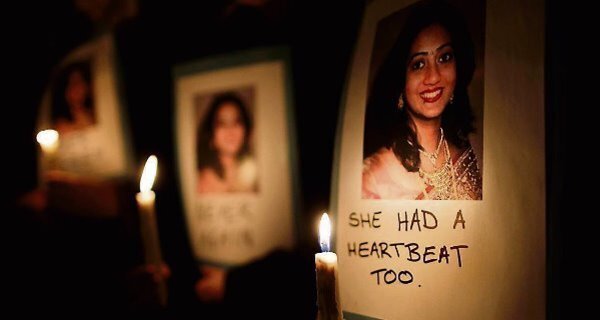
I’m thinking of Savita Halappanaver and how she asked for an abortion when she realised she was miscarrying, but was refused one, and how an Irish woman in similar circumstances would probably never have made the same request because we are so culturally conditioned to believe that in these matters it is our place to suffer, and these things are not to be spoken of out loud, but furtively. What a hard lesson for her and her husband to learn in their adopted land.
I think of yet another woman recently caught in an unspeakably awful situation— the one who found herself pregnant as a result of being raped as a war crime, arriving in Ireland as an asylum seeker and discovering herself pregnant but not having the resources she needed to travel to get the abortion she wanted. She attempted to take her own life. She was forced to undergo a caesarean section.
I think of the woman who is told that the baby which is growing in her belly has a condition which is incompatible with life. I try to imagine what it must be like to hear such a thing, and after deciding she does not wish to continue with the pregnancy the woman then being told she will have to leave the country of which she is a citizen and travel elsewhere for a termination. I try to imagine something else as barbaric, and I fail.
I think further of those women who are told their baby has a fatal foetal abnormality and who travel to the UK and make the decision, which is entirely understandable although risky, to travel back home after the first part of the termination procedure has been carried out, preferring to deliver in a hospital at home. So these women drive to the airport, check in, wait for their flight and fly home, mid procedure.
Most stay in the UK and face the heartbreak of having the cremated ashes of their baby sent home by courier a few weeks later. A few come back to collect the body of the baby and put it in the locked boot of the car and travel home by ferry. Either scenario is obscene.
The Termination for Medical Reasons Ireland (TFMR) group, which campaigns for a change in Irish law to allow termination in the case of fatal foetal abnormality, wrote a letter earlier this month to Taoiseach Enda Kenny. They appealed to him to allow a free vote on Clare Daly’s Bill. They pointed out how insult is added to their injury because the longer their situation continues the more of them have to break anonymity, and expose themselves to “deeply hurtful abuse from some segments within our society to ensure that you and your colleagues are sufficiently informed to enact just laws”.
We’re racking up some set of examples aren’t we? We’ve had no shortage lately of “hard cases”, each with their own shocking detail. My worry is, that on one level, rather than this all being seen as utterably intolerable, there may be a certain level of us all becoming a little inured to these situations.
A sort of toleration has built up about women and their partners getting on boats and planes to deliver babies that were never going to live. We’re also living with the idea of a woman being forced to deliver an unwanted baby by caesarean section, or the body of a clinically brain dead woman being kept alive because of a fear over doctors being prosecuted.
I’m not suggesting those who believe there should be something done by our politicians are changing their minds, rather I’m worrying the number of cases we are hearing about, and their regularity, make it easier for the Government to continue to do nothing.
There is zero chance of anything happening ahead of the next general election. However in their manifestos the political parties must include their exact intent in relation to abortion, and fatal foetal abnormalities, and a timeline of when their intentions would be carried out, if they were to end up in Government.
This is some country to be a woman in. Looking at the Dáil on Tuesday afternoon and watching all those men troop through the lobbies to vote No to the Daly Bill, I couldn’t help but think that had all of them been in possession of a womb they might have had more balls.
READ NEXT: ALISON O'CONNOR: If male TDs had wombs they might have more balls when they vote
CONNECT WITH US TODAY



Be the first to know the latest news and updates