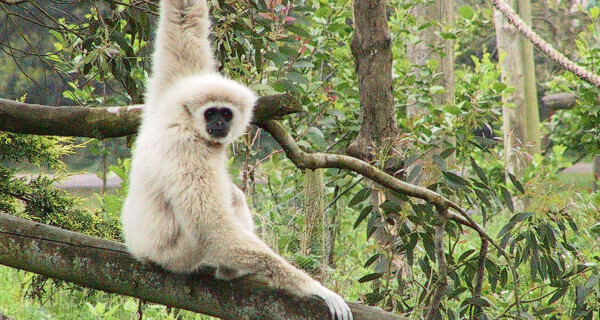
Gibbons can communicate with each other and have an extensive vocabulary
This conviction started to erode around a century and a half ago. Evolutionary theory suggested that we developed from animals and might have more in common with them than we realise. The progress of science since then has proceeded to chip away at our notion of our own uniqueness.
But one point of difference that we have clung to with something approaching desperation is the notion that we are special because we have language and can use it to communicate with each other in a way that no other living creature can.
However scientific research is casting increasing doubt on this assumption. It’s beginning to look as though some species of animal, and even some birds, can talk.
But in order to unlock the secret of Dr Dolittle and understand what they’re saying, perhaps even be able to talk back to them, we have to create some rather complex computer algorithms and listen very carefully.
One place where this is happening is the University of Wisconsin-Madison where scientists have been working with lar gibbons, also called white-handed gibbons. These endangered noisy apes live in rain forests in south-east Asia. But the ones the researchers are working with live in a nearby zoo.
Their results are startling. The gibbons not only have an extensive vocabulary, they also have elements of grammar and are able to construct simple sentences by using adjectives with nouns.
This is the first time such an ability has been demonstrated in a non-human animal and, amongst other things, it should throw light on the complex subject of how human languages first evolved.
Another of Darwin’s ideas was that spoken language might have evolved from singing. Much of the current research tends to support this theory. It seems increasingly likely that music is the precursor of speech.
There is other research going on in other parts of the world into animal and bird languages. They’re also working with gibbons in Japan, Australia and the UK.
In Florida a scientist has taught a dolphin a word for a particular type of seaweed and the dolphin appears to associate the sound with the object and, on at least one occasion, has repeated the word — in effect talking back to the scientist.
In a way, this is not that extraordinary. If I say ‘ball’ to my dog he goes and gets his ball. If he could make the right sounds I’m sure he would say the word back to me.
The prospect that some IT wizardry could unlock this barrier and let us communicate with other species is an exciting one.


CONNECT WITH US TODAY



Be the first to know the latest news and updates