Verbal attacks on Israel encourage the killing of Jews in Europe
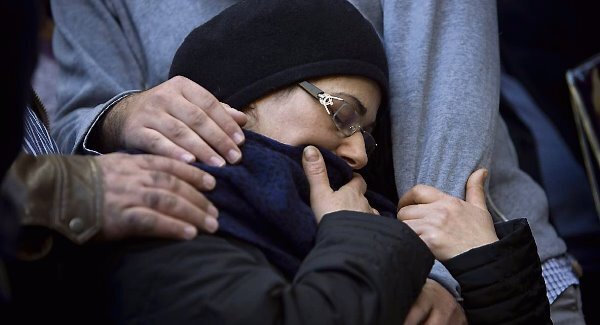
FTER a horrible event, it is necessary to stand back from the horror to understand it. It is one week since the attack on Charlie Hebdo; five days since the attack on the Kosher supermarket; and three days since millions marched in France.
We are in the throes of events that are destined to last for a generation, and perhaps more.
There is no quick- fix, no short-term solution.
That the attacks — first on a newspaper, a bastion of secularism, and then on a Kosher supermarket — were connected is chilling, but hardly surprising. One place apparently profaned religion; the other, in supporting the faithful to keep their dietary laws, was part of a religious establishment. Damned if you do, damned if you don’t.
This is the conundrum integral to Jewish experience in Europe. Waves of pogroms in the east drove Jews west. Many integrated and became secularised, believing that by becoming French or German in identity they would be protected, and would prosper in countries signified by enlightenment values.
The truth of that proposition was at the heart of the European enlightenment and the French Revolution. Last week, the French prime minister, Manuel Valls, said of his country: “To understand what the idea of the republic is about, you have to understand the central role played by the emancipation of the Jews. It is a founding principle.”
Speaking to The Atlantic magazine, Valls, who is the son of Spanish immigrants, said. “If 100,000 French people of Spanish origin were to leave, I would never say that France is not France anymore. But if 100,000 Jews leave, France will no longer be France. The French Republic will be judged a failure.” What Valls says of France applies to Europe. It applies to Ireland.
The genesis of events in Paris last week is generations old. It is a legacy of failed state-making following the First World War. Our ‘decade of commemoration’ overlaps with this thematically.
As millions of French people marched on Sunday, and hundreds of millions watched them on TV, in Ireland hundreds of thousands of people tuned in after RTÉ’s Nine O’Clock News to watch the second episode of Charlie. Charlie Haughey premised his analysis of this island with his description of Northern Ireland as a “failed political entity”.
Just as the dismemberment here of the British Empire led ultimately to a crisis of authority, as acted out in sectarian violence, so, too, with the Ottoman Empire in the Middle East.
Lebanon, Syria, and Iraq have never been stable or successful states. The legitimacy of Israel has never been accepted by most of its neighbours. Their repeated attempts to destroy Israel led, after 1967, to the occupation of the West Bank.
A template has not been agreed that would resolve the occupation and secure acceptance for Israel. Egypt, the largest Arab country, is barely held together, under an autocratic rule that frequently fails to provide for its people’s basic needs, let alone their aspirations.
Across the Arabian Peninsula, dynasties rule oil-rich territories as kleptocracies and theocracies, simultaneously. There is profound alienation of Arab populations, overwhelmingly Muslim, from their governments and what they see as western hegemony.
Unable to right the wrongs of their own countries, they personify and demonise Israel as either the root of all evil, or at least the most potent symbol of what is wrong. In Europe, every Jew, by default or design, risks being signified, again, as an outrider for deeper forces elsewhere. This has a name. It is called anti-Semitism.
The tone, as well as the content of much of what passes for discussion on Israel, is too often a feral legitimisation of anti-Semitism. What bothers me is neither criticism nor attacks on Israeli policies generally, nor specific actions in particular. That is legitimate debate. What is not is an increasingly blanket failure to contextualise, let alone try to understand, the perspective of a state in which people feel threatened and besieged.
Very many people in Israel look around, and believe they see no genuine partners for peace who can match both willingness and capability in delivering their countries into lasting agreements. No constructive conversation can begin without at least an understanding of the Israeli perspective.
It is ironic that after every outrage in the West there is a mass demand for increased security. It is invariably accompanied by suspicion and demonisation of Muslims at large.
Yet, ironically, the impulse for self-defence, and the societal suspicion we so willingly indulge ourselves, are singularly and ferociously condemned in the case of Israel. It is a continuous and sulfurous condemnation, largely unleavened by any parallel critique of the reality of that country’s surrounds in the Middle East.
For France, the failed state-making in the former Ottoman Empire is coupled with the legacy of its colonisation in North Africa, especially in Algeria. In vast sink estates on the periphery of French cities, millions live on the edge of a society that has never embraced them.
That lack of embrace is now accentuated, for a younger generation, by an alienation expressed in a politically driven, religious radicalism that has its roots, or at least finds expression, in the events of recent decades in the Middle East.
The failure of Arab states to give either leadership or legitimacy to their own people is as much at fault as any Israeli overreaction. And so horrible acts arrive, by circuitous routes,to a Kosher supermarket in Paris.
Most anti-Semitism does not manifest in massacre. It is graffiti; it is small, but significant, acts in public places; and it is a felt perception of, again, after all that has passed, of being unwelcome or even in danger. A persistent delegitimatisation of the state of Israel is legitimating this danger in France, in the view of its own prime minister, and it is happening here, too. This is not a criticism of debate, it is the result of debate without contextualisation.
Probably the greatest French author was Marcel Proust. The assimilated-but-not-out son of a Christian father and Jewish mother, his seven-volume novel Remembrance of Things Past is one of the greatest works of literature. He wrote of a French drawing room, where “a Jew making his entry as though he were emerging from the desert, his body crouching like a hyena’s, his neck thrust forward, offering profound ‘salaams,’ completely satisfies a certain taste for the oriental.” Few in our contemporary conversation have the lyricism of Proust.
But like him at the start of his great work, we only have to taste the madeleine biscuit we have dipped in tea to be disturbed by the flood of returning memory. This is Europe now, disturbed, threatened by the flood of old memories. Islamophopia is one; anti-Semitism is another.










