The law fought Redmond and he won
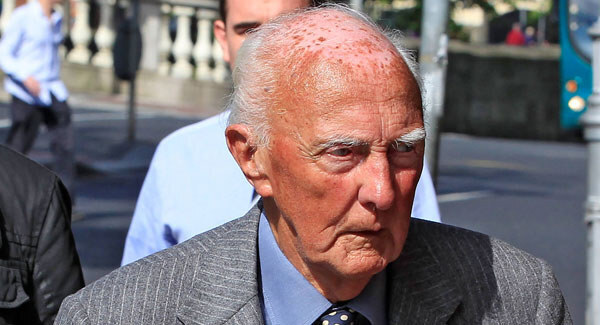
He spoke briefly outside the Four Courts. “It has been going on a long time and it has had a huge effect on my life and the life of my family,” he said.
The High Court hearing had ruled that findings of corruption against Redmond, by the Planning Tribunal, be overturned, and that his costs for attending the tribunal be paid by the State. The basis for the ruling was that evidence from the chief witness, James Gogarty, was witheld, and could have brought Gogarty’s credibility into question.
Some media outlets reported that Redmond had been vindicated.
His story could have been made in Hollywood. Plucked from retirement, he was hauled before the Planning Tribunal, which was set up to investigate planning corruption, but which, in the eyes of some — including not a few judges — lost the run of itself.
Redmond came to the tribunal’s attention. He was investigated every which way.
Most of the evidence against him consisted of allegations by a few witnesses, who painted him as a grasping, greedy man who used his position to hoover up money.
In its third interim report, the tribunal found against him, that he was corrupt.
That was bad enough, but the Criminal Assets Bureau went after him, charging him with criminal corruption. In 2003, a jury at Dublin Circuit Criminal Court convicted him, and he was sentenced to a year in prison. Redmond was 79.
Six months later, the Court of Criminal Appeal overturned the verdict. Redmond was vindicated, although he had served half his sentence.
The CAB didn’t stop there. He was prosecuted again, in 2008, on corruption charges in relation to two separate incidents.
The jury found him not guilty in one case, and couldn’t decide in the other. Vindicated again. It was as if the State was doing everything it could to hound this man, who had served as a public official for 48 years.
This story has it all. The steely pensioner going up against the might of the State. A miscarriage of justice. The long walk to freedom, as he labours through the winter of his life, to clear his name for his family.
And, finally, when his enemies are dead and gone, and the tribunal has been exposed as an out-of-control beast, vindication. Redmond exits towards the sunset, shuffling off with his good name under his arm.
There is another version. Old George is entitled to his good name before the law, but, throughout much of his public service, he conducted himself in an inappropriate manner.
Redmond’s problems came to the fore on February 5, 1999, when he was arrested at Dublin Airport in possession of £300,000 in cash and cheques. He had withdrawn the money from offshore accounts in the Isle of Man.
In the months following his arrest, he made a number of admissions to CAB officers, which were aired at his criminal trial in the absence of the jury.
He told the cops that he’d acquired the money for giving advice, consultancy work, and the odd finder’s fee, but nothing illegal, nothing criminal. All of this activity took place while he was a senior public official with major influence and power on planning matters.
From early on in his career, he gave of his advice freely. One neighbour to whom he gave advice showed his gratitude by offering him goods at his hardware store at wholesale rates.
He introduced another man to a council tenant. “I had an old car and was facilitated by a trade-in. He paid the difference,” said Redmond. “He gave me a few pound at Christmas. I got £20 from another man. I gave people advice. I never asked for payment.”
Redmond became friendly with a colleague in the council, Paddy Treacy, who subsequently left and went to work for Gallagher’s, one of the biggest house-building firms in the State.
Treacy organised a good deal for Redmond on a new home in Castleknock. Their relationship grew.
“Paddy Treacy became a regular gift-giver at Christmas and builders’ holiday. He gave gifts of £10,000 and £15,000 per year… one Easter we went for a holiday in Mallorca. He paid for it,” Redmond told the CAB men. This was when Redmond’s annual salary was under £10,000.
“I advised the Gallagher group and that was what the money was for. In the 1970s and 1980s, Paddy Treacy was the bagman. He gave cash from other builders. He did work for other builders. If there was an objection in the county council (to planning), I would have advised them. I was happy with what I got.”
He also told the cops that he got money from the late PV Doyle, the founder of Jury’s Hotels. “On two occasions, I got cash from PV Doyle in the 1970s,” he said. “I don’t recall doing anything for him. When he gave me the money, I knew he had an expectation to ingratiate himself to me. He had plans for hotels.”
He got at least £10,000 from Tom Roche, the founder of National Toll Roads, which built the west link bridge on the M50 and had extensive interests in the city.
There were many others who gave Redmond money, including a garage owner, Brendan Fasnidge, who, Redmond said, handed him £5,000 “out of the blue”. Fasatnidge, the only person willing to give a statement to the CAB, claimed it was £10,000 to sort out a right-of-way. That statement led to the criminal charge for which Redmond was convicted, before the conviction was overturned.
When he retired in 1989, Redmond’s salary was £29,000, yet at the time he had £600,000 stashed away in 33 accounts.
The Planning Tribunal has uncovered copious evidence of extensive planning corruption in the Dublin area, going back as far as the 1970s. Figures like Ray Burke, and the late Liam Lawlor — a great pal of Redmond’s — have been found to have been corrupt.
During all that time, up until his retirement, Redmond, by his own account, was in receipt of large sums of money from builders and other business interests. People just gave him money because they liked the cut of his jib.
In the eyes of the law, as expressed by both the tribunal and the criminal courts, he did nothing wrong. He is an innocent man. He has been vindicated.











