The Scottish referendum: Implications for Northern Ireland
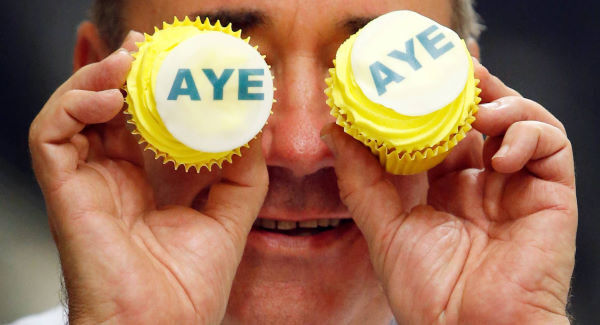
The YouGov survey shows the nationalists with a two-point lead, and if they can hold that momentum, then Scotland is on course to vote for independence in the referendum on September 18. The latest poll puts the ‘yes’ side on 51%, with the unionists on 49% — an outcome that overturns a 22-point lead enjoyed by the Better Together campaign just over a month ago. Of course the only poll that matters — that on September 18 — has still to be decided, and there is ample time for the ‘no’ side to muster its troops and sway voters.
Just now the result is balanced on a knife-edge, but already George Osborne, the chancellor of the exchequer, has warned that the referendum poses “an existential threat” to the British state. Some Conservative MPs have even said that David Cameron would have to resign as prime minister if Scotland decides to go it alone. This is just one of many imponderables raised by the referendum. The TV debates between Alex Salmond and Alistair Darling ranged across a number of these. There is the currency question, the revenues from North Sea oil, the future of the nuclear submarine bases in Scotland, the implications for Queen Elizabeth II as Scottish head of state and her oath to uphold the Church of Scotland, and, crucially, the status of an independent Scotland vis-à-vis the EU.
Here is Ireland we may also wonder what the implications of a ‘yes’ vote might be for us, especially Northern Ireland. Here in the Republic, given our history and our long, complex and sometimes bloody relationship with the British crown, it would be surprising to discover that there isn’t an innate and indeed instinctive sympathy with the ‘yes’ side. The union of Great Britain and Ireland (ended by the Anglo-Irish Treaty of 1921) dated from 1801; the union of England and Scotland is of even older origin, dating from 1707. A ‘yes’ vote, therefore, would rend asunder a 300-year-old polity with consequences that even the most enlightened on either side can still only guess at. Would hardline unionists in the North, for instance, seize on a victory for the ‘yes’ side as a mechanism to press for a fully independent Northern Ireland, the better to guard against and scupper any Sinn Féin campaign for a United Ireland. Could a fully independent Northern Ireland ever hope to survive economically? That’s a question for another day, though victory for the ‘yes’ side will undoubtedly give it a fresh urgency. The biggest challenge that will face the architects of an independent Scotland will be sorting out the new country’s relationship with Brussels. Scotland is in the EU now under the umbrella of the United Kingdom, but what of the status of a breakaway Scotland? No convincing answers to this crucially important question have yet been forthcoming. If a newly independent Scotland has to start from scratch and apply for membership of the EU, that could take a considerable length of time to be processed. And a miffed parliament in London is unlikely to be helpful.
CONNECT WITH US TODAY



Be the first to know the latest news and updates