Who’s the fastest land animal?
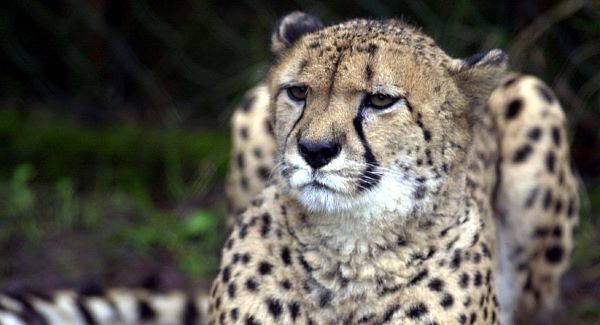
The Park’s ‘cheetah run’ is a special attraction, not just for visitors but for the cats themselves. Food, suspended from a hook, is moved at speed and the cheetahs chase after it just as they would when hunting down prey in the wild.
The cheetah is an ambush predator. Other big cats creep close to their victims before pouncing. The cheetah does likewise but the striking distance is much greater. Accelerating to 100km/h in less than three seconds, it can reach 130km/h in a 300m sprint, drawing 120 breaths per minute through extra large nostrils. A racehorse’s maximum speed is around 74km/h. The Jamaican runner, Usain Bolt, reached 44.72km/h, very briefly.
The cheetah’s claim to be the world’s fastest sprinter seemed unassailable; surely nothing could outrun this animal over short distances? Then in the 1990s, to everyone’s surprise, it lost the coveted title to an American cockroach, able to run on its two hind legs. This record, in turn, was overtaken by a beetle. Now, an even smaller creature has grabbed the limelight.
To compare performances in the animal Olympiad, ‘a level playing field’ must be established, taking account of size. Speed, the judges argue, should not be measured in km/s but in body lengths/s. A cheetah, running at 100km/h, clears about 16 body lengths every second.
In the 1990s, scientists began studying Australian tiger beetles. These predatory insects hunt in short super-fast spurts, the way cheetahs do. Moving so quickly, their small eyes can’t gather enough photons. The resulting temporary blindness may explain their curious start-stop behaviour. Although running at only 9km/h, one species of tiger beetle covered 171 body lengths in a second, 22 times what a human athlete could achieve.
Losing out to another furry mammal would not have disgraced the glamorous cheetah but being upstaged by cockroaches and lowly beetles was a comedown indeed. ‘See how the mighty are fallen!’ Now, it’s the beetle’s turn to go down in flames. Samuel Rubin, of Pitzer College in Los Angeles County, has been studying a creature so small its legs are virtually impossible to see with the naked eye. It has no vernacular name and the scientific one is a bit of a mouthful: Paratarsotomus macropalpis. Native to Southern California, this distant relative of spiders lives in cracks in sun-drenched rocks and the verges of stony pavements. Its hunting behaviour resembles that of the cheetah; the mite remains motionless for long periods and then sallies forth in a high-speed sortie. Like the cheetah, it can change direction quickly when at speed.
To measure the little animal’s performance, Rubin had to abandon conventional methods. He placed mites on flat concrete surfaces in temperatures up to 60°C. Using a special camera, he videotaped them and calculated their speed from the recordings. The results were presented at the 2014 Experimental Biology Conference in San Diego. The maximum velocity, attained by a mite, was 322 body lengths/s, almost twice that of a tiger beetle. If a person could travel at a corresponding rate, he or she would reach 2,000km/h, almost as fast as Concord! But why does a mite need to travel this fast? Is it trying to avoid being burned when running on a hot surface, as a barefoot person can pass over hot coals by running fast? Apparently not; like a space shuttle, the mite has a heat-resistant outer layer protecting it. The explanation, it seems, is that, like the cheetah, the mite needs to be super-fast to catch its prey. This led Christine Dell’Amore of National Geographic to suggest that mite’s prey must run at a comparable speed.
Scientists have not yet identified what creatures the mite eats but they are bound to be very small indeed. Applying the ‘scaling rule’ for sporting comparisons, they must also be faster runners. If Dell’Amore is right, the mite with the unpronounceable name won’t hold the world record for long.
CONNECT WITH US TODAY



Be the first to know the latest news and updates