Bird’s eye view from my window
I haven’t felt too deprived because this is normally the most interesting time of year for watching birds at the feeders.
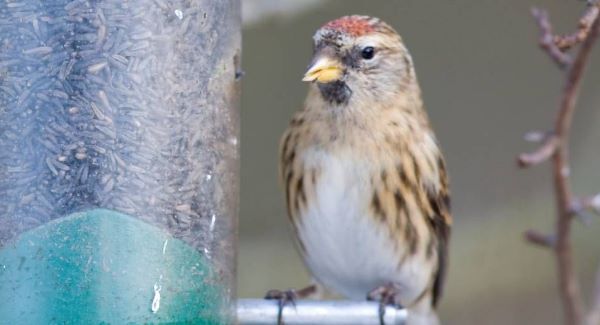
As the winter progresses, supplies of wild seeds in the countryside dwindle and shyer species that are usually reluctant to come into the garden are forced to join the regular visitors to the feeders. February is the month I’m most likely to see siskins, lesser redpolls (inset) and long-tailed tits.
And there’s always a chance of a real rarity, like a brambling.
In fact the less common birds have been slow to arrive this year. The preferred diet of the species I’m waiting for is birch, alder or larch seed.
At least, I think this is the explanation. But birds like siskins and redpolls travel massive distances in winter in their search for food, sometimes thousands of kilometres, and it’s very hard to predict their movements.
There is one exception to the general lack of interesting birds, a single male lesser redpoll competing for access to the ports on the niger seed feeder.
He already seems to be in his breeding plumage because he has a pink flush on his chest and a bright red crown.
He is a very small bird, smaller than the goldfinches and very much smaller than the greenfinches he’s competing with for access to the seed.
Despite this he holds his own, muscling in to the perch on the feeder and refusing to be dislodged by the aggressive wing fluttering and abusive calls of the larger finches.
Lesser redpoll is a slightly silly name because there isn’t, in fact, a greater redpoll.
Exactly how many other species there are is a matter of heated argument among the very small number of people who argue about such things. Being a ‘lumper’ rather than a ‘splitter’, I prefer to think of one redpoll with a massive circumpolar range embracing Scandinavia, through Siberia to Alaska, Canada, Greenland and Iceland. We are at the extreme southern limit of this range and there is evidence that redpolls have colonised Ireland quite recently and are spreading here.
With such a vast range and such a variety of habitats it’s not surprising that there is some variation in redpolls.
CONNECT WITH US TODAY



Be the first to know the latest news and updates