Cycling can teach GAA a trick about peddling its wares
The scene that greets us is one of chaos and colour. The street is thronged with life. There are cyclists, pedestrians, banners and noise — lots of noise.
The policeman is informed that we are Irish journalists who have come to see the ‘partenza’. He waves us through.
We park beside a pink bus. It’s pink because La Gazzetta dello Sport is printed on pink paper and the newspaper sponsors Il Lombardia, the last one-day Classic of the season.
These are the races every top bike rider in the world wants to win, Milan-San Remo, Paris-Roubaix, Liège-Bastogne-Liège, The Tour of Flanders and Il Lombardia.
Win a ‘Monument’ and a rider’s name is etched into the sport’s history where he will join legends like Binda, Bartalia, Coppi and Kelly. Sean Kelly won this race three times.
That was back in the day when Irishmen like Kelly and Stephen Roche ruled the continent while their British counterparts didn’t count. But those days have changed and one of the reasons for the shift in power sits directly across the road. It’s Sky’s team coach, the temporary home of the last two winners of the Tour de France, Bradley Wiggins and Chris Froome. Two gleaming Jaguars, sprayed in the familiar black and blue livery of Team Sky are parked behind the bus. The Pinarello bikes on the roof of the cars have gathered their own fan club.
Italian club cyclists are salivating over the bikes. I join them. I salivate too, because I, too, am a bike perv. Further down the street is the Garmin Sharp team bus. As I approach, Ireland’s Dan Martin hops onto his bike. He wheels away towards the noise where a bigger crowd has gathered. He’s going to sign in.
This little pre-race ritual is probably unnecessary, but cycling reveres its traditions. And besides, the ‘foglia firma’ (signature check) serves an important role. It allows the public to see their heroes in the flesh, without helmets and sunglasses. And all the heroes are here. Vincenzo Nibali, Phillipe Gilbert, Peter Sagan, Nairo Quintana, Alberto Contador, Joaquin Rodriguez, Rui Costa and Alejandro Valverde. I join the crowd. The Italian fans are unashamedly partisan. While I am there, Sagan, the green jersey winner at the Tour de France, and Quintana, who won the polka dot jersey are introduced. They salute the crowd. There is virtually no applause.
Then Vincenzo Nibali walks onto the stage. Nibali is Italian. Even more, he’s an Italian champion. He won this year’s Giro d’Italia. When Nibali waves, the crowd erupts. But there is another rider, or to be more precise, a jersey, that can break the veto on cheers for non-natives.
There is magic in the rainbow jersey, the iconic garment worn by the world champion. Portugal’s Rui Costa won the title in Florence the previous week. Costa stands before us. White helmet, white jersey, white shorts, white gloves, white socks, white shoes, white teeth. And those five magic bands. He is shining. I think he looks like a cycling angel. Costa is cheered on and off the stage.
Later, when I moved to the starting point, the access to the world’s greatest cyclists becomes slightly surreal. It wasn’t just journalists who were free to mingle, fans did so as well. Ivan Basso, a fading Italian star, posed for photos. A throng followed the rainbow jersey as Costa was ushered to the front.
It was organised chaos, Italian style, and I loved it. It reminded me of the All-Ireland finals when fans were able to join their heroes on the field.
Sunday was the first time I was ever at a major cycling race. We witnessed the start and we were at the finish when Spain’s Joaquin Rodriguez was the first man home.
Since gaining an interest in cycling a few years ago, I have become ever-so-slightly obsessed. Its history, stories, cyclists, culture, even the doping fascinates me. And despite its horrific past, cycling is still selling itself to the world. Three stages of the Giro d’Italia will be held in Ireland next year.
The arrangement is mutually beneficial. The organisers of the Giro d’Italia sell their bike race while the bike race allows the Northern Ireland Tourist Board sell the wonders of the North Antrim coast.
The Giro reaches a potential broadcast audience of 775 million people. Many reside in the lucrative tourist markets of Britain, Germany and Spain.
As excited as I am about the prospect of the Giro coming to our native shores, that happiness is tinged with a sense of regret for our own indigenous games.
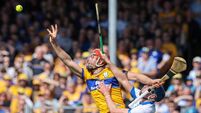
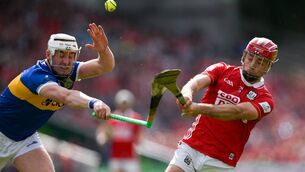
Two weeks ago, I was in Croke Park for the All-Ireland hurling final between Cork and Clare. A journalist from The Christian Science Monitor was also at the game. Since then, that journalist has stated hurling is “the greatest team sport in the world no one has ever heard of”. The Guardian was also prompted to write an editorial praising our hurlers for “playing for love not money” and expressing hope the GAA “will do all sports fans everywhere a massive favour and produce DVD copies of this memorable game”.
But why would anyone buy a DVD of a game they’ve never heard of? In the same way many people like me have recently been awakened to the thrill of cycling, there must be millions of sports fans who, given the chance, would concur with the journalist from The Christian Science Monitor. Our games, arguably our island’s finest gems, remain largely undiscovered.
Ah well, we’ll just have to hope that Cushendall are playing a home game when the Giro’s peloton passes through North Antrim next year.