Life of a high-flyer who crashed and soared deserves our attention
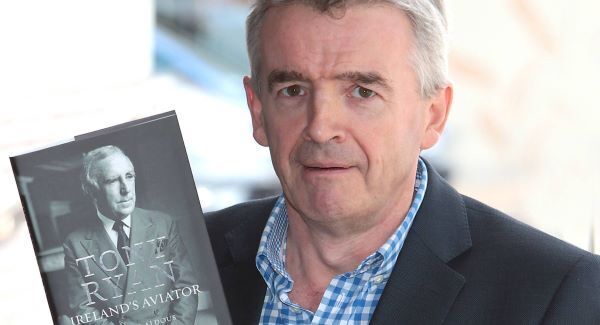
Does it reflect accurately the personality that you encountered? Does it include the most relevant stories of his or her life? The English historian Richard Aldous has produced an authorised biography on the life of businessman Tony Ryan, who died in 2007. Ryan was an extraordinarily successful businessman: he founded not one but two exceptional aviation companies, one in organising the supply of aircraft to airlines, the other in breaking a State-sponsored monopoly to create one of the most successful commercial airlines in Europe. He became exceedingly rich, lost most of it, then became exceptionally rich again.
As a business journalist I encountered Ryan most during the period of the decline of the first company, the Shannon-based aviation leasing company GPA, his seemingly fallow years after its effective collapse and takeover by the giant US General Electric, and the growth of Ryanair that led to it joining the stock market. I saw him in his pomp, reported on his fall and witnessed on occasions how he coped with it before soaring again.
In particular, I remember going with him and a group of other invited guests to an Ireland versus England rugby international at Lansdowne Road in March 1993.
Ryan’s PR man PJ Mara — famous in political circles for decades for his work with Fianna Fáil but who had left government service a couple of years earlier after his master Charles Haughey’s exit — had rung me some days previously with the offer of a ticket, on condition that I join his group for lunch beforehand. I said that I might be late because I was travelling up from a wedding in Mallow that morning. I was instructed to get there on time no matter what. I was to discover soon why.
Mara had booked two tables of 10 people at each at the pre-match lunch in what was then the tented village at Lansdowne Road. Various bankers and airline executives had been invited as guests of GPA.
We ended up all being seated at one table as 10 ticket holders did not show up for the lunch. Ryan was regarded as crashing to earth; the same people who had hung out of him a couple of years previously, desperate to get money out of their association with him, now couldn’t be bothered, moving onto the next mark.
Ryan was not happy and still wasn’t even after Ireland’s 17-3 victory, still regarded as one of Lansdowne Road’s better days, so unexpected was the result.
Mara explained why he hadn’t cheered up. An English newspaper would reveal the following day that Ryan was unable to repay a $35 million loan he had taken from the US bank Merrill Lynch to buy shares in Bank of Ireland five years previously and which he had sold subsequently at a large loss. He was on the verge of going bust.
Aldous’s book details how Ryan not just lost control of GPA but faced the loss of all of the assets he had accumulated: a variety of trophy properties in Ireland and abroad, a prized collection of art and antiques, various other investments.
But Ryan refused to transfer assets from a family trust he had set up for his now adult children, including the family shareholding in the then rapidly growing but still relatively small airline Ryanair.
Here’s how rich people stay rich: Ryan simply dug his heels in, argued strongly with his bankers that he would not repay and ended up making a settlement of just $4.5 million for what he owed. His family kept its Ryanair shareholding which, in time after it had been sold, meant a profit of about €500 million.
Michael O’Leary, then a personal assistant to Ryan before becoming boss at Ryanair, was instrumental in beating off the US bank. It isn’t explored in the book — because it isn’t relevant to the story — but it would make you wonder how well this country would have done in its dealings with the EU over the financial crisis that it if it had people like O’Leary doing the negotiations.
It also raises the issue of the giving of people a second chance. Ryan would have been ruined if the bank had been allowed to take the Ryanair shareholding as settlement of his debt — and it was a legal sleight of hand that prevented that — but had it happened then Ryanair’s very future would have been threatened.
It is most doubtful that Ryanair would have gotten to the 1997 flotation as successfully as it did and would have grown as it did subsequently without the break that allowed Ryan to continue to play his part. Playing hardball with banks can work, at least if you have the ability to face them down.
Ryan lied consistently too about his involvement in Ryanair during his GPA years. Aer Lingus was a major shareholder in GPA but he went into competition with it anyway by setting up the new airline. Should we be bothered by that, given that the competition drove down the price of air travel out of and into Ireland? If Ryan had been stopped then would all have enjoyed that benefit?
The book raises all sorts of such interesting questions as to what we want of our businessmen. Are we prepared to tolerate the sort of outrageous bullying that men such as Ryan use to achieve what they want? Does it matter to us how some management, well paid for their trouble, are treated and required to behave to make money? Do we indulge aggression in business management on the basis that the ends justify the means? Do we celebrate people just because they are rich?
The book deals well with the many complexities of Ryan’s character, even if it admits to struggling with explaining how a man rising through middle management at Aer Lingus became obsessive about creating his own business instead as he neared middle-age.
It is also very interesting that the book focuses on Ryan’s concern as to how the public perception of Ryanair would reflect on him. He wanted VIP treatment for his friends who travelled with it, but it wasn’t forthcoming. He worried about radio publicity about a seeming disregard for customer care, but there is nothing in the book to suggest any concern for the way staff were being treated.
In his concluding chapter, Aldous cites research by Ernst & Young that identifies three behavioural characteristics that successful entrepreneurs seem to share: an opportunistic mindset, acceptance of risk and potential failure, and independence and control. He believes that these were three attributes that Ryan displayed in abundance. It is a fair conclusion.
Does the book fulfil the criteria I mentioned earlier in this column? Yes. It tells me things I didn’t know. What I did know is told accurately, at least as I understood things.
It analyses Ryan’s personality fairly and, I believe, accurately. You or may not like Ryan, his attitude, his behaviour, his achievements and his failures, but he was certainly a major figure in 20 century Ireland and deserving of a book such as this.