Endearing stork courting rituals
A lorry carrying Stork margarine overturned on the A531 in Staffordshire, UK, when Britain and its allies were fighting Hitler’s Germany in the Second World War.

Endearing stork courting rituals

Food was rationed at the time and looters carried off the truck’s contents. The location is still called ‘margarine corner’.

The accident was a godsend for Unilever. The unauthorised free handout helped remove anxieties about the health effects of eating what was then a relatively new-fangled product. The stork is the bringer of babies; using it as a logo helped allay such fears.

The association with midwifery is odd. According to W B Lockwood of Reading University, the old German ‘storch’ meant ‘stick’; storks often stand on one stick-like leg. ‘Storch’ also referred to the penis and inquisitive youngsters would be told that babies came from storks.

There are 19 species worldwide. Two of them, the white stork and the black stork, are on the Irish bird list; individuals lost on migration turn up here occasionally.

In 1416, a pair nested on St Giles Cathedral in Edinburgh and, in 2004, there was a nesting attempt on a pylon in Yorkshire. People will know the white stork from visits to Spain and Portugal where, despite the mess it makes nesting on houses and churches, the bird is loved and tolerated.

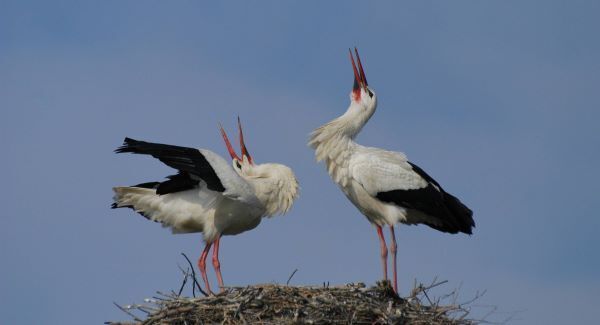
Its courtship rituals are especially endearing. In the ‘clattering and up-down display’, the head is thrown backwards and brought slowly forward with loud claps of the bill. Birds may proclaim their undying love for each other but they ignore their partners when on the feeding grounds. At migration time, each heads for sub-Saharan Africa without its mate. They may get together again the following spring but often a new partner is selected. Fidelity to the nest site is stronger; the property, it seems, is more important than the spouse.

According to the Nature Conservation and Biodiversity Union (NABU), storks bred very successfully in Hamburg for the third year in a row. The region experienced its best season in 51 years; 23 pairs raised 50 chicks. Fifteen pairs fledged 37 young last year. In 2011, 19 pairs had 46 babies. According to Jürgen Pelch of NABU, a shift is taking place in the population; in the region east of Hamburg, the stork population has declined by 30%. Pelch thinks that the intensification of agriculture is responsible. Urban nests are proving more productive than rural ones.

The situation further south is not so rosy. According to a report in Wildlife News Extra, Czech storks had their worst season ever. The Czech Union for the Conservation of Nature monitored 285 nest locations in 25 districts. No chicks fledged in ten of the areas and the number produced overall was 80% below normal. The weather, says the report, ‘has killed a generation’; youngsters failed to survive a particularly cold spell. Parents spread their wings over their babies to protect them but such measures proved futile this year. Nor could they feed their young adequately; although storks are carnivores, vegetation was found in the stomachs of dead chicks. As old buildings and chimneys disappear, there are fewer places to nest. Platforms are being erected to help the birds.

Nor are problems confined to the breeding season. Storks heading southwards on migration face many dangers. Ancient wetlands are being drained and pesticides are killing the creatures which storks eat. Power lines are another threat.

But the greatest threat comes from trigger-happy hunters. Fortunately, storks avoid Malta, the worst offender, by crossing the Mediterranean at Gibraltar or the Bosporus. The Maltese government has established a ‘Wild Birds Regulation Unit’ which critics claim is packed with hunting supporters. The new body, described by BirdLife Malta as the ‘Wild Birds De-regulation Unit’, has abolished the 3pm curfew on hunting which offered some protection to birds. Legal shooting and trapping will continue until 7pm during the migration season this October.

More in this section

Revoiced

Newsletter

Sign up to the best reads of the week from irishexaminer.com selected just for you.

Cookie Policy Privacy Policy Brand Safety FAQ Help Contact Us Terms and Conditions

© Examiner Echo Group Limited