Budget cutbacks - Cabinet must take a stand that is just
Two of the more controversial moves in the recent budget — the 1% levy on all income up to €100k, including those earning the minimum wage, and the plan to introduce a comparatively low threshold on a means test that would take the medical cards off those over 70. Those proposals roused such an unprecedented level of public outrage that the Government retreated in virtual panic. It dramatically raised the threshold of the means test for the medical cards and abandoned the levy on the earnings of those under the minimum wage.
The Government’s failure to anticipate the public outrage was a measure of just how out of touch it has become with the electorate. This was further reflected in the latest public poll in which Fine Gael replaced Fianna Fáil as the most popular party for the first time in history. Fine Gael actually enjoyed a comfortable lead that was well above the margin of error.
In a democracy, politicians ignore public opinion at their own political peril. But our history has also shown, especially in the late 1980s, that with proper leadership a government can take hard decisions to introduce necessary cuts that may not have seemed popular but earned respect, with the result that the government actually gained in popularity. The acid test is the public perception of what is fair and necessary.
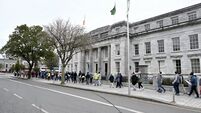
The focus of public protest has now turned to the proposed educational cuts. Thousands of teachers and parents demonstrated outside Leinster House yesterday.
The Green party has come under particular pressure as those opposing the educational cuts have focused their attention on it. The party is being pressurised to demonstrate that it has some clout within the government by securing some concessions.
The Government must get it right this time. It should ensure that the issues on which it takes its stand — whether on high-profile educational matters, or other issues — are both right and just.
If the Government makes further ill-advised moves and is forced to back down again, its moral authority will be further damaged, and its ability to rule will come under serious question.
Vested interests inevitably seek preferment for their own policies. The teachers have been protesting loudly, but the Government appears to be taking a stand in relation to increased class sizes and substitution coverage.
There are undoubtedly areas in the public service where the coverage of substitutes has been grossly abused. Employees have abused sick leave as if it were an extra holiday period. There have been examples of employees in other areas of the public service availing of all of their sick leave on a regular basis. They call in sick so that colleagues can avail of overtime by providing cover. They have been doing this for each other on a reciprocal basis.
The Government must tackle the abuse of sick leave right across the public sector. It has been doubly taxing — in paying for an unnecessary substitute and effectively providing extra paid holidays for skiving individuals.
The Celtic tiger economy flourished on low corporate taxation and the high level of educational development. Inasmuch as the country is currently living beyond its means, cutbacks are necessary, but they should not hamper future development.
Education Minister Batt O’Keeffe is trying to engage teachers, school managers and parent organisations in partnership to deal with the situation. We are facing a serious economic situation that demands co-operation.
The size of demonstrations may not necessarily be an indication of public feeling. Public perception of the legitimacy of the protest is much more important. In the present crisis, demonstrations should be clearly seen to be in the public interest, not mere posturing.
Most people in this country were educated at a time when class sizes were much bigger. The real emphasis should therefore be on quality education, rather than class size. In physical education, for example, a football or hurling game will require a larger class size.
A proper, rounded education must be provided for children to cope with the developing challenges of the future in an integrated Europe. Cutting back on classes for foreign students could be highly counterproductive because those “new Irish” could play an invaluable role in helping to promote integration.
As a people whose children have been scattered all over the globe, we should be acutely aware of the needs of migrants in this country; their proper integration can play a big role in promoting integration among all the children of the nation.

CONNECT WITH US TODAY



Be the first to know the latest news and updates