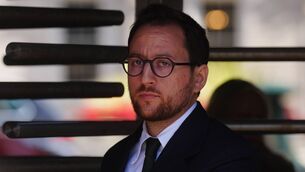
Dermot Ahern: diligent, professional, contradictory, understated. A keeper

WHEN Dermot Ahern was being elevated to near-sainthood on the Late Late Show by GOAL’s John O’Shea, it must have felt to him a bit like being embraced by Mike Tyson.

That is to say; powerfully affirmative, with the additional exciting possibility of losing half an ear.

It was unexpected, too. O’Shea, like Michael O’Leary in Ryanair and the Red Queen in Alice Through the Looking Glass, usually favours the robust “off with his head” approach.

Nor had Dermot Ahern, up to then, looked like an immediate candidate for beatification. Indeed, not so long ago, someone - Pat Rabbitte, probably - responded to one of Ahern’s jibes across the floor of Leinster House by calling him a “Dundalk bootboy”.

Boot boys and tsunami saints might seem worlds apart, but what’s interesting is that Pat Rabbitte and John O’Shea are both right about the Louth man.

Dermot Ahern is an interesting and contradictory piece of work. He has survived a number of Government departments which have not done other ministers any favours. He has come through a shrivelling tribunal session about his efforts to investigate Ray Burke’s bona fides.

(That last was akin to doing an IQ test on Anna Nicole Smith: the process was going to be tedious and the end results predictably negligible.) Ahern’s willingness to do well-intended forensics put him in the running to replace Peter Sellars, now that they’re doing a remake of the Inspector Clouseau series, as Vincent Browne’s endlessly replayed satirical sketches hammered home.

Fianna Fáil insiders’ eyes narrow when Ahern’s name comes up for discussion.

They see him as super-competent, able, diligent and professional. They also believe that if the Big Picture conflicts with Dermot Ahern’s local priorities, Dermot Ahern will not bust himself to help paint the big picture, although he’ll make bloody sure to be seen to be busy with a paintbrush. All of which means Dermot Ahern, like his namesake the Taoiseach, is a political realist who never loses sight of the central command: Man, mind thy seat.

However, to describe a man as a political realist is neither to diminish him nor to ignore traits he may have which are neither self-preservative nor self-serving.

Even back in the old days when many members of Fianna Fáil, the Republican Party, regarded the IRA as - at worst - distant cousins, Dermot Ahern, who lives, remember, in a Border county where atavistic loyalties run deep, never failed to condemn them in unequivocal and specific terms. That took courage.

Against that background, his more recent acknowledgment that Sinn Féin were likely to be in government in the south sooner than might have been expected would have been particularly galling for him. But he did it. Because that (at least before the bank heist) was the reality. And Ahern deals in realities.

That said, he is no Michael Woods. Michael Woods dealt in realities, and did a splendid micro-managerial job in any department entrusted to him.

However, a micro-manager no matter how excellent, could not have come up with Dermot Ahern’s fine response to the tsunami aftermath. He has defined himself by that response. Up to now, he tended to be defined by who, or what, he was not. He was not as brilliant as Brian Cowen. Not as funny and likeable as Micheál Martin. Not as passionate as Noel Dempsey.

While defined in a new way by his response, he is not all hero. Perhaps we, particularly those of us in media, need to get over the expectation we subconsciously have, that individuals will be homogeneously ‘good’ or ‘bad’. Professor Jared Diamond, the man who wrote the stunning Guns, Germs and Steel derides the notion that a single quality of virtue could or should shine through every aspect of a person’s behaviour.

“If we find people virtuous or admirable in one respect, it troubles us to find them not so in another respect,” says Diamond. “It is difficult for us to acknowledge that people are not consistent, but are instead mosaics of traits formed by different sets of experiences that do not correlate with each other.”

Dermot Ahern is a very interesting mosaic. Diligent, dignified and understated - as the last 10 days have shown - he can also do a Dáil bootboy digging- match. Courageous in his personal condemnation of the IRA, he can also get real about the probability of Sinn Féin participation in Government.

He is short on rhetorical flourishes: people do not tend to quote chunks of Dermot Ahern speeches. He is, nonetheless, one of the most coherent and crisp presenters of Government thinking.

Witness yesterday’s lunchtime news programme on RTÉ, where he managed to defend Conor Lenihan while never losing sight of the fact that all of the Irish people missing as a result of the tsunami have not yet been found.

His contradictions are what make him interesting. For example, he looks like a man who spends all of his time at a desk, but is, in fact, quite an athlete, skiing and windsurfing with reputed skill.

Ahern’s not a vision man. He won’t have a sudden flashing insight. But he’ll listen to experts and advocates and civil servants, and if one of them has a sudden flashing insight, he won’t miss it.

His response to the tsunami was simply right. Walking around the areas of maximum destruction, unmasked, wasn’t reckless: the miasma from putrefying human bodies carries no huge health risk. But it was respectful. His comments from the tsunami site were well-informed and unemotive. Any fool can go out and cry in sympathy. Ahern put in a much more professional performance.

It is to be hoped that his performance on this issue will not cease at this point. Natural disasters are happening more frequently in more populated areas and require a newly co-ordinated response.

It’s about a lot more than money. Significantly, Medecins Sans Frontiers announced, days after the disaster, that it didn’t need any more money: the issue was logistics. It would be splendid if Ireland were to lead the creation of a new European or better still, world capacity to respond to natural disasters, so we became known throughout the world for something other than being small and rich and having spawned Riverdance.

Some of the recipients of Ahern’s Christmas cards will have gone back to have another look at this year’s card in the light of what happened on St Stephen’s Day. The card was quietly exceptional, standing out, among those sent by politicians, because it was not big and colourful. Rather the reverse. No crib. No star. No sheep. No santa. Not a reindeer in sight. Instead, this year’s card was a spare, black and white pen and ink sketch of an old stone church drawn by Maeve Ahern, the minister’s wife.

One recipient of the ministerial card said to me most of the bright coloured cards went in the bin when Christmas was over, but this quiet, understated black and white one was a keeper.

Dermot Ahern is an interesting piece of work. Not unlike his Christmas card. Understated. A keeper.

More in this section

Revoiced

Newsletter

Had a busy week? Sign up for some of the best reads from the week gone by. Selected just for you.

Cookie Policy Privacy Policy Brand Safety FAQ Help Contact Us Terms and Conditions

© Examiner Echo Group Limited