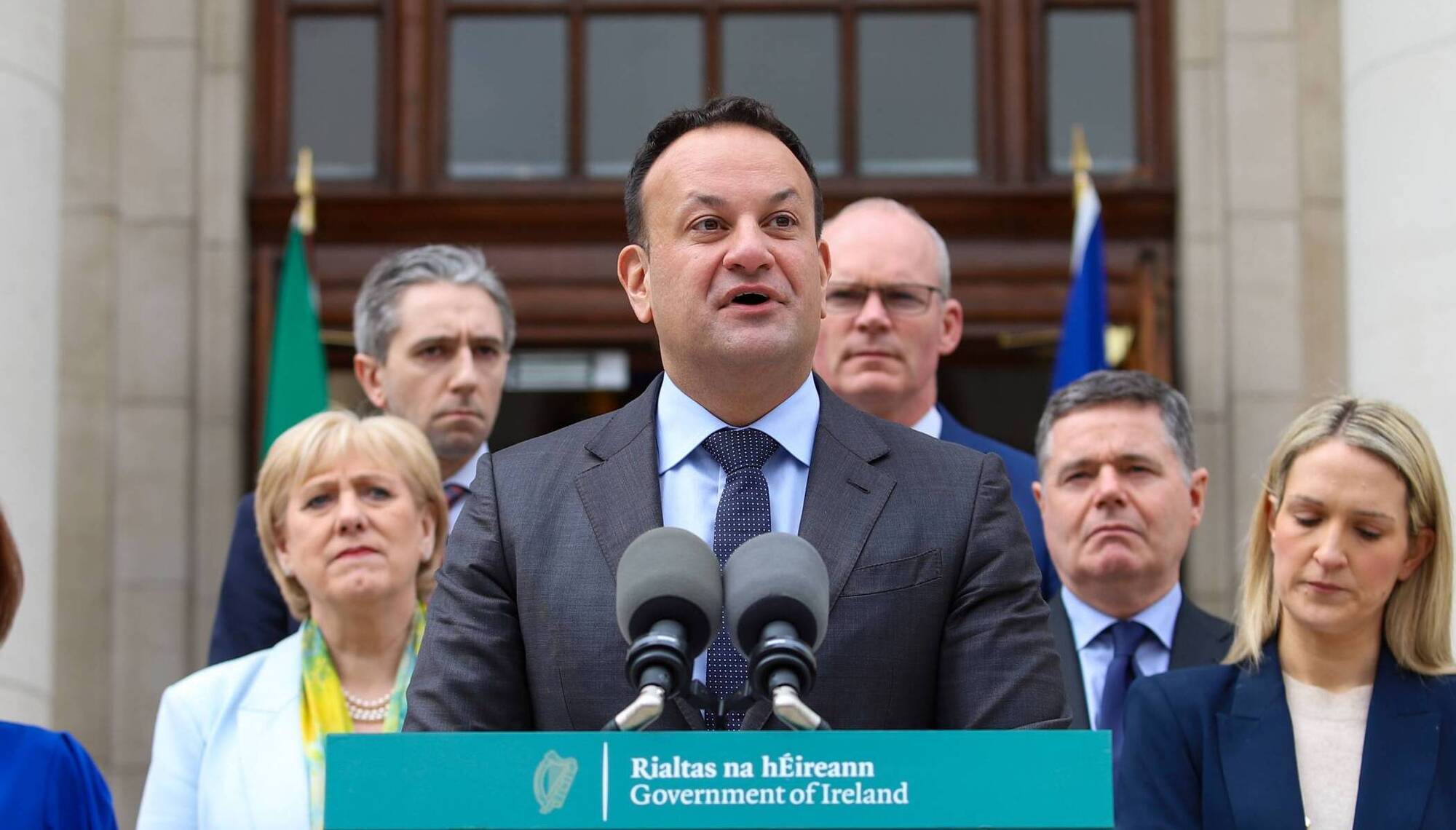
The Taoiseach as technocrat is a distinctive political identity, one which can be traced back to Garret FitzGerald and perhaps even as far as Seán Lemass.
Mr Varadkar’s conservative affect has a fair pedigree. However, when he became Taoiseach in 2017, his tenure came freighted with different possibilities. He was the
youngest taoiseach ever, the first gay taoiseach, and the first from a different ethnic background to his predecessors, but such differences did not mean a radical tenure.
Hence, the surprised reaction to his speech: In his time in the big office in Merrion St, Mr Varadkar’s performance was more about keeping a steady hand on the tiller and less to do with charting a bold course to the future.
Another strand of reaction to the speech was sadly predictable. The racism and homophobia online in response to Mr Varadkar’s statement offered a more persuasive reason for his resignation than any conspiracy theory: The toxicity mentioned by the Taoiseach’s party colleague Ciaran Cannon as a reason for his was on full show.
Historians will offer a detailed verdict on the Varadkar premiership in due course, and there were notable peaks. He defended Ireland against the depredations of Brexit, despite dealing with some of the worst prime ministers in history. He gave leadership to the country during the covid-19 pandemic, a time of deep fear when such leadership was badly needed, and leaves with the economy best described by that word only politicians seem to enjoy using — robust.
When he addressed the nation in March 2020, his televised speech was the most-watched television broadcast in Irish history. On the other side of the balance sheet, Mr Varadkar was embroiled in spats and controversies, including against Cabinet colleagues, particularly in the early days of the Coalition and the leaking of a GP pay agreement in 2022. He has also lost loyal and trusted lieutenants, with the party set to lose a wealth of experience in the next general election.
The real stain on his record is the housing crisis. This is a mess that bleeds into almost every sector of Irish life, and alienates generations young and old from politics and Fine Gael. As Harry Truman said, the buck stops at the top desk —and the Taoiseach has been there long enough.
As Mr Varadkar spoke yesterday in Dublin, more than 13,000 people in Ireland were homeless. It is the ultimate marker of dysfunction within the State, and casts a shadow over the careers of all the big names in political life at present, not just Mr Varadkar’s.
Events such as a Taoiseach’s resignation reverberate at different frequencies. The evaluation of Mr Varadkar in comparison with his predecessors co-exists with urgent short-term political calculations.
Fine Gael must now find a new leader within the next couple of weeks in order to have a figurehead to guide it through the upcoming local and European elections.
Some of the Cabinet colleagues flanking the Taoiseach at the podium yesterday will have designs on that job, but the task is an onerous one. Those elections were already viewed as a chance for disgruntled voters to express their dissatisfaction by punishing the current administration at the ballot box; based on the referendum results a couple of weeks ago, that punishment may be sharp indeed.
Seeing one of the Government parties shed its leader a few weeks beforehand will hardly impress those voters, while Fine Gael’s partners in Government are no doubt evaluating the impact of Mr Varadkar’s departure on their prospects in those campaigns — and the big one, the general election due at some point in the next 12 months.
The calculating and scheming, the dealmaking and deliberations, all continue, even as the protagonists change. That’s politics, and our Taoiseach knows that as well as anyone.
Rational discussion on assisted dying
In today’s fevered political climate, it sometimes seems impossible to have a rational, reasoned debate on the subject matter at hand — discussions can become divisive almost immediately, often for reasons completely unrelated to the topic itself.
An emotive debate is certainly on the horizon when it comes to the issue of assisted dying in Ireland, going by the experience of an Oireachtas committee dealing with the matter.
The committee is to issue a report this week, but its members are already split over that same report, which is expected to make very specific recommendations — for assisted dying to be legislated for in cases where a person with an incurable illness is expected to die within six months, for instance, and extended to 12 months when a person has been diagnosed with a neurodegenerative disease.
However, independent senator Rónán Mullen and Fianna Fáil TD Robert Troy are now expected to put forward a minority report supported by committee chairman, Independent TD Michael Healy-Rae.
It is difficult to attach credibility to a report issued by a committee when that committee’s chairman is supporting a different report on that committee’s deliberations.
However, focusing on the procedural chaos or political opportunism involved here misses a wider point. Ireland is going to have to hold an informed national debate on the challenging topic of assisted dying, and learning from the experience of others will need to be part of that debate.
Euthanasia has been legal in Canada for a decade, and is often cited in discussions of the topic. Over 4% of deaths in that country are aided by doctors.
Yet there is also a good deal of debate within Canada itself about expanding the original provisions, and the implications of such expansion.
With that in mind, a rational discussion of the topic at hand is vital, no matter what happens in the short term because of a fractious Oireachtas committee.
CONNECT WITH US TODAY
Be the first to know the latest news and updates