From Reaganomics to Kilkenomics
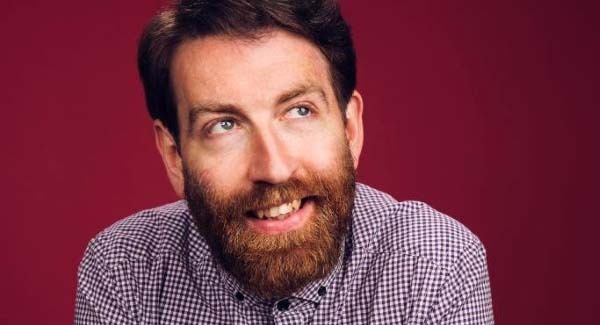
I got the gig because I work at Kilkenomics, which is a portmanteau of Kilkenny and economics. There isn’t a specific Kilkenny economic theory but if there was, Brian Cody wouldn’t tell us about it anyway and you’d only find out at the later stages of the championship.
Economics as entertainment is a long way away from where economics used to be. My earliest introduction to economics was in the late 80s when my older brothers were studying commerce degrees in college.
The economics books were grey. The covers didn’t even have a picture on them. There weren’t even any of the sexily shaded spheres that you’d see in science textbooks.
Now this was the late ‘80s, so in fairness, all textbooks were like this. There were no photographs of smiling German teenagers ice-skating or using a computer or helping an old person. Textbooks were meant to remind you that life is dull and full of problems.
We were just ships that pass exams in the night. Later in the ‘90s, I didn’t do economics in school, partly because it appeared to be one of those subjects that was taught exclusively during the afternoon slump. When I peeked through the door at older students, they seemed to be comatose.
The radiators were on the October to March setting and the rooms was hotter than a bikram yoga studio.
Economics came from the Greek word oikonomia, meaning the law of the household. There is economy in religion, which refers to God’s “handling of things”. God would be fairly hands-off, in fairness. He could even be criticised as letting the market take care of things. But somewhere along the line people realised that economics had one crucial thing — a catchy end bit, and that end bit has gone on to finish off a plethora of words.
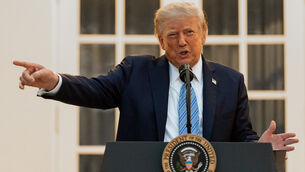
One of the first nomics was Reaganomics, and they named nomicses after every president since. We didn’t have any nomicses because for most of the ‘90s and ‘00s, the economy was improving so we didn’t ask too many questions about where the money came from.
But then after 2007 everyone wanted to know where their money went. This led to a boom in economics, and nomics followed as a result.
We started talking about Bertienomics — a largely cash-based one — and around the world other nomics mushroomed. Many everyday words have had an omics appended to them. Agronomics, Spousenomics, Babynomics, Cocoanonics, Coffeenomics, Beefenomics, Abenomics, Trumpnomics.
There’s no real limit to it — make up your own one: Absenomics — the economics of gyms and its opposite Nomnomnomics — the economics of comfort eating. Then the financial impact of what happens after too much comfort eating — Colonomics.
Menonmomonics — the economics of the Muppets. The point is, nomics is catchy — let’s make it the umbrella term. Or better still, to reflect the inherent vagueness that comes with GDP figures, 15 different measures of unemployment, the touchy-feely consumer sentiment, let’s call it Shnomics, the Nomics of Vague Life.
A huge part of shnomics has to be our predictable unpredictability, our irrationality, our emotions, our motivations. Who knows what that son of yours will do? Or your niece. She’s a law unto herself.
Shnomics is hard to define so it’s a great one to be an expert in because you can’t be wrong. You can learn off a few phrases like ‘it depends on a number of variables’ and ‘if you pressed me for an answer I’d have to say that it could go either way’ and ‘I don’t know really but if I had to guess I would say..’
And since there’s plenty of demand on TV and radio for being a commentator like that, the shnomic forecast is bright.