Leo Varadkar basks in the limelight a year after coronation
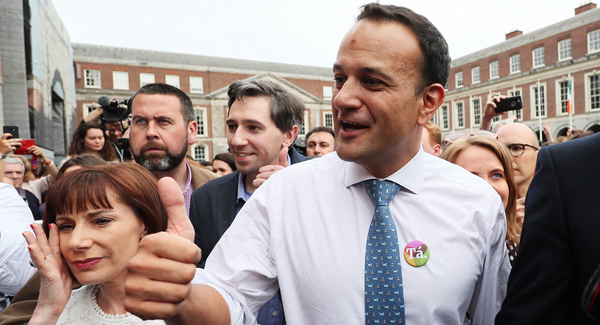

LAST Sunday, Taoiseach Leo Varadkar and a select number of his ministers and TDs gathered in the Dean Hotel on Dublin’s Harcourt St in celebration.
Buoyed by the referendum result 24 hours earlier, those gathered included ministers Eoghan Murphy, Helen McEntee and Josepha Madigan and TDs Kate O’Connell, Tom Neville, Maria Bailey, Marcella Corcoran Kennedy and some key staff members — but they also drank to mark another milestone.
The invitation sent out on the Saturday caught most TDs on the hop as they had already left Dublin and were putting in some quality time with their families.
But those who gathered did so to rejoice in a happy weekend for their party.
Over barbecued burgers and salads, which were washed down with wine and bottles of beer, they toasted one year under Leo’s leadership.
You see, today, Varadkar is one year in office as leader of Fine Gael.
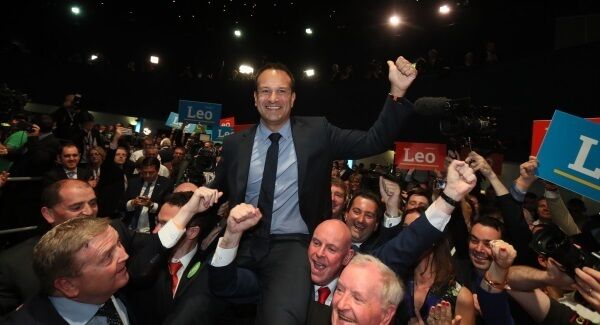
While Varadkar is basking in the glory of last weekend’s dramatic referendum victory, some within his own party described his performance during the campaign as “hopeless”.
“He and his staff did not see this coming, the size of the victory. Sure he gave the referendum to Simon Harris as a poisoned chalice but he delivered and then some,” one TD told me.
Maybe in spite of himself, the previously deeply conservative Varadkar, now the symbol of a modern, inclusive, secular Ireland, is in charge of the truly social liberal party Garrett FitzGerald could only dream of.
While there is a perception that Harris and Varadkar remain somewhat wary of each other, Varadkar, on one level, must be in a happy place one year into his leadership.
Unlike Enda Kenny, John Bruton and Michael Noonan before him, Varadkar is in total control of his party.
“He is in political heaven,” said one veteran TD.
The old divisions are gone and obviously people are seeing our polls up about 10 points on where we were at the general election in 2016. For most, that means they are likely to keep their seats.
An examination of the Behaviour and Attitudes exit poll carried out for RTÉ on the day of polling makes for pleasant reading for Varadkar’s Fine Gael.
Based on a sample of 4,000 people who actually voted (four times the sample of normal polls), once 24.9% of don’t-knows were excluded, they suggested that Fine Gael is now on 36%.
This means, if this exit poll is to be believed, Fine Gael commands a 13-point lead over Fianna Fáil.
On 36%, this is the level of support the party achieved in its historic 2011 election win when it secured 76 Dáil seats, within spitting distance of an overall majority.
Fianna Fáil, according to the exit poll, was on 23% and at this stage is nowhere near being in a position to become the country’s favourite party.
It also too has Sinn Féin not too far behind it on 16%, which is more a realistic figure for Sinn Féin than has been suggested in some recent opinion polls.
But digging down into the data, in terms of age groups and location, across every demographic bar one (the over 65s age group) Fine Gael was significantly ahead of Fianna Fáil.
For example, among the newly energised young electorate under 24, Fine Gael is by far the most popular party — taking 19.5% of the vote, compared with 9.4% for Fianna Fáil, and 14.2% for Sinn Féin.
In terms of the ABC1 voters, the most affluent and best educated in the country, Fine Gael on 30.6% is almost three times ahead of Fianna Fáil, who are on just 12.8%, the exit poll reveals.
The upshot of all of this is that Varadkar is odds-on favourite, as of now, to be returned as Taoiseach.
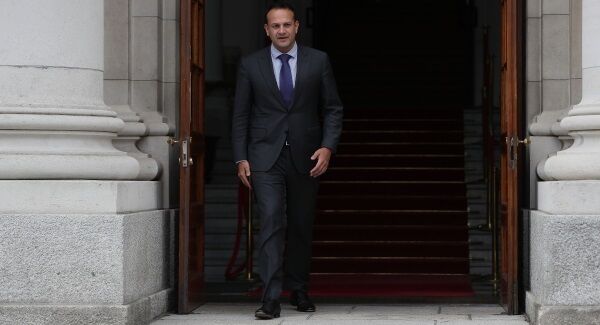
With poll ratings of 36%, it is now not impossible for the party to think of achieving in excess of 65 seats, which puts them in the driving seat to form a government.
At the Fine Gael parliamentary party on Wednesday — which is held in private but leaks like a sieve — following on the referendum, a call came from the floor that the party whip should be deployed in future when it comes to passing legislation in the House.
Step up Waterford TD and US envoy, John Deasy, who made a salient point as to the difference in life under Varadkar compared to Enda Kenny.
“We tore ourselves apart in 2013 and lost good people because the leadership was so rigid on the whip. Now we have a free vote and the party lives on,” he is said to have commented
Deasy was making the point that whipping votes is what caused so much anger and acrimony in 2013, when the likes of Lucinda Creighton, Paul Bradford and Peter Mathews left Fine Gael.
For the party, Creighton’s departure was the biggest loss — she would and should be in Cabinet now had she remained.
Varadkar does, in truth, deserve credit for committing to the referendum within his first year, and he delivered on that promise, whatever about his reluctance as to the mechanics of what was on offer.
Buoyed by the result, and given the poll numbers discussed above, talk of cutting and running emerged throughout the past week.
Why wouldn’t the Taoiseach break early before the summer and capitalise on the goodwill of the people and try and form a more sustainable government?
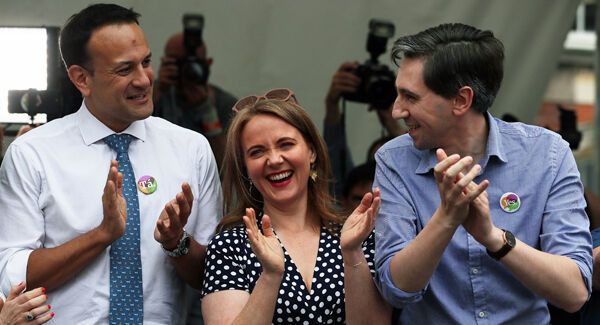
But those around Varadkar describe him as a mathematician, someone who tries to figure out the next five steps, not just the next one.
“Leo takes risks, but calculated ones. He is not going to risk a Theresa May collapse even if the temptation is there,” said one TD.
Several sources who were canvassed for this column said Varadkar’s goal is to sit in and go as long as he can.
Such talk would support the comments of Social Protection Minister, Regina Doherty, who called for Fianna Fáil to back a two-year extension to the confidence and supply deal.
“We want the confidence and supply deal to be extended for two years and we would call on Fianna Fáil to sit down with us and talk during the summer,” she said, while also ruling out a snap election: “I can categorically say no to you; our job is to get the legislation passed and passed as quickly as we can.”
When asked, the Government press secretary dismissed Doherty’s comments as not being reflective of the Government’s view — but it would seem she is.
One year into the leadership of his once deeply conservative party, Leo Varadkar is now the most popular leader amongst young people. He is seen as more liberal than Fianna Fáil and holds a commanding lead in the polls.
He is, in fact, the most popular leader of any in the country.
It is remarkable to think that Fine Gael, who had never before 2016 been re-elected to government, now stand on the threshold of a historic third term in office.
Some would ask, why wait to grasp it?
CONNECT WITH US TODAY



Be the first to know the latest news and updates