Bringing delusional Brexiteers to senses


He writes clean, deceptively simple prose that initially appears to be devoid of style. On first reading one of his novels, I found it easy to put down. But once away from the page, something kept pulling me back. It’s as if the author manages to burgle your imagination while you’re looking the other way.
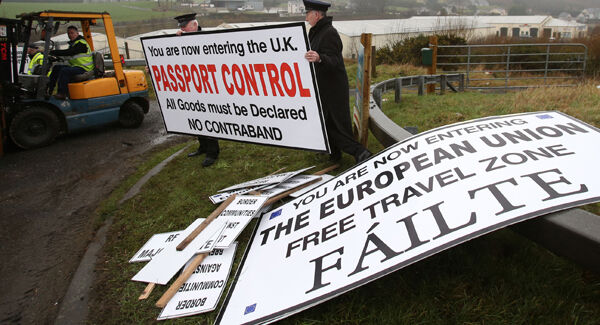
Prior to embarking on a successful career as a novelist, Tóibín began his writing life as a journalist. In that capacity, he wrote in 1986 an arresting account of literally walking the length of the border between the North and the Republic.
The strength of Tobin’s prose, and the accompanying photographs by Tony O’Shea, bring to life the struggles of real people who were living in an unreal world. The violence and hatred that fed the Troubles for 25 years were at their sharpest along the border. Anybody under the age of 40 today might find it difficult to believe that this world existed so recently.
At this point, it is custom to declare that the book, Walking Along The Border, should be required reading for anybody interested in Brexit and its capacity to undo what was constructed in the last 20 years or so. But to suggest that would be to assume that those driving Brexit care a whit about such things.
Brexiteers have far bigger fish to fry. They are working to a vision that encompasses recapturing the exceptionalism of Britannia in today’s globalised world. They are convinced that once freed from the shackles of the EU, they can rule the waves once more, distributing lucrative trade deals rather than conquering and enslaving.
To that extent, the challenges of the real world are a mere irritant to these people. And that includes the huge issue on this island of the future of the border. Where once this country felt dogged by the attitude of Perfidious Albion, in this process the biggest danger comes from incompetent Albion.
Early yesterday morning the EU and the British government reached a deal designed to address fears of a return to the border of the past between the Republic and the North. There will be no hard border. Come what may, whatever storms the good ship Britannia may
encounter in the coming negotiations, a soft border has been anchored.
Let’s hope so. The whole Brexit process is so rooted in a sense of unreality it’s difficult to take anything at face value. The deal reached raises an uncomfortable proposition for those driving Brexit. How can the UK have a frictionless border with an EU member state while remaining outside the customs union, and by extension the single market? To remain in both is anathema to the Brexiteers who dominate Theresa May’s Conservative Party. How could Britannia ever fill its sails if such calm conditions were to prevail in the trading climate? What would the point of it all have been?
The negotiations leading up to yesterday’s agreement opened up for the Brexiteers a tiny porthole view of the real world. It’s noteworthy that the North and the advances made in the last 20 years didn’t feature in the Brexit debate before or after the vote in 2016. Earlier this year, Boris Johnson delivered a 4,000-word speech about his vision, that didn’t even mention the North.
This failure to address the real cost of the vision is not confined to the North.
During the week, David Davis, the Brexit minister, told a House of Commons committee that no impact assessment had been done on any sector. Mr Davis said he didn’t believe in economic models as they are consistently wrong. This echoes with the dismissal of “experts” by Michael Gove ahead of last year’s vote. These people are obviously highly reluctant to address the real world lest it interferes with their delusion of grandeur.
For a view of the real world, sample a tiny slice of what Tóibín encountered when he walked along the border in the summer of 1986. In one passage, based in South Fermanagh, he met two men who gave him a flavour of the routine hassle they received from British soldiers.
“On rainy nights, they said, the army would take you out of the car and make you stand there, delay you, ask you questions, your name and address, where you were going, where you were coming from; particularly if you were going to a dance and dressed up. When the army came around, having landed from helicopter, they wanted to know the names of dogs on each farm, they told me. Imagine wanting to know the names of the dogs.” Another local man described how there were effectively six different armed entities congregated in their area.
Tobin wrote: “How were there six armies within one mile? He listed them: The RUC, the British Army, the UDR, the free state gardaí, the free state army and the water rats? The water rats? I didn’t understand. The water rats, he repeated. The Irish customs officials, he
explained.”
That was the border of the past, a raw contour soaked in violence, fear and bereavement. Nobody ever wants to go back there. Years of painstaking talking and manoeuvring saw that border confined to history. On the British side, politicians led by John Major and Tony Blair went where few of their predecessors ever bothered, in giving a huge amount of time to settling ancient enmities.
Thankfully, even a worst-case scenario does not envisage a return to the 1980s, but what is notable is that the Brexiteers of today appear to regard the Irish border as an irritant.
Ahead of Friday’s agreement, Johnson and his colleagues repeatedly suggested that the EU should just get on with things and leave this little matter to the future.
At least persistence by the Irish Government, and the solidarity of EU members, has ensured that the Brexiteers must now sit up and take notice.
As such, the deal struck to maintain a free-flowing border has seen the real world intrude on the delusions perpetuated by Johnson’s merry band of Brexiteers. Their worst nightmare might, as a result, be about to unfold. If Britain is to maintain a form of customs union with this State, how can it avoid doing so with all other EU members?
The agreement is certainly a victory of sorts for the Government and the people of Northern Ireland. What remains to be seen is whether the detail contained therein can survive the dismantling of the delusions that have informed the whole Brexit project.
Either the agreement will act as an agent in bringing Brexiteers to their senses, or else we could be in trouble.
Constant vigilance will be required to ensure that this particular deal is bedded down, because God knows, those driving Brexit appear so incoherent and incompetent, there’s no knowing how things will end up.
CONNECT WITH US TODAY



Be the first to know the latest news and updates