Parents have learned the hard way that school system is underfunded
THERE are transitions in every family. Sometimes you don’t even notice them until after the event, when you realise things will never be the same again.
My daughter, Vicky, will be experiencing one of those transitions next month, as the last of her three children starts school. It’s not yet clear if the primary school system in Ireland is ready for Mikey, mind you. Mikey was born with a fully formed personality, and leaves a lasting impression wherever he goes. (I could fill a book, never mind a column, with Mikey’s adventures. But that’s for another day.)
You never forget the day you started school. Back in my day, classrooms were drab and cheerless, and teachers cold and forbidding. If it was a bad experience for you, as it was for thousands of children back then, you sent your own children off to school with a sense of foreboding. I remember meeting a mum some years ago whose schooldays had been so awful that she was able to walk her children to the school gate, but she couldn’t bring them in.
It’s not like that anymore. School is, as it ought to be, the start of a great adventure. That first moment of terror is instantly replaced by a welcome. Friendships are made within minutes, and children come running out after the first day all excited about what they’ve done. Classrooms are fun places to be, and learning happens much more naturally than it did in my day.
But the grind of getting everything ready for that first day never seems to end. The start of school might be a great adventure for the children, but it’s an immense pressure for parents.
Increasingly, that’s unique to Ireland. If my three grandchildren were starting school, or going back to school, 200km north of where they live now, their schoolbooks would be waiting for them. There’d be no letter from the school seeking a voluntary contribution. And there’d be a free bus to take them to and from school. All of that would be mandated by the law of the land.

Of course, that would be on the other side of a border, in a different jurisdiction. We’ve all lived for years thinking that the border was a thing of the past, something that we’ve moved beyond. Latterly, and because of Brexit, our politicians have taken to saying that the worst possible thing that could happen would be the re-emergence of a border. If the North leaves the EU, as part of the UK, we’ll see a border again, in some shape or other.
But, oddly enough, although the physical border might have become invisible to us in recent years, they still do things differently in different jurisdictions. And one of the things they do differently is how they fund primary education. There is no expectation there, or anywhere in the UK, as there is here, that it’s the job of parents, no matter how hard-pressed, to subsidise the system.
Of course, there is one other difference. We have a written constitution down here. That constitution (in Article 42) provides that all our children must receive a “certain minimum education, moral, intellectual and social”, and, on that basis, specifies that the State “shall provide for free primary education”.
It’s a funny concept, isn’t it. All of our children, without exception, have a right to a free primary education, and the State has an obligation to provide it. You’d have to ask, wouldn’t you, how it’s possible to have something described as a right, when it’s dependent on your parents’ ability to afford it?
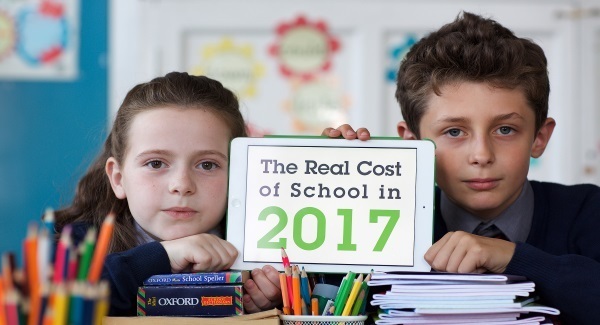
And we know the extent of that burden. Last week, as we do every year, we, Barnardos, published our annual survey of the costs of school. This year, we asked more than 1,800 parents to share their experiences with us.
The figures are frightening. On average, it’s €355 for a child starting school — that’s more than €1,000 if you have three children, by the way. It’s €395 for a child going into fourth class, and it’s €800 for a child starting secondary school.
We know, from our work with families, how stressful this is. And we know, from the survey, that nearly half of all parents have to cut back on other things to pay this money. Utility bills go unpaid in many instances, but utility bills don’t go away. Non-payment of bills like that, to buy a school uniform for your child, can start a downward spiral. And quite a few parents find themselves plunged into debt for this reason.

Our survey started a lot of discussion, as it always does. And there is, thank goodness, some sign that the discussion is beginning to have an effect.
For example, more schools than used to be the case are now allowing and encouraging generic uniforms. Fewer schools are putting pressure on parents to pay the so-called voluntary contributions. And many more schools, especially at primary level, are using book rental schemes, which keep costs down.
There are signs, too, that the politicians are beginning to listen. On his last day as Minister for Social Protection, Leo Varadkar raised the back-to-school clothing and footwear allowance by €25 for eligible children under 12, and by €50 for children over 12. (To be eligible, children must live in families where the income is very modest — a single parent with one child would have to earn less than €22,000 a year to qualify).
These are all steps in the right direction. But they’re designed to help people cope with the burden of cost.
It would make far more sense — and it would be the bold and imaginative thing to do — to eliminate the cost altogether.
That, in turn, wouldn’t break the bank. It would cost €100m at primary level, and another €125m at secondary level. In the overall scheme of things, it’s tiny. Even in the context of the Department of Education’s own budget of nearly €9bn, it’s a really small proportion.
And you know what? We’re going to have to do it someday, anyway.
In the discussion about Brexit, which I mentioned earlier, one of the other strands of conversation is about a united Ireland as one possible consequence of Britain leaving the EU. It has been proposed that a second, new Ireland Forum should be established, to identify the economic and social barriers to unity.
Such a discussion would have to be immensely wide-ranging, of course. But some barriers are more easily eliminated than others. The cost of starting school is one of them.
We’re never, at any time in the future, going to ask parents to vote in favour of a primary school system that treats them and their children differently than they are treated now.
So let’s get rid of that barrier — it strengthens the case for unity, and even enhances the psychology of unity.
And, in doing so, let’s lift an utterly unfair burden from thousands of parents.