'We need everyone to recognise this violence and call it out': Gender-based violence a daily reality for women across Ireland
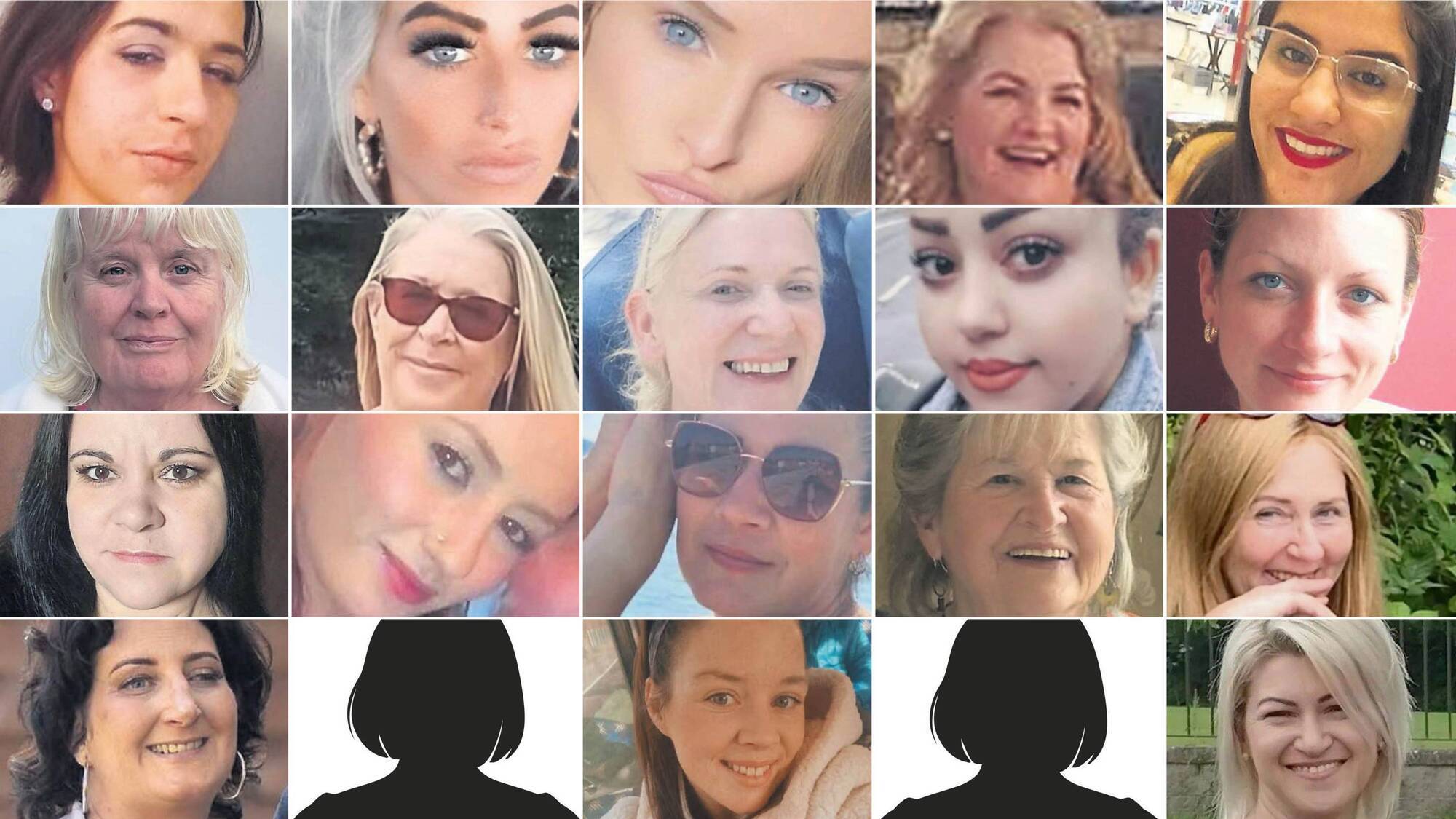
The faces of the 20 women who were killed in Ireland in 2025 and 2026. File picture
As the 16 Days of Action against Gender-based Violence continues this week, families in homes across the country are hearing the echoes of last night’s violence or are bracing themselves for the horrors of what is to come today.
No matter what spotlight is shone on the issues of domestic abuse, coercive control, rape and sexual assault during these 16 days, figures from the 2025 report from Women’s Aid, published in recent days, shows that violence is a daily reality.
With just one month left of 2026, the fact that the violent deaths of women in Ireland this year is almost double the figure for all of last year is a concern among advocates for survivors and victims of domestic abuse.
Those advocates do not just include those providing services for victims of abuse. It also incorporates the few providers of services out there for perpetrators of violence, such as MOVE Ireland.
That organisation also published its annual report last week. Last year, 604 referrals were received by the organisation, making the fifth consecutive year that there has been an increase in demand for Move Ireland’s services.
Read More
According to the report, self-referrals was the largest source of referrals in 2025, followed by referrals from the Probation Service and Tusla. Other referrals came from bodies including the prison service, addiction and mental health services.
It said: “Consistent with previous years, men aged 30–39 accounted for the largest proportion of referrals in 2025. The data also demonstrated that the proportion of self-referrals increased with age. Self-referrals accounted for: 29% among men aged 22–29, 41% among men aged 30–39, 46% among men aged 40–49, 49% among men aged 50–59, 52% among men aged 60 and over.”
The report highlighted concerns about the impact of domestic violence on children. It said: “In 2025, MOVE Ireland recorded 663 children (this figure also includes adult children above the age of 18) linked to MOVE clients. In addition to this, MOVE also recorded 12 pregnant partners.”
It continued: “Children’s exposure to domestic abuse remains a significant concern. Our own evidence and that from organisations working directly with children highlights that children do not simply ‘witness’ domestic abuse; they fully experience it.
"Abuse enters a child’s world through what they see and hear, as well as through the fear and uncertainty it creates in the home. Children living with domestic abuse report feelings of sadness, powerlessness, fear and worry, alongside anger and confusion.”
The concerns around the impact of domestic abuse on children was echoed in the annual report published by Women’s Aid. The report noted that there were 4,755 disclosures made to its national free helpline and its support services last year about abuse against children in domestic abuse situations.
While emotional abuse accounted for almost 4,200 of the disclosures, there were 261 disclosures of physical abuse, as well as 247 reports of economic abuse and 58 of sexual abuse against children.
The report said: “These disclosures were made alongside women’s own disclosures of abuse, illustrating how often domestic abuse affects children and adults simultaneously within the same household.”
Some women reported that their children were harmed while their abuser was attacking their mother, while others reported that the use of physical force was used against children to intimidate or control them.
Disclosures were also received by Women’s Aid of effects of post-separation abuse on children and their mothers, including children being “forced to attend unsafe access visits” while others spoke of how access arrangements were being used to “monitor, threaten, or harass women”.
The use of pets in abuse of women was also reported to Women’s Aid last year, with 68 disclosures of such incidents.
The report outlined: “Within these disclosures, women described tactics including threats to harm or kill pets if women resisted abuse or attempted to leave; physical abuse of animals used to intimidate or frighten women and children; withholding access to pets or removing animals from the home; using pets to control women’s movements or decisions; preventing women from fleeing to safety with their animals.”
The report elaborated: “Fear for the safety of a pet can be a significant barrier to leaving an abusive situation. Women described remaining in dangerous circumstances, delaying escape, or being unable to access refuge accommodation because they could not bring their pets with them.
"Cruelty towards animals often occurs alongside escalating abuse against women and children and may indicate heightened risk. Recognising the use of pets and animals as a tactic of domestic abuse is therefore an important part of risk assessment, safety planning, and effective responses for women and children.”
The role of pornography in abuse was highlighted in the report, with women reporting being “coerced into re-enacting scenes from pornography and being forced to consume pornography”.
The report listed pornography as being one of the systemic realities facing women and said that Women’s Aid continues to work with civil society organisations and statutory agencies “to examine how society can reduce and prevent the harmful impacts of pornography on gender equality, healthy sexual development, and online safety”.
It also cited perpetrator accountability as being another systemic reality for women, saying: “Despite legislative reforms, consistent perpetrator accountability remains limited. Women continue to report ongoing abuse, intimidation, and fear even after separation.
"Domestic violence and abuse are not inevitable. It is rooted in inequality and sustained by systems that fail to respond early, effectively, or consistently. The context outlined here shaped Women’s Aid’s work in 2025, from frontline support to training, research, and advocacy, and underlines the urgent need for prevention, protection, and systemic change.”
Chief executive of Move Ireland, Michelle Walsh, believes that society as a whole needs to take a look at how it accords respect and dignity to women and children. In her speech at the launch of Move’s annual report, she said: “I think, as a society, we have become much better at recognising what is not acceptable.
"We know that domestic abuse is wrong. We know that coercive control is wrong. We know that violence against women is wrong. We know what we are supposed to say. But knowing what is unacceptable, and challenging the beliefs that sit underneath it, are not necessarily the same thing.
"And sometimes those contradictions are so familiar to us that we don't even recognise them. They're in the jokes we laugh at. The comments we let pass. The assumptions we make.
Perhaps that's where some of the most difficult work begins. Not in changing what we say we believe. But in examining what we actually believe. Our internal narrative. Because those beliefs shape what the next generation learns from us.”
She added: “Domestic abuse disproportionately impacts women and children. And I deliberately say women and children, not women and girls. Because our boys are children too. They are listening. They are watching. They are learning what relationships look like, what respect means and what it means to be a man. And they learn not just from what we tell them. They learn from what we tolerate. What we challenge. And what we model.”
Ms Walsh questioned what is available to a perpetrator who recognises he needs to address his behaviour, warning: “At MOVE Ireland, people are currently waiting an average of three months to access intervention, and in some areas, particularly Dublin, that wait can be as long as six months. Six months. Someone has reached out. An opportunity to intervene has presented itself. But the capacity isn't there to respond as quickly as we would want – and during that time, the potential for further harm doesn't simply disappear.”
The country’s fourth national strategy on tackling domestic, sexual and gender-based violence is due next year.
Ms Walsh said it presents an important opportunity to look at ways of prevention by providing a national coordinated response through the creation of a framework for perpetrator prevention and intervention. She called for the creation of a dedicated function within Cuan, and for an awareness campaign to direct people to services to address their abusive behaviour.
Chief executive of Women’s Aid, Sarah Benson, said that the development of the new strategy must reconfirm at all-of-government approach to enable Ireland build zero tolerance against domestic, sexual and gender-based violence.
She said: “Ireland is one of the wealthiest countries in the world, and we have good laws. Yet women are still being killed by the men closest to them. Most men choose never to behave this way, and that is exactly why we need everyone to recognise this violence and call it out.”
“Every woman has the right to be safe in her home and in her community, but this is not the case for too many.”

BLACK FRIDAY
Already a subscriber? Sign in

CONNECT WITH US TODAY



Be the first to know the latest news and updates