Murky methods and motivations of ‘predator hunter’ groups
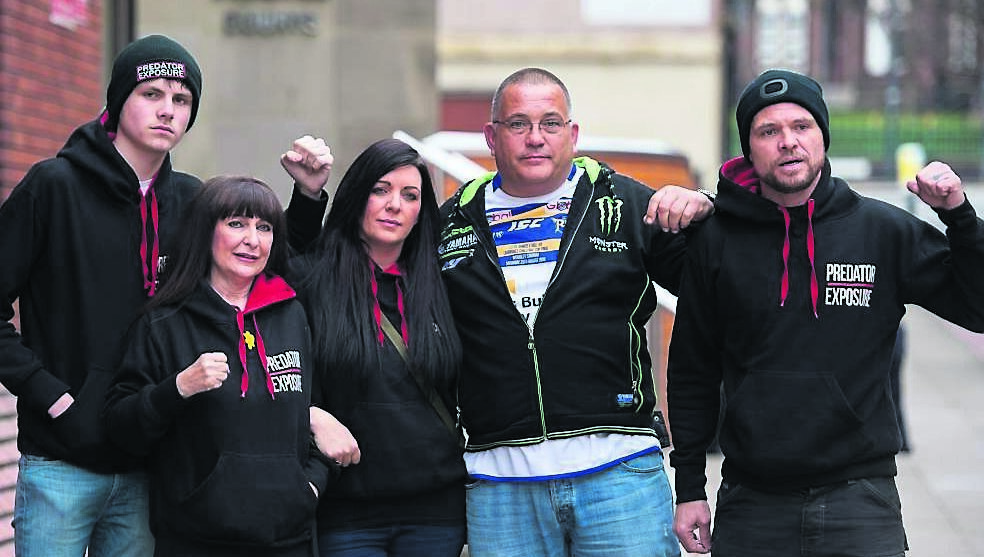
Members of paedophile-hunting group Predator Exposure, two of whom identified themselves as Christine (second left) and Phil (right) (no surnames given), outside Leeds Crown Court after the sentencing of TV producer Kieran Creaven. Picture: Peter Powell/PA
“Why are we here?” is the first question.
“I have videos I have received, explicit videos that you sent to these children. Do you have any ideas of what them videos are?”
“Probably of me being naked.”
“And what else?”
“Probably playing with myself.”
“And what else?”
“Probably ejaculating.”
“Explain to me why.”
“I think I’m a sick individual.”
The video runs on for another 20 minutes. A short, stubby man is standing in front of a mobile phone camera bathed in light from the flash. A voice on the other end of the phone, the identity of whom viewers never fully see, pelts questions at his prey.
Why did he do what he did? Why was a man married for 20 years messaging social media accounts he believed were owned by underage children?
The subject of the video appears, if not petrified, then shaken, coming to terms with a world slipping out of his grasp.
The video ends as the recorder says gardaí have arrived off camera. At the time of writing, the video has garnered thousands of views on social media. The altercation is currently being examined by Fiosrú, the Garda watchdog.
The video is part of a wider phenomenon of ‘predator hunting’ that showcases online groups conducting sting operations to catch alleged paedophiles.
There have been numerous cases where similar stings have ended in convictions for sexual offences. Others have resulted in false accusations, mistaken identities, assaults, and, in the most extreme instances, suicide.
Many underneath the Facebook video champion the hunters as heroes and the guardians of Ireland’s youth. Some raise questions over ethical ambiguities and the manner in which the stings are conducted. Others see the practice as vigilantism at its worst.
“I had a family member who was affected by it [sexual exploitation],” says ‘Jay’, who leads a group known as ‘Child Online Protection Enforcers (COPE)’. The group has more than 100,000 followers on Facebook and conducts stings across Ireland.
“There was a team in Northern Ireland…I joined them in the back end of 2017. We used to go as far as Dublin.
“Then one day, I said to my head of security: ‘Guys, this is not right.’ And my head of security goes: ‘Jay, what's not right?’
“And I went: ‘What about the rest of these kids right now in Ireland? Do they not deserve a team like ours?”’
He has led the COPE group for four years, and says he now has a team of 24 members. Members are split between ‘decoys’, ‘hunters’, and ‘security’ personnel.
The ‘decoys’ set up accounts designed to impersonate underage children, waiting to see if the accounts receive sexually charged messages from adults. After back-and-forth dialogue, and after what Jay says is sufficient evidence-gathering, the ‘hunters’ are then enlisted to track down the adult and set up a sting. Security personnel come along for the ride.
Jay stresses the purported legitimacy of the operation, which he carries out on a full-time basis. He says he has a “100% conviction rate” in the individuals that he has dealt with, and that all actions are designed to secure a conviction. He strongly objects to the term ‘vigilante’, which he believes comes with a veneer of criminality.
The group was involved in a sting that eventually saw Michael Macken from Coolock in north Co Dublin sentenced to eight years in prison. Macken had previous convictions for sexually assaulting children.
“We're not in it for fame … the only thing we're in it for is to protect kids from being sexually abused,” Jay says.
“Maybe a couple of other people think that this should be left to them [gardaí]. But the guards basically do the same as what we do, right?
“So they're only getting so many. For the ones that they're not getting, we have picked up some very dangerous paedophiles, and Michael Macken was a prime example.”
Gardaí have expressed concern at multiple groups in Ireland engaging in predator-hunting activity, warning the actions could lead to investigations becoming jeopardised and putting affected individuals in danger.
Over a 35-year career, Mick Moran worked with An Garda Síochána and Interpol, specialising in cybercrime and child exploitation. He now leads Hotline.ie, the State’s trusted flagger for reporting online child sexual abuse.
For Moran, notions of the groups operating in a moral grey area are nonsense.
“If these people really cared about the long-term solution and that these people get properly outed and dealt with by the criminal justice system, if that was their genuine desire, then they're going about it the wrong way by doing these confrontations,” Moran tells the .
In the videos, the alleged predators are questioned relentlessly by the groups over their actions, with Moran believing the confrontation does little to advance a conviction, and rather a lot to derail one.
Refrains of the subjects being “sick fucks” by the recorder behind the camera are common. The subject of stings can range from members of the professional classes — such as the former RTÉ sport producer Kieran Creaven — to local 'wrong’uns'.
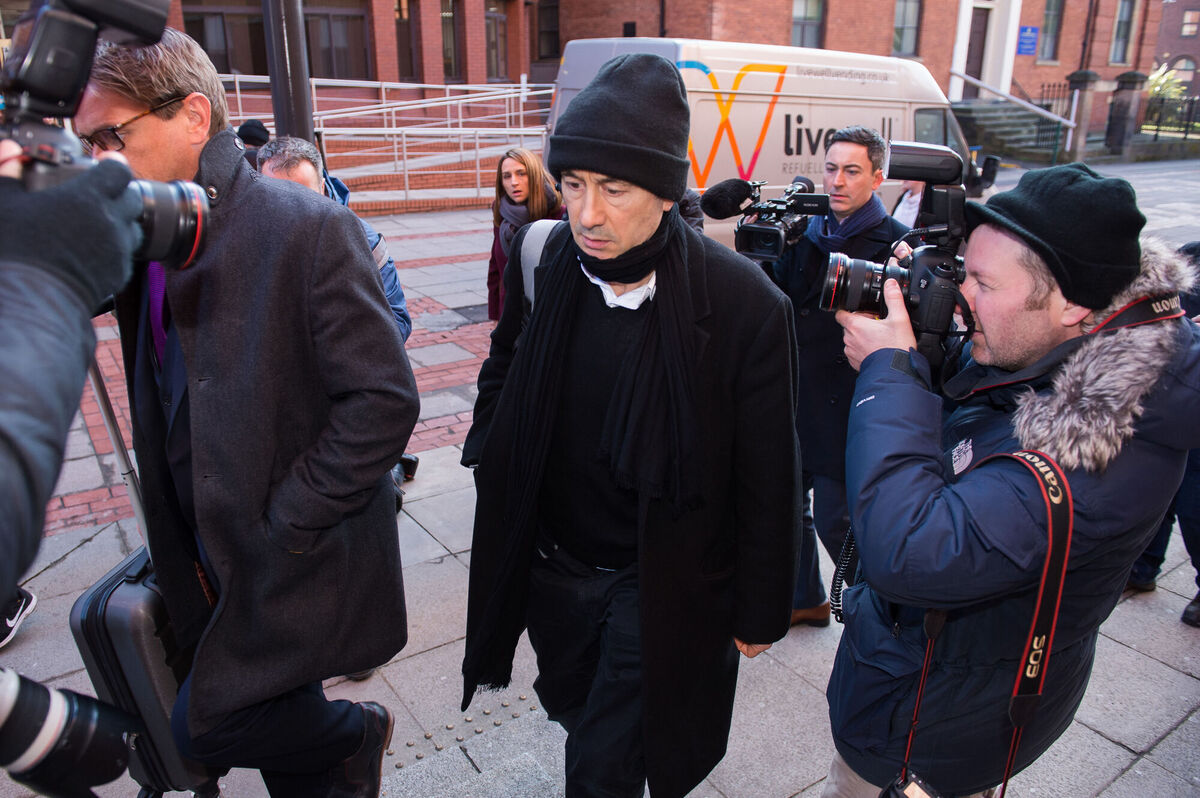
In many cases, subjects appear to be individuals with intellectual disabilities or caught in the throes of addiction.
Moran says that the confrontations, which can run for hours, are the product of a “click economy".
“They're taking enormous risks to the lives of the people themselves, to the vicarious victims, for example, the families, the wives, children of these people.
“They're taking risks with evidence. If something goes wrong and these guys don't get driven to the Garda station by these right-thinking people, then you're ending up in a situation where evidence will be destroyed by this person.
“That's the first thing they're going to do. They're going to go inside and take their hard drive and put a drill through it.”
Michael Lynch, a former investigating officer in An Garda Síochána’s Child Protection Unit, expressed similar concerns.
“I think really for the whole criminal justice system, the idea of it going up on the internet when there's no conviction or even the start of a Garda investigation, they just put it straight up…that's something that could be prejudicial to the court case later on.”
The groups often present gardaí with a ‘dossier’ of evidence, showing the decoy’s interactions with the alleged predator, a method which Mr Lynch says lacks weight in court. In reality, Gardaí must sift through personal devices and search the alleged criminal’s home to begin prosecuting a case.
“[A dossier] fails very often in the electronic trail that can prove that that person actually sent that message," says Mr Lynch.
“The big problem with it, for me, is they seem to operate from a presumption of guilt, whereas the criminal justice system operates from a presumption of innocence, and you have to prove the guilt without reasonable doubt.”
Suzanne, who works as a decoy for another hunting group, ‘Justice Reborn’, says that like Jay, her work has solely been focused on putting dangerous paedophiles behind bars.
She believes she is the only female hunter in Ireland. She thinks everyone in the space began with altruistic intentions but that some have become infatuated with social media clout, which in turn produces an increasingly aggressive interrogation style.
“The worst I will do is shout,” she says.
“I do not believe in belittling them or slagging them off or calling them silly names, because the way I look at it…They have families. A lot have children. They have parents.
“They have friends who are going to see this and learn this about the person they know for the very first time. There's an awful lot of devastation caused internally among their family and friends.
“I have knocked on the door and exposed you as being a child predator. I don't then need to belittle you on top of that. I've already destroyed your world.”
She says there is a strict ‘no hands’ policy employed in all of Justice Reborn’s stings, yet videos posted directly on social media appear to contradict that claim.
A video showcasing an alleged predator in Tallaght, a man with hollowed cheeks and sallow skin, begins with an opening frame of a Justice Reborn ‘security’ guard grabbing the man in a position akin to an arm lock. Another security man grips his arm to prevent the alleged criminal from escaping.
He squirms in their grip. He is then brought across a patch of grass and made to sit down with his back to a fence.
Over the course of the hour-long video, the hunters tell this subject “to be a fucking man” and begin answering questions over his interactions with a decoy account.
Suzanne said the physical contact at the beginning of the video amounted to ‘hand holding’ and that it was in the subject’s own interest that he was not let go.
She says all of the stings Justice Reborn carry out are consensual, and that the target of the sting can decline to be recorded.
Phelim O’Neill, a solicitor at Harrington LLPs, represents a client accused of sexual offences that stemmed from a Justice Reborn sting.
Mr O’Neill told the that his client was filmed non-consensually over the course of a sting operation on their private property, and was subject to manipulated conversations with false identities online.
The case is still awaiting DPP direction. Mr O’Neill questioned why social media companies were allowing stings to be platformed, and if they were being algorithmically boosted.
Meta said it has dedicated channels for law enforcement to flag content and takes action on content that could prejudice unconvicted individuals. Hunting accounts continue to upload stings with individuals who have not been convicted that generate hundreds of thousands of views.
TikTok said it reports any credible and imminent threat to human life to relevant law enforcement authorities.
A professor of original ethnography at Cambridge University, Mark de Rond spent four years embedded in one of the UK’s most prolific hunting groups.
“I think what's challenging is that keeping kids safe is such a moral imperative. It's such an important thing because kids are seen to be the archetype of innocence and purity,” de Rond tells the .
“It's so important that it gives people a get-out-of-jail-free card to kind of do whatever they want. And you get a situation where the ends kind of justify almost any means.”
He posits that the ‘hunters’ frame themselves as the archetypal lone wolf, a comic book hero like Batman who delves into the shadows that they believe law enforcement can’t or don’t want to reach into themselves.
“I think what the police found particularly challenging is trying to understand why hunters don't just collect the evidence by going online and pretending to be kids and dating predators, and then just hand it over to police,” says de Rond.
“There's all sorts of reasons why they think the exposure itself is an important part of the hunt…If you think this sort of fairytale logic has something going for it, that hunters are a noble knight that rides out to slay a terrible monster who's gone after a damsel in distress and do all society's service…it speaks to the narrative.
“It gives people — not only them, but people watching — a sense of more superiority, right? We love watching people being humiliated.”
A new RTÉ programme examining the operations of the vigilante/child protection groups is scheduled to air tomorrow evening.
A new film, could see interest crescendo. Starring Robert Pattinson as journalist Chris Hansen, it chronicles the rise and fall of NBC’s , where Hansen conducted sting operations with suspected child predators in conjunction with law enforcement.
The show was also the focus of David Osit’s 2025 documentary , where Osit compiled hours of found footage from Hansen’s interviews with the subjects of the show.
came to prominence at the dawn of the internet — when users were never really sure what lay around the corner, the true depravity in the crevices of everyday life.
Yet crafting the documentary, and watching hours of footage that was unused in the broadcast, left Osit rattled, feeling raw entertainment had been prioritised above justice.
“I was watching 75- or 80-minute single-shot takes of someone’s life ending in slow motion,” Osit previously told .
“If you’re human it’s hard not to feel something watching that, regardless of what someone’s done or might have done.”
CONNECT WITH US TODAY



Be the first to know the latest news and updates