Wind energy: Local communities should get a better dividend from wind farms
As Ireland steps up its wind energy capacity, Neil Michael learns that our flawed model for ensuring communities benefit from local wind farms may be undermining the objectives of a 'just transition'
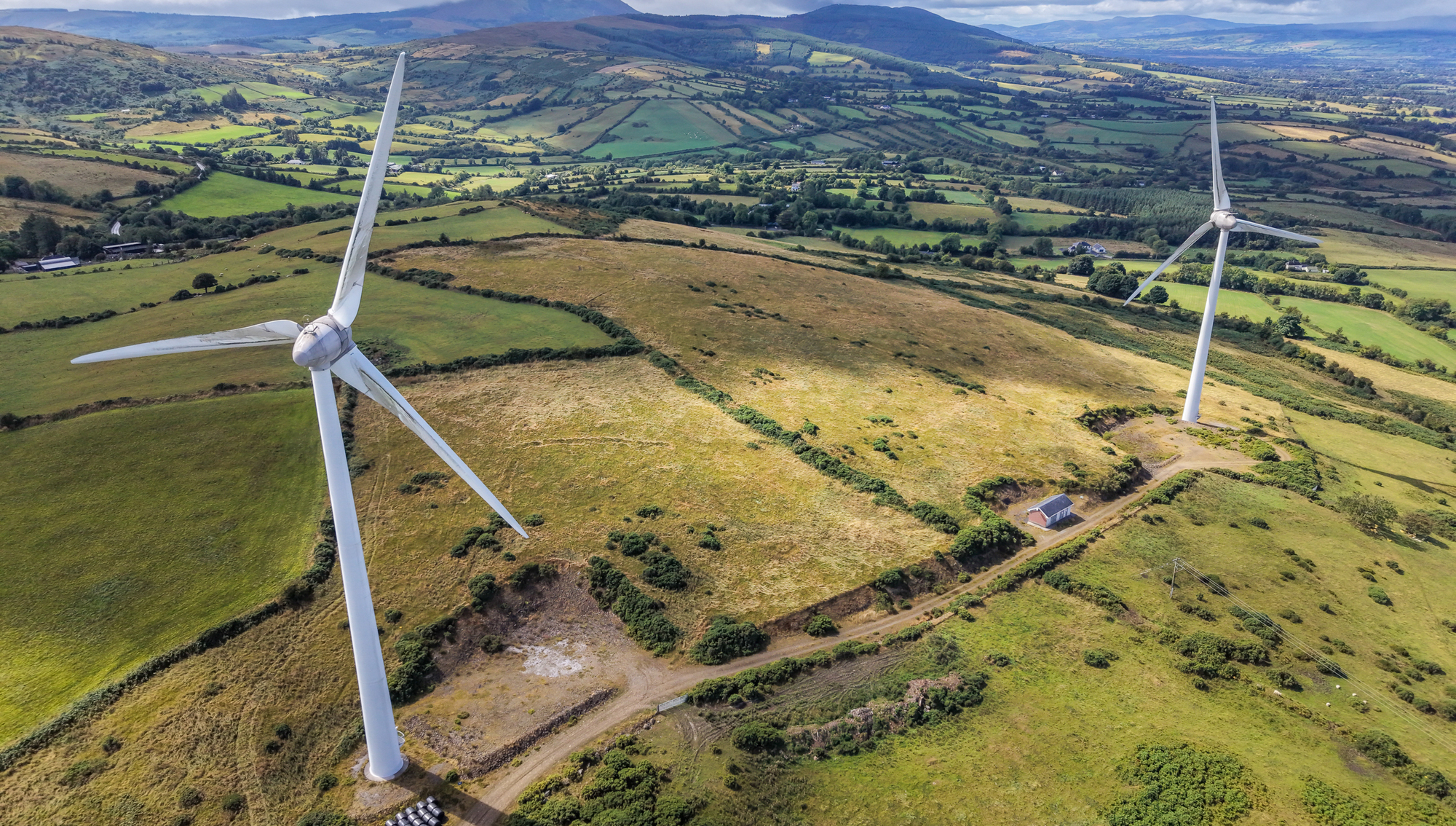
Templederry Wind Farm in Tipperary is an outlier, being Ireland's only community-owned wind power generator. By contrast, the first ORESS-1 auction round awarded contracts to huge, mostly foreign-based companies worth billions. Picture: Neil Michael 

Templederry Wind Farm in Tipperary is an outlier, being Ireland's only community-owned wind power generator. By contrast, the first ORESS-1 auction round awarded contracts to huge, mostly foreign-based companies worth billions. Picture: Neil Michael 

Two words often get neglected in discussions about wind energy — “just transition”.

The noise from protests about wind farms, the prospect of Ireland being fined billions of euro for missing 2030 climate targets, and the growing chorus in favour of decarbonisation get far more attention than a concept that is actually the cornerstone of EU climate policy.


Just transition is effectively a blueprint for how everybody in society should benefit from the transition to clean, renewable energy.

It is all about making sure the benefits and risks of that transition are shared in a just and equitable way and that — crucially — “nobody is left behind”.

It was with this in mind that Sheila Harty brought her experience as a former insurance industry actuary — measuring risk, calculating fair prices, and ensuring companies have enough money to meet future claims — to bear on the concept where it relates to companies building onshore and offshore wind farms in Ireland.

CLIMATE & SUSTAINABILITY HUB

Ms Harty has produced a body of peer-reviewed research, which was published to little fanfare in March, and it comes to some key conclusions, namely that the Government’s current model for ensuring communities around wind farms benefit could actually be undermining the objectives of a just transition.

This article is part of the Wind Power Special Report in print and online here in the 'Irish Examiner' today, Monday. 

A focus of her research was on the awards in 2023 by the Government of supply contracts for a combined 3,100MW of electricity — enough energy to power up to 3m homes at any one time — from offshore wind energy to four companies.

The contracts were awarded to huge, mostly foreign-based companies worth billions, under auctions arranged under the first Offshore Renewable Electricity Support Scheme auctions (ORESS-1).

Under the scheme, the state agreed to buy electricity from the companies at an average of €86.05/MWh for up to 20 years.

Norwegian, French, Danish, and German mega-firms

Two of the projects are the 1,300MW Codling Wind Park — a 50/50 joint venture between Norway’s Fred Olsen Seawind and French state-owned EDF Renewables off the Wicklow coast — and the German RWE Group’s 824MW Dublin Array, 10km off the coast, straddling counties Dublin and Wicklow. 

Earlier this year, Forbes magazine reported that the Essen-based company had revenue of €15.3bn, assets of €114.5bn, and profits of €2.7bn.

There is also the 500MW North Irish Sea Array off the coasts of Dublin, Meath, and Louth, which is owned and developed by Denmark’s Copenhagen Infrastructure Partners (CIP) and Statkraft.

The latter, a Norwegian state-owned company, has invested more than €1.4bn into the Irish market since it entered in 2018, over €350m of which has been invested in wind projects to date.

The Danish company, which manages more than €43bn in funds, earlier this year launched a new European renewable energy company, Perigus Energy.

Headquartered in Cork, it was created after CIP’s €1.4bn acquisition of the predominantly Danish government-owned Orsted’s European onshore platform.

Ireland's first offshore wind farm at the Arklow Bank Wind Park (Phase 1), off the Wicklow coast. Constructed in 2003/04 and owned and operated by GE Energy, the seven wind turbines have a capacity of 25.2MW. Picture: Neil Michael 

Sceirde Rocks plan scrapped 

The fourth successful project awarded a contract was the 450MW Sceirde Rocks wind farm.

Owned at the time, and due to be developed by Fuinneamh Sceirde Teoranta, it was a €1.bn joint venture between Australia’s Macquarie’s Green Investment Group — which manages billions in green infrastructure assets — and the €263bn Canada-based Ontario Teachers’ Pension Plan.

But plans for the wind farm, which would have seen the construction of 30 “Eiffel Tower sized turbines”, according to opponents, off the coasts of counties Clare and Galway, were later scrapped.

TD: Ireland 'a bit player' in its own natural resources

The fact that the offshore auction was so dominated by foreign companies — whose shareholders will doubtless receive a hefty share of the resulting profits — is not lost on Social Democrats’ climate spokeswoman, Wicklow TD Jennifer Whitmore.

“When you look at any of our natural resources, we tend to enable large corporations to be the largest beneficiaries from it,” she said.

“We’re happy to be a bit player in it rather than actually driving it.

“Irish governments have always been hesitant about being major drivers in things like this, and they tend to be more risk-averse.

“They also don’t have any sort of faith in the State’s capability to be a large player, and therefore will put their trust in international corporations before they put their trust in their own bodies.

“That said, there is absolutely a need for international expert experience and international business experience in it.

“But the State could have had an opportunity to be a much bigger player and go big into partnerships with international organisations to really invest in our natural resources. Sadly, so many dividends are instead going offshore and will continue to for decades.”

Flaw in the community benefit fund stipulation

One of the conditions of the awards to the remaining three project owners is that they have to put €2 for every MW they generate into a community benefit fund (CBF) for the duration of their guaranteed minimum payment contract under the ORESS-1 scheme.

However, the payment is linked only to theoretical output, not profitability, and does not adjust to higher-than-expected profits.

But Ms Harty, who works for the UCD Energy Institute’s energy research programme NexSys, concludes: “While the fixed €2/MWh CBF generates approximately €228m in cumulative value over 20 years, an alternative community share scheme [CSS] allocating 20% equity or shares to local communities could yield substantially more cumulative value.

“However, this carries with it a risk that if the project fails or does not yield as much profit as expected or forecast, the value of their shares could, like everything, go up or down, and that is a risk they take.

“The findings suggest that incorporating optional community equity mechanisms within future ORESS rounds could enhance alignment with Just Transition objectives without undermining investment incentives.”

Her paper evaluates whether or not ORESS-1’s exclusive reliance on a CBF “adequately aligns offshore wind policy with Just Transition principles”.

Using Codling Wind Park as a case study, she compares financial and distributive outcomes under the mandated CBF with a counterfactual — or “what if” — 20% CSS model.

Using discounted cash flow and scenario analysis, the project is found to be profitable for developers across a wide range of scenarios with support from ORESS-1.

She estimates it could — even after all the many and varied costs of building and maintaining it are factored in — make between €3.1bn and €7.7bn in profit throughout its lifetime.

But this does depend very much on how smoothly the project runs, and the most likely outcome modelled is about €5.5bn in profits.

Her results indicate the current CBF model favours developers relative to a hypothetical CSS — under which the cumulative value of a 20% community stake — would exceed that of the existing fund by more than €900m.

She said: “These findings suggest ORESS-1 does not fully optimise the equitable distribution of economic benefits and may risk widening inequalities, thereby undermining the objectives of a just transition.

“Policymakers should consider offering alternative models, such as CSS, alongside or in place of CBFs. She added: “Policies should also facilitate broader citizen participation through accessible support mechanisms and risk-sharing structures, in closer alignment with Just Transition principles.”

Her research is a good indication of the scale of the profits to be had from wind power generation in Ireland, and what local communities around or near the wind farms could benefit.

Wind power worth €10-€14 per month to customers

Research carried out on behalf of Wind Energy Ireland goes some way to try and answer the million-dollar question: How better off are electricity customers from the wind energy we generate? The short answer is that it is somewhere between €10 and €14 a month.

A great deal of the research and reasoning behind this figure can be found across two reports published in 2025 and carried out by global consulting firm Baringa Partners.

These are Cutting Carbon, Cutting Bills: Analysis of savings in gas consumption delivered by wind farms in 2024 and Good for your Pocket: How renewable energy helps Irish electricity consumers.

Cutting Carbon, Cutting Bills explores a particular question in isolation: How much gas does Ireland avoid importing due to wind and solar farms, and how much does this save us?

Good for your Pocket explores every possible impact on the bills of consumers, and the findings — which are, while comprehensive, conservative — can be easily translated into estimates for euro per customer per year.

In that report, Baringa focussed on power bills but did not include any savings from avoidance of non-compliance costs at the EU level, which would be additional benefits beyond Baringa’s findings.

Baringa’s research concludes that if there were no wind or solar farms, then Ireland would have had to import an extra 2.4bn cubic metres of gas in 2025, at a cost of €1.3bn over 12 months.

Baringa also pointed out that the €1.3bn cost includes the cost of the gas itself and the €350m cost of ‘carbon credits’, which have to be paid for each tonne of CO2 released when the gas is burned.

In Good For Your Pocket, the research found that Irish wind and solar farms lowered electricity bills by a total of €840m between 2000 and 2023.

This is the financial benefit of Irish wind and solar farms to all domestic, commercial, industrial, and agricultural electricity customers. The €840m saving has been realised on bills over 24 years between 2000 and 2023 — some €35m per year or €14 per account per year.

Between 2020 and 2023, the saving was actually €1.7bn — much larger, because renewables added a small cost to bills in the 2010s, before paying this back in the 2020s.

As a result, over the four years from 2020 to 2023, the saving was €425m per year, or an average of €170 per account per year per electricity customer account.

To what extent the huge fines Ireland faces for missing EU climate targets have the potential to erode benefits to electricity consumers is also an issue.

Baringa Partners manager and decarbonisation expert Alec Granville-Willett, one of the authors of both reports, said: “Ireland has pledged to decarbonise all sectors of its economy, and failure to achieve these legally binding targets leaves the state, and ultimately Irish taxpayers, exposed to fines imposed at the EU level. Joint research from the Irish Fiscal Advisory Council and Climate Change Advisory Council suggests that fines could be as large as €24bn based on Ireland’s current trajectory.

“Our own research shows that Irish wind and solar farms have lowered the electricity bills of consumers across all sectors, and annual savings could grow if Ireland continues to invest in the renewable transition.

“The benefits of renewable projects don’t end at household bills though; every wind or solar farm built will get Ireland closer to achieving its targets and lower the potential fines.”

Wind power isn't cheap but is good value

Global energy modelling expert Paul Deane, a senior University College Cork lecturer in energy futures, believes the savings identified by Baringa are an accurate estimate.

“Working out the savings for each customer is a very tricky question,” he said. “Back in 2018, for example, when international gas prices were very, very low, renewables would have been adding on to people’s bills and costing us money.

Paul Deane: 'while wind energy and solar are not cheap — nothing is cheap anymore — they are cost-competitive with the alternatives.' File picture

“But of course, when natural gas prices go up, and because we generate so much of our electricity from natural gas, that means that the benefit from wind increases when natural gas prices go up. So, we would have been paying roughly about €170 extra if we didn’t have wind for 2025.”

He points out that most people — when they see them — equate large electricity pylons dotted around the country with huge costs. But, he says, a huge cost for electrical infrastructure in Ireland is actually the wooden poles and copper wires. Mr Deane said around €300-a-year of our electricity bills goes into the maintenance, upkeep, and the replacement of Ireland’s pole and wire system.

He said: “This is a legacy issue because Ireland has a very dispersed population and, as a result, the length of wires we need to get electricity from where it’s made to our homes is incredibly long.

“Indeed, if you took all the wires that are just on wooden poles in Ireland, they would wrap around the world four times.”

With all the costs involved — including the developers’ fees, the landowners’ fees, the cost of turbines, maintenance and the cost of accessing the national grid — it does beg the question: Is wind power actually economical at all?

Mr Deane doesn’t hesitate. Yes, in his view, it is.

“It is economical when gas prices and fossil fuel prices are similar to what we’ve seen over the last five years,” he explains. “If you roll back the clock to 10 years ago when gas prices were very, very low, about a third of what they are now, then the economics of wind would be unfavourable.

“But while wind energy and solar are not cheap — nothing is cheap anymore — they are cost-competitive with the alternatives, which in Ireland’s case is natural gas.

“When Russia crossed the frontier into Ukraine, the world of energy changed completely. The cost of everything went up.

“Not only did the cost of natural gas go up, but the cost of metal, steel, labour — everything just went up.

“So nothing is cheap, but you can say that renewables are cost-competitive with fossil fuels, with natural gas.

“If you look over the next number of years, the big challenge is — when trying to understand the future of our electricity bills over the next five months or over the next 10 months or 10 years — you really have to understand what’s happening with natural gas prices.

Brendan O’Brien, Kerry Orienteering​; Kieran White, CEO​, Perigus Energy​; Sean Kelly MEP​ and Sarah Foley, Perigus Energy at an event last month to celebrate 20 years of renewable energy generation at its wind farm in Kilgarvan, County Kerry. Picture: Alison Miles/OSM

“Natural gas prices are at the moment about three times higher than they were at the historic average.

“It’s very difficult to see a world scenario where international gas prices go back to kind of 2018. I think that ship sailed a long, long time ago, and that’s where the economic advantage of things like wind and solar come in. So it’s not so much that wind and solar have got cheap; the alternatives have just got way more expensive.

“Also, wind and solar give you what fossil fuels don’t — they give you predictability and they give you stability.”

Ireland now has wind power capacity of 8GW

Ireland has now reached a record 8GW (gigawatts) — enough to power more than 1.6m homes — of renewable generation capacity, up from 4.8GW in 2020. Five new wind energy projects with a combined potential generating capacity of 311MW — enough to power 180,000 homes a year — were approved in the second quarter of this year, marking the highest level of approvals since Q1 2025.

Onshore wind energy provided one third of Ireland’s electricity in 2025, and in
January, the country hit the important milestone of 5GW of installed onshore wind capacity.

The milestone of over 2GW of installed solar capacity was achieved in November, according to the Department of Climate, Energy and the Environment.

Solar went from a near-zero contributor to replace coal as the third-highest source of indigenous electricity generation in less than a decade, with over 2.6GW of solar PV generating power across the country, including over 1.2GW of rooftop solar.

The department told the Irish Examiner: “We are also prioritising the development of offshore wind capacity, with five ‘Phase One’ offshore wind developments off the east coast currently going through the planning system, and having the best chance of being in construction by 2030.”

The department, which is responsible for environmental policy, energy policy, and protecting and developing our natural resources, was asked why Ireland has been so slow to capitalise on its own wind. It replied: “In Ireland, our long-standing reliance on fossil fuels — specifically gas — for electricity generation has been a driver of higher energy costs.

“Also, our location as an isolated island, our low-density and widely dispersed population and small market scale also influence prices.

“While household electricity prices are a challenge, a recent report from the International Energy Agency shows that Ireland was sixth highest when it comes to a household’s overall spend on energy — not just electricity.

“Ultimately, the only lasting way out of fossil dependency is to modernise by shifting electricity generation to renewables, and by electrifying the economy as rapidly as possible.”

For academics such as Sheila Harty, they will be hoping that the transition is as just as possible too.

x

CLIMATE & SUSTAINABILITY HUB

More in this section

Lunchtime News

Newsletter

Get a lunch briefing straight to your inbox at noon daily. Also be the first to know with our occasional Breaking News emails.

Cookie Policy Privacy Policy Brand Safety FAQ Help Contact Us Terms and Conditions

© Examiner Echo Group Limited