Liz Dunphy: Everywhere you look are reminders that nowhere in Ukraine is really safe
As families buried their dead in the wake of more deadly missile attacks, Taoiseach Simon Harris came to Kyiv with funding and a message of support from Ireland
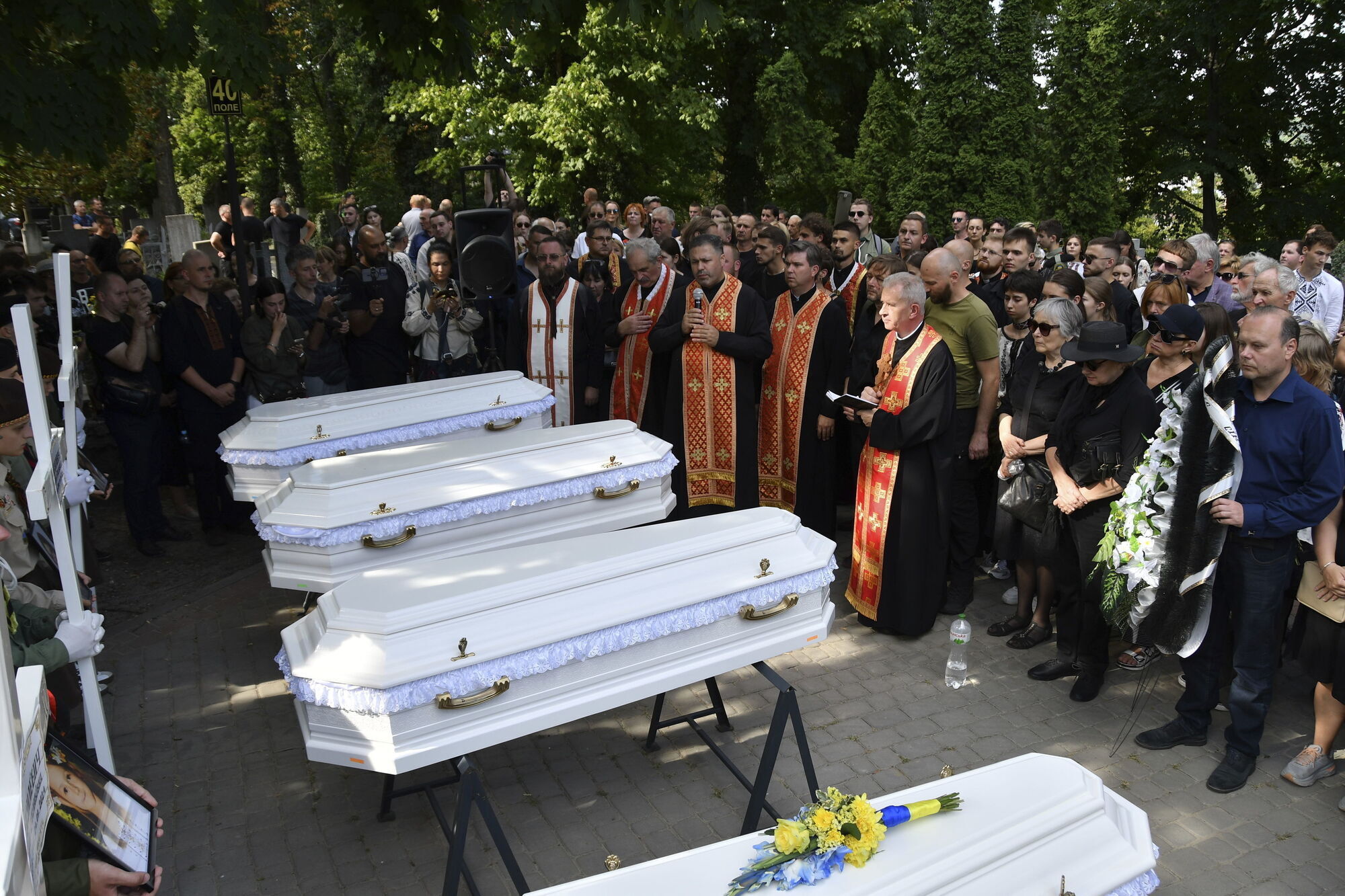
Priests conduct the funeral service for family members of Yaroslav Bazylevych at a city cemetery in Lviv, Ukraine today, Friday. Mr Bazylevych's  wife Yevgenia and their three daughters — Daryna, 18, Emilia, 7, and Yaryna, 21 — were all killed in Wednesday's devastating Russian missile attack. Picture: Mykola Tys/AP

Priests conduct the funeral service for family members of Yaroslav Bazylevych at a city cemetery in Lviv, Ukraine today, Friday. Mr Bazylevych's  wife Yevgenia and their three daughters — Daryna, 18, Emilia, 7, and Yaryna, 21 — were all killed in Wednesday's devastating Russian missile attack. Picture: Mykola Tys/AP

Anti-missile batteries tilt up towards the sky around Rzeszów airport in Poland, a chilling reminder of the bloody war being fought over the nearby border.

The small regional airport in the south-east of the country has become a key location for Western support of Ukraine because of its location, just 80km from the border.

Military personnel, politicians, aides, and journalists now provide an economic boost for the pretty and peaceful town of Rzeszów which is used as a jump-off point from the EU into Ukraine.

The military train that takes people on the 10-hour journey to Kyiv runs through the night.

Taoiseach Simon Harris meeting Ukrainian president Volodymyr Zelenskyy before the signing of a memorandum of understanding in Kyiv as Ireland announced millions of euro in new funding for Ukraine. 	Pictures: Stefan Rousseau/PA
Taoiseach Simon Harris meeting Ukrainian president Volodymyr Zelenskyy before the signing of a memorandum of understanding in Kyiv as Ireland announced millions of euro in new funding for Ukraine. Pictures: Stefan Rousseau/PA

Its narrow bunk beds provide a shuddering base for passengers as it trundles through the darkness past pine and birch trees that pierce the horizon like spears, and pitched roof houses that huddle over well-tended kitchen gardens.

Fields of sunflowers, bright faces hanging and stems slightly hunched, mourn the lack of light as the train rushes by.

Another train pulls tank after tank of fuel into the country which has had its energy infrastructure repeatedly targeted by air strikes since Russia’s invasion in February 2022.

The train, carrying Taoiseach Simon Harris and an Irish delegation for bilateral talks with Volodymyr Zelenskyy, stops for 40 minutes in the western Ukrainian city of Lviv, just hours before missile and drone attacks struck the city early on Wednesday morning, killing seven people.

A family funeral 

A mother, Yevgenia Bazylevych, and her three young daughters — Yaryna, Daryna, and Emilia — were among the dead, killed in their home in the city.

The attacks in Lviv are a reminder that nowhere in Ukraine is really safe.

Hypersonic missiles and drones struck the historic city the day after Russian air strikes killed 53 people in the central Ukrainian city of Poltava — the deadliest single strike this year.

Later on Wednesday, air defences targeted Russian missiles above Kyiv, triggering explosions over the city.

Taoiseach Simon Harris during a bilateral meeting with Polish prime minister Donald Tusk in Rzeszow, Poland, on Thursday. Picture: Stefan Rousseau/PA 

Russian aerial attacks have increased across the country since Ukraine launched an unprecedented cross-border offensive into Russia’s Kursk region last month.

The ramping up of Russian attacks has prompted urgent calls from Mr Zelenskyy for Western air defences and long-range weapons to retaliate and strike deep into Russia.

But in Kyiv, people try to maintain normal lives between the air raid sirens and electricity blackouts.

One woman said that she has learned to catnap when she can by day because sirens often disrupt your sleep at night.

The coffins of four members of one family, Yevgenia Bazylevych and her three daughters — Daryna, 18, Emilia, 7, and Yaryna, 21 — are placed in their shared grave after all four were killed in a devastating Russian missile attack on Lviv in Ukraine on Wednesday. Picture: Mykola Tys/AP

Military checkpoints and infrastructure pockmark the beautiful city. Large concrete slabs slice through the roads, forcing traffic to zigzag slowly by checkpoints.

Large military tanks and groups of soldiers in fatigues are stationed throughout the city.

But expensive-looking clothes shops remain open for Kyiv’s well-dressed citizens.

A young women, wearing bright red lipstick and fashionable black clothes walks by, holding her boyfriend’s hand. He was one of the few young men on the streets not visibly working for Ukraine’s army, which is ever-hungry for recruits.

People sat outside cafés in the sun and gathered in twos and threes on the squares at night, enjoying being outside in Kyiv’s perfect summer weather.

But winter is coming and many cold, dark months wait patiently for them.

Taoiseach Simon Harris laying a wreath at the memorial in Maidan Nezalezhnosti square during his visit to Kyiv as Ireland announced millions of euro in new funding for Ukraine. Picture: Stefan Rousseau/PA Wire

Electricity blackouts are frequent. And power stations are always targets for Russia’s missiles.

One of Ukraine’s largest thermal power plants, Trypilska in southern Kyiv, was destroyed in April. Missiles blasted through the roof, smashing craters into the dense concrete floor.

Workers rushed to a shelter and survived the attack but the plant was destroyed.

Russia fired 82 missiles and drones in the attack. Ukraine’s air force said it shot down 18 of the missiles and 39 of the drones but its air defences could not prevent all of them from striking.

Work is underway to rebuild, replace and repair. But the plant still only retains half its roof.

When Simon Harris visited the site on Wednesday, people repeatedly requested money to replace equipment.

Ukraine’s deputy energy minister Mykola Kolisnyk said the plant once provided power for four of Ukraine’s 25 regions, including the capital Kyiv.

“We lost 1,800 megawatts of capacity,” Mr Kolisnyk said. “The whole generation was stopped. It was fully destroyed. Everything had to be rebuilt.”

North of Kyiv, saplings planted in a park were a sign of hope.

Simon Harris visiting the Trypilska thermal power plant south of Kyiv which has been hit by repeated military strikes by Russia.

Women stopped to inspect flowers and intricately woven wreaths outside a nearby florist.

Down the road, an elderly man tended to a small field in the shadow of a house heavily pockmarked by shrapnel.

The rooms of what were once family homes are exposed to all who pass by in buildings in Borodyanka where missiles ripped through concrete walls and human limbs.

Rainbows, love-hearts, and cartoon animals are painted above children’s beds in a new childcare centre there, just below a window through which the jagged edges left by bomb blasts on the apartment block opposite can still be seen.

Chairs were still stacked neatly under the kitchen table in one of those apartments, inches from where a blast pulverised the rest of the building.

A fridge teetered close to the edge of that blast scar, any food inside long rotted and withered away.

People died here. Children, women, men. Some were killed as they slept in their beds. Others when they were cowering in fear in bunkers, with nowhere else to escape to.

Some bodies were never identified. Others were never fully retrieved.

When the town, Borodyanka, was occupied by Russian forces early in the war, soldiers stopped people at gunpoint, preventing their efforts to dig their family, their neighbours, their friends, out from under the rubble.

Irish funds help Child Rights Protection Centre

The war and Russian occupation continues to exert devastating impacts on many families. In Kyiv, the Child Rights Protection Centre (CRPC) helps children who lived under Russian occupation in Ukraine or were abducted and taken to Russia or Belarus.

The Unicef project is to receive €2m from Ireland’s additional €36m funding package to Ukraine, announced by the Taoiseach in Kyiv on Wednesday.

Since the war started in February 2022, Ireland has given more than €380m to Ukraine and taken in some 109,000 Ukrainian refugees.

The CRPC helps children reintegrate and heal after returning to Ukraine. It also collects data on any war crimes being committed by Russia for any future prosecutions.

Potential war crimes 

Children are interviewed — in a child-sensitive manner by professionals — to record any crimes perpetrated against them. The interviews take place in what looks like a comfortable children’s playroom, with a camera and microphone in the corner.

A legal team monitors the interview from a room next door and feed in questions.

Some 19,500 Ukrainian children are either in temporarily occupied areas or in Russian territory, according to official government statistics.

The centre, which opened in Kyiv last year, is the first of some five to six centres which Unicef plans to establish around the country to support children and document the crimes they endured.

Children speak of torture and sex assaults

Children in occupied territories have returned speaking about parents who had been tortured.

Russian soldiers would beat, harass, and detain their parents. Sexual assaults on mothers are also suspected. And children were forced to speak and learn through Russian rather than their native Ukrainian in schools.

Taoiseach Simon Harris visited the centre on Wednesday and met a family being helped there.

The mother, a journalist, and her three children, aged seven, 15, and 17, escaped Russian-occupied territory but their father was blocked by Russian forces from leaving.

The family has now been separated for one year.

While in Russian-controlled Ukraine, the family suffered “intense, extreme intimidation” because of the mother’s journalistic work and the family felt forced to leave for their safety.

“I met young children — very young children and older children — and a mother, all of whom had been deeply traumatised by the impact of war, violence, torture — physical and psychological,” Mr Harris said following the meeting.

“This is a war of real pain, of real agony, and of real brutality.

“The people of Ireland stand with the people of Ukraine.” 


More in this section

Lunchtime News

Newsletter

Get a lunch briefing straight to your inbox at noon daily. Also be the first to know with our occasional Breaking News emails.

Cookie Policy Privacy Policy Brand Safety FAQ Help Contact Us Terms and Conditions

© Examiner Echo Group Limited