Archives: What does the future have in store for our children?
One hundred years ago, the Cork Examiner published a series of opinion pieces by a contributor known as 'Periscope', highlighting a range of social and political issues — some of which are as relevant today as they were back then
Archives: What does the future have in store for our children?

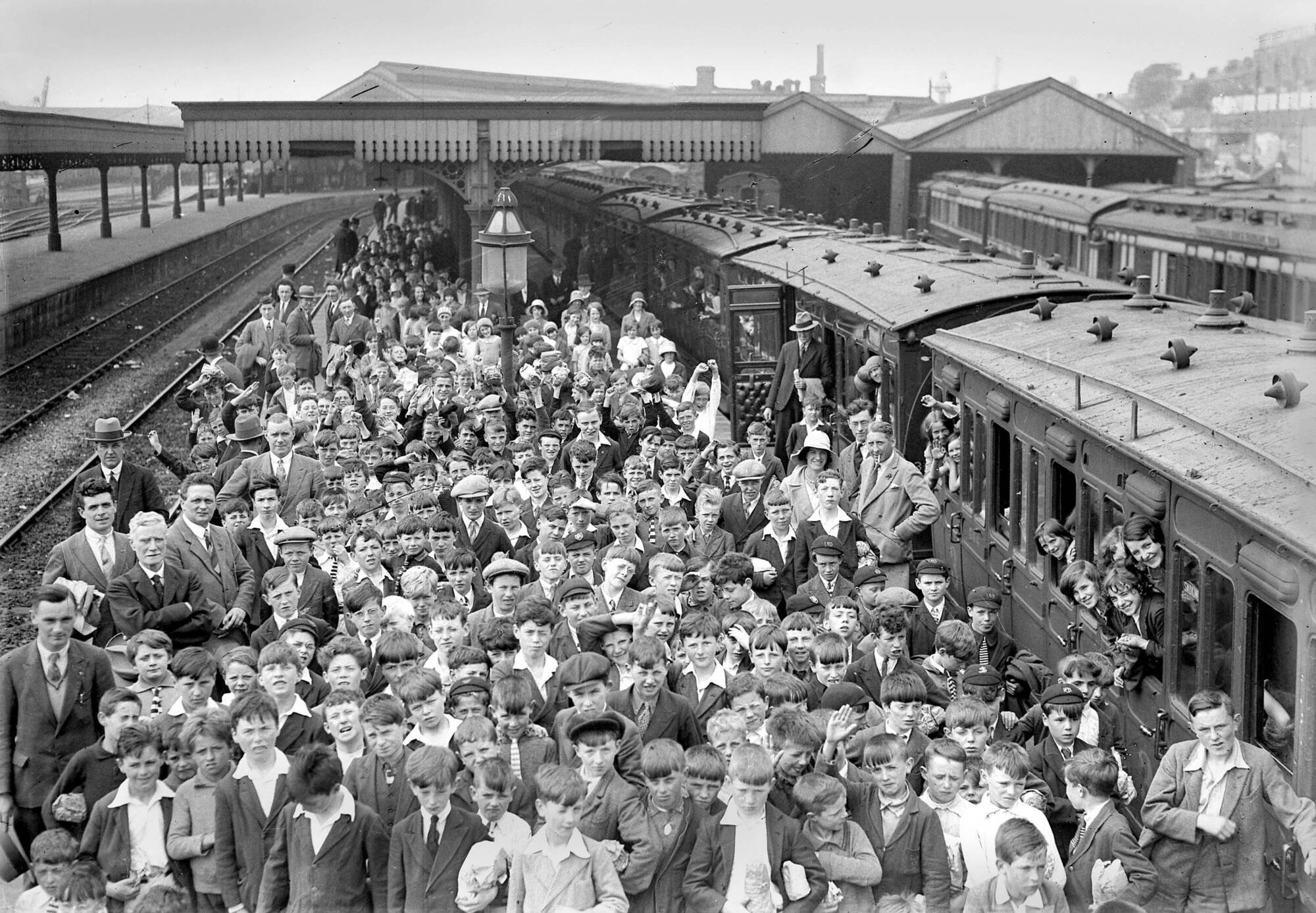
A Cork schoolchildren's summer excursion to Youghal leaves Lower Glanmire Rd station on July 1, 1931. 

The last rose of summer which, as we have heard in song and opera, was left blooming alone, might bloomin' well have chuckled at having bested "all her lovely companions" which were "faded and gone" before the burst of summer weather that made Wednesday the finest summer day of the season. 

Well, cabbage rose or rows of cabbage, every living thing must have grown and lived the better for such a day of sweet sunshine and warm air. 

And of all places around Cork, commend me to Youghal on a fine day. This quaint old town, so like an old English town, with its well-ordered plan, its long main street, its little courts up alleys, and its terraces, on the one side; its glorious stretch of beach, the grey-blue broad Atlantic and the lovely sea-banks of Ardmore on the other, has an environment equal to that of any watering place in the Kingdom; while, on Wednesday, the autumn-tempered air, fragrant with the scent of the sea and the grassy banks beside it, completed the sum of these things which made one feel that, in spite of the clouds that are not the clouds of heaven, it was good to be alive on such a day. 

And, best of all, it was the children's day. As I saw them thronging, happy and free, to spread over the fair beach, I could not but think once again of these lines of Elizabeth Barrett Browning's:

Come out children from the mines and from the city; Sing blithely as the little thrushes do. Pluck your handfuls of the meadow cowslip pretty; Laugh aloud to feel your fingers let them through.

HISTORY HUB

If you are interested in this article then no doubt you will enjoy exploring the various history collections and content in our history hub. Check it out HERE and happy reading

And here there was no doleful answer such as the poet's great mind conceived, in her deep sympathy and commiseration, but instead a happy laugh or a vigorous shout or a divestment of clothing with a speed which would have done credit to any famous quickchange artist, and then a plunge in the briny. 

The delight of it! It is a great idea, this children's excursion, conceived by that estimable citizen, the late Augustine Roche, whose passing away left his native city the poorer for the loss of one who was in all good causes loyal to the heart's core. 

But concerning the present method of carving out the idea, I have the impression that the recently-developed plan of larger numbers is not altogether desirable, because it is hardly feasible. 

I should be strongly inclined to advise the committee having charge of the project to take in hand next year half the number of Wednesday's total, and extend the scope of the actual entertainment in the matter of the catering, providing something more substantial in the way of food. 

The salt sea air is a great producer of the keen edge of appetite, but I cannot think that it was altogether responsible for the ravenous way some of these little trippers grabbed the bread and buns served out to them when starting on the homeward journey. 

It was literally a bun-struggle of the most strenuous kind. When children are taken on an excursion it is well to provide as far as possible holiday fare, such as the children do not get every day. And it is a very debatable question whether some point nearer home could not be chosen for the fete, so as to give a longer day to all the children, it being apparently impossible to bring back from Youghal such a large number without some having to make too early a start for home. 

These are all matters which may be fully considered and discussed before the time for the excursion comes round again.

A Cork schoolchildren's summer excursion to Youghal on July 1, 1931 

Happily, the children enjoyed themselves in the glorious air of the seaside. One cannot see such a throng, so full o' the quickening vitality of childhood, and not wonder what the future has in store for them, how many will grow up to face the battle of life, and how far their future life will be influenced by the temper of the times in which we live.

Thoughtful, observant people cannot have failed to be struck by the number of children who are influenced in their very playtime by the evil incidents common to the present day. Imitation revolvers are the latest playthings, and 'sniping' the latest game. What playthings! What a game!

The lesson the children stand most in need of is that which teaches them the sacredness of human life, and keeps before their young minds the Commandment: "Thou shalt not kill," and parents have in this respect a duty which is imperative beyond any other. 

"Preaching politics!" No; it is one man humbly protesting against the gospel of bloodshed spread by teaching or by default among the children who come to us with white souls from the hand of God.

Parents who buy for their children such toys as I have mentioned, or tolerate such games, are helping a monstrous evil, when they should make the best effort to guard their children from the very thought of crime. We are a "civilised" race, but what is our civilisation worth?

The European war ought to have taught us what the boasted civilisation is worth! 

And now, when here in our own country we look around at scenes of ruthless bloodshed and destruction, brother against brother armed in fratricidal strife, we can only think of our civilisation as a blood-stained failure, and in silent suffering wonder why the "primal eldest curse" lies so heavy upon us. 

Can we wonder if God's face is turned from us? Let us not name civilisation among our boasts. Civilisation is, we know, always comparative. A notable writer, himself a Slav, said that you had only to scratch the Russian aristocrat and you came to the monjik. 

It is typical of all nations that while with some individuals civilisation is always deep and ineffaceable, in others, despite the best up-bringing, the most laborious culture, it is a veneer, a silken thread, that strong passions will break through as easily as the winds of winter lift the leaves of autumn.

Can even centuries make us any surer of our civilization? In the old town of Youghal, I bridged the long, long years, and found a dead end. 

In the garrison of the old town, somewhere about 1700, were stationed two young officers, close friends, good chums. One morning with hot heads, doubtless "All fevered from the stern debauch" of the night before, "crawsick" in the common language, and very irritable, they quarreled over the sugar bowl. 

Fit of passion

In a fit of passion one challenged the other. They fought. One killed the other. I wondered the other day if they fought on the sands or in the fields near the barrack, but the duel was a fair fight. 

The survivor, smitten with grief at his act, left the army and eating his heart out in remorse, was in his grave within a few months. How uncivilised was the 18th century! Let us see how much better we are today. 

When a certain place was on fire recently, a woman with a shawl over her head said to a man: "There's prisoners inside — they’ll be burned.” 

“Let them burn," he said with a snarled oath. "My own brother is among 'em and if I had him out here I'd kill him!" 

Behold how much the centuries have done for our civilisation! The power for evil is an abiding danger, a constant test of our civilisation, a thing to be always striven against, and those who are charged with the care of children must strive their hardest for them. It is not always easy.

It may be said with a great deal of truth that parents no longer bring up their children; the children bring their parents down, from their former position of authority and guidance, because the law, which is an ass, has gone to the extreme of largely removing from the hands of parents and teachers the means of reasonable correction. 

But there are always gentler methods which are more admirable, and in most instances far more effective. "There is little sign of God in the surroundings of a Christian in the days in which we live. The world seems to take one road leaving Christ to carry His Cross along another." 

And are we not all bound sorrowfully to confess that Christ and His Cross are repudiated altogether in the welter of blood which has fully come about in this unhappy land of ours? 

Fathers and mothers, for Christ and His Cross, keep your children from the abominable taint of the damnable fratricidal strife we politely call "Civil War!" 

Teach those little ones to regard such strife and its crimes and its calamities with horror and loathing as an outrage to the image of God glassed in men's souls.

To those of us who are grown up in the world the periods of strife bring their hurts and afflictions as trials of life for which the mature mind is ever prepared. 

The storms which cannot uproot or injure the tree may easily warp or destroy the sapling. Who can measure the mischief of evil impressions upon young minds?

  • First published in the Cork Examiner  on September 9, 1922.

Read More

More in this section

Lunchtime News

Newsletter

Keep up with stories of the day with our lunchtime news wrap and important breaking news alerts.

Cookie Policy Privacy Policy Brand Safety FAQ Help Contact Us Terms and Conditions

© Examiner Echo Group Limited