Poles apart: The Irish at the ends of the Earth this Christmas
A polar research ship carries two Irish men carrying out vital work in the Antarctic, while a reindeer expert from Dublin lives in the ‘official’ home town of Santa Claus. All will be spending Christmas far away from home, writes Sorcha Crowley
Poles apart: The Irish at the ends of the Earth this Christmas

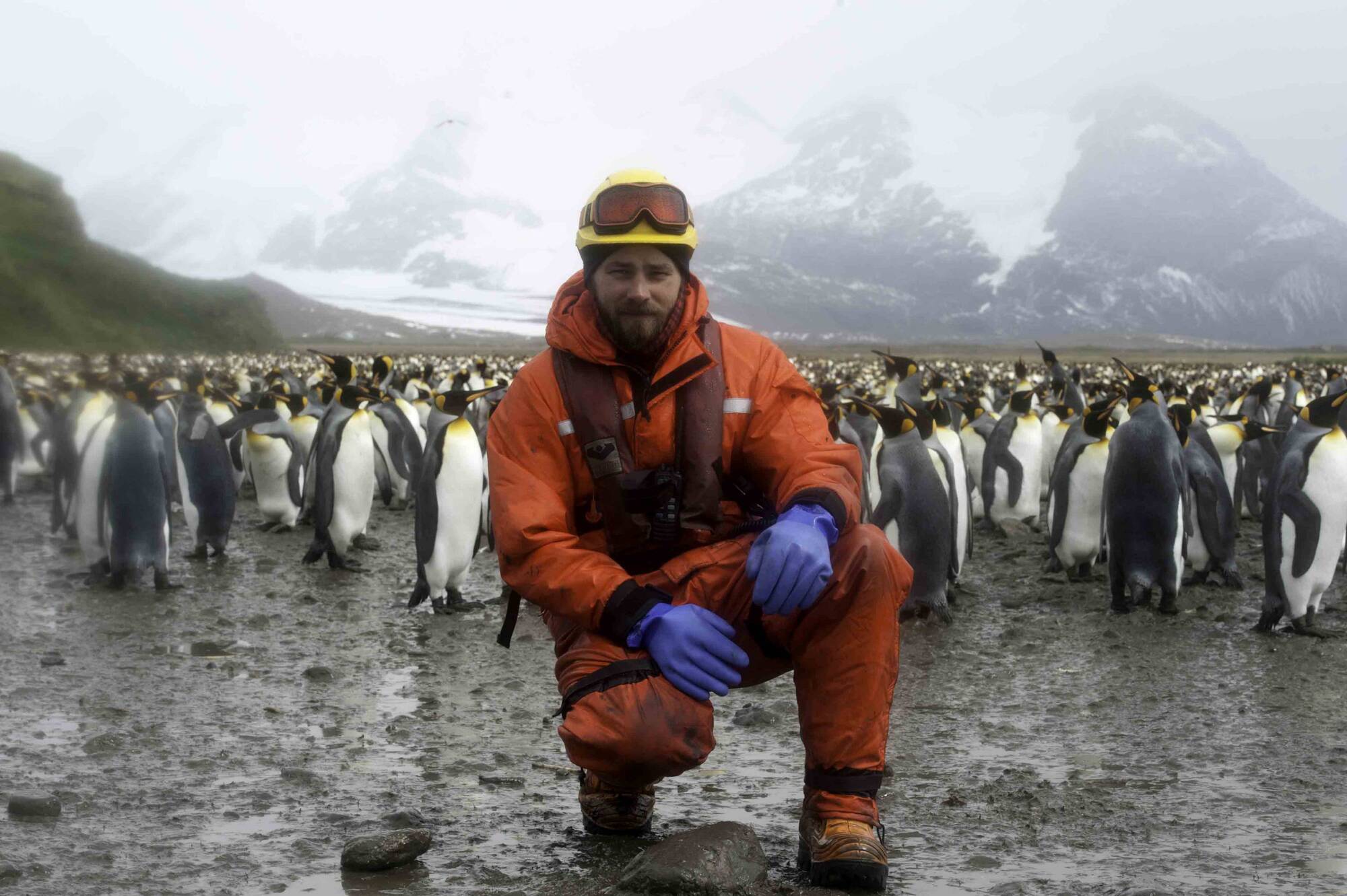
Captain Matt Neill at a King Penguin colony on Salisbury Plain, South Georgia. "There’s half a million King penguins there," he says.

The best part of Captain Matt Neill’s job is, by his own admission, the bit I suspect many of us would love a go at: smashing a great big ship through a vast expanse of Christmas cake sea-ice, in the same frozen ocean that crushed Antarctic explorer Ernest Shackleton’s Endurance in 1915, happy in the knowledge that a century on, your 10,000 tonne reinforced hull gives you far better odds of survival than Shackleton ever had. 

As job skills go, it’s niche. Not to tempt fate, but the £200m, 129m-long superstructure Capt. Neill commands is the most advanced polar research ship in the world, sensibly named after the naturalist Sir David Attenborough, (don’t mention the public online poll which voted for it to be called Boaty McBoatface in 2016). 

It has been designed to break through ice up to a metre thick, conduct vital scientific research, and transport both people and supplies to the British Antarctic Survey's five Antarctic research stations near the South Pole. It can accommodate up to 40 crew and 50 scientists.

The Derryman at its helm is living a dream far removed from what he thought would ever be possible. 

“Being in command of a £200 million vessel is not something to be taken lightly and in charge of all these people’s lives and safety. I was so ready for it. It’s a great feeling. It’s like a childhood dream of becoming a pop star or something. I put it out of my head completely and just forgot about it until it came up. And then suddenly everything lined up for me. It’s unbelievable and I’m so, so thankful,” he tells the Irish Examiner.

Captain Matt Neill on the bridge of the RSS Sir David Attenborough: "It’s a great feeling. It’s like a childhood dream of becoming a pop star or something." Picture: British Antarctic Survey

It’s Capt. Neill’s first command, having worked his way up through the Antarctic ranks since 2011. Since 2018 he has been working on the RSS Sir David Attenborough, from her construction in the shipyard until her launch and commission at the beginning of this year.  “It’s been a really nice journey to see that all the way through,” he says.

While Capt. Neill enjoys his first Christmas Day at home in several years with his young family, the RSS Sir David Attenborough will berth at Rothera Research Station, the largest British Antarctic facility, on Adelaide Island to the west of the Antarctic Peninsula. Christmas in the land of the midnight sun includes a half day off (“no such thing as a full day off at sea”), carols on the heli-deck, a bit of lunch and then football on the ice. 

“It’s nice to be onboard for Christmas in Antarctica because you’re guaranteed a winter wonderland,” he adds.

In January he will fly south to the Antarctic gateway port of Punta Arenas in Chile and from there he will sail the ship into the notorious Weddell Sea for the first time, close to where Shackleton’s Endurance sank. “We’ll be operating in that area so it’s quite historic,” he says. 

“Every time we go it’s like an expedition and whether it's science or we’re relieving bases, bringing in fresh produce like a lettuce to a base that hasn’t seen fresh food for six or eight months and seeing the smiles on their faces, that’s fantastic,” he says. 

The coldest he’s been in is about -30 degrees Celsius, but “with wind chill it brings it down to sort of -50s.” 

Captain Matt Neill at work on a cold day of operations in small boats. The coldest he’s been in is about -30 degrees Celsius, but “with wind chill it brings it down to sort of -50s.” Picture: Richard Turner.

Has he ever hit an iceberg? 

“No, if you hit an iceberg that’s bad. We often break ice, glacial ice which is from the land and sea ice which is just frozen seawater and that we would be breaking every season to get places. Glacial ice is really hard, it’s like hitting rock so you don’t want to be hitting that,” he says.

Capt. Neill has encountered the kind of wildlife most of us only see on the real David’s Frozen Planet BBC TV series. 

“I’ve seen seals, penguins, whales, everything you can imagine. On South Georgia there’s a place called Salisbury Plain, there’s half a million King penguins there, I stood beside that,” he says. 

He’s also been lucky to see Emperor Penguins, only found down on the sea ice of the Weddell Sea. And then there are the humpbacks and minkes. 

Last season I saw 360 degrees on the horizon, whale blows, hundreds of whales.

No wonder going home from work is an anti-climax. 

“In fact, when I’d finished my first trip as captain and came home, I was on a bit of a downer because it’s sort of a lifelong achievement done, box checked. I had to readjust my goals because I’d done something that I’ve been working towards most of my life."

The grandson of merchant navy men, Capt. Neill grew up in the port of Coleraine and spent his childhood sailing, kayaking and swimming in the icy waters of the North Atlantic Ocean. He still pilots boats into the port whenever he’s home on leave. 

Andrew Fleming - mapper

Remarkably, the same town has produced a second Antarctic explorer, or in this case, mapper, who works on the same ship.

Andrew Fleming rejoices in the job title Head of MAGIC (that’s Mapping and Geographic Information Centre to you and me) for the British Antarctic Survey. He and his team tell the world about melting glaciers and track penguin populations from maps of their poop.

“My kids think I’m Dumbledore somehow,” laughs Mr Fleming. 

Head of MAGIC, mapper Andrew Fleming, often spends up to two months at a time in the Antarctic summers, working long hours to make the most of the constant daylight. Picture: Jamie Anderson.

He’s in charge of mapping the Antarctic and the polar regions and has a huge range of technology and equipment in his bag of tricks, including bat-like radar satellites, drones, five aircraft, “one very large icebreaker” and three stations in the Antarctic, one of which operates year-round and one of which is on a floating ice shelf.

“It’s a really complicated and logistically heavy operation over a very large area in a really remote and hostile part of the world. So these maps are really important. It’s changing all the time so we need to keep people up to date about long-term changes like climate change, but also short-term changes like crevasses opening up or sea ice moving,” he explains. 

While based in Cambridge most of the year, Mr Fleming often spends up to two months at a time in the Antarctic summers, working long hours to make the most of the constant daylight.

He’s also spent time on the world’s northernmost inhabited areas of the Arctic, Svalbard, known for its rugged, remote terrain of glaciers and frozen tundra sheltering polar bears, Svalbard reindeer and Arctic foxes. 

“Svalbard is an amazing place. It’s some of the coldest temperatures I’ve ever experienced,” he says. Being in the Antarctic however, is immensely fulfilling for Mr Fleming.

“It’s such a unique and fascinating place, combined with the people I get to work with, it just leads to this mixture of fascinating science and really novel discoveries and real understanding about the planet and how it’s changing.

“Of course it feels like a long way from us in Ireland but it directly affects us. It’s such an important controller of the whole planet,” he says. 

Head of MAGIC, mapper Andrew Fleming in the Antarctic. “It’s such a unique and fascinating place," he says. Picture: Jamie Anderson.

A typical day can be very varied, Mr Fleming could be doing “10 different things” if he wanted to. 

“Everybody loves staring at maps and we get to do everything from making that map to sitting on the committee that decides on place names. We get to work with the UK Foreign Office too at the same time as charting where the latest large iceberg is moving to. It’s fascinating and massively rewarding,” he adds.

The hardest part is trying to curb his enthusiasm for what he wants to achieve. The fun parts are making live satellite calls to his kids’ classrooms from an Antarctic base. 

“They love that sort of thing. I’m cool for five minutes whenever I’m on a ship in the Antarctic, not the rest of it,” he says with the kind of rueful laugh only a father of three teenagers can give.

Life on board the ‘Attenborough is challenging but it has the creature comforts you’d expect of a 21st-century polar ship – sauna, gym, en-suite cabins, movie nights and fancy dress nights. The hardship of 19th- and 20th-century expeditions are “confined to history.” 

There will be no eating of penguins or seals to survive here. 

“We wouldn’t touch that,” says Mr Fleming, who maintains a strict policy of two meals a day while on board the food is so good. Like Capt. Neill, Mr Fleming has seen all kinds of wildlife but will “take a killer whale anytime over a penguin” in terms of the wow factor.

How does one small town on the northern coast produce two Antarctic seamen? 

“I don’t know, I don’t think it’s any coincidence that both of us ended up preferring the ocean and ship part of it. It’d be a hard choice between the Antarctic and the North and West coast of Ireland,” says Mr Fleming, whose mother hails from Westport. 

“I think there’s something about big wild open spaces that attract us,” he ponders.

Philip Burgess - reindeer expert

At the other end of the world, Dubliner Philip Burgess will be spending Christmas in the ‘official’ home town of Santa Claus, Rovaniemi, the capital of Lapland, where he lives with his wife Rauna and two sons.

“I just fell in love with the North, with the Arctic,” he says. He came to the far north of Finland 25 years ago to study salmon fisheries and is now an expert in reindeer herding in the Arctic circle countries. His wife is Sámi, an indigenous people of northern Norway, Sweden and Finland and a professor of indigenous studies at the University of Lapland where Burgess also works.

Today he’s researching what reindeer herding is going to look like by 2050. “We know that the climate is changing and it’s changing in the Arctic faster than anywhere else. And that’s going to have a huge impact on people who hunt and fish and herd reindeer,” he says. 

Global warming and rain instead of snow has led to ice forming over land where once snow piled high like sugar, leaving it too hard for reindeer to dig through to find grass. “Then they get hungry. And in some regions, they die. That’s happened on multiple occasions in Russia and Scandinavia,” he says.

In order to help the reindeer survive, herders have been bringing pellets up to their reindeer in the mountains but like everywhere else, the feed has been affected by the cost-of-living crisis being felt across Europe.

Philip Burgess: “I just fell in love with the North, with the Arctic.” Picture: Philip Burgess

“You’ve got to put fuel in your snowmobile, drive up to the mountains. You’ve got to buy fertilizer and pellets. And in those pellets are potash and most of it comes from Russia. There are sanctions. The price of potash and pellets have gone through the roof, so these are all cascading down,” he explains. 

“Mining for rare earth minerals has really taken off, particularly in Finland and Sweden and those are impacting on where reindeer graze, where they have their calves in spring. So there’s less space, there’s more tourist activities,” he says.

Tourism is huge in Rovaniemi, with Ryanair flying two flights a week directly from Dublin this winter season. 

“It’s quite weird to go down the town and hear people say ‘it’s cold here’,” he smiles. Their peak tourist season is four months long but Burgess has noticed big changes in the past two decades. It didn’t snow until December this year. 

There’s less snow. And it’s not as cold today, it’s -4. It should usually be really -10 to -20 at this time of year. The river froze really late. It’s happening and it’s really obviously happening. 

What will it look like in 25 years’ time, one wonders. “There won’t be snow. I can’t even imagine what this town will do if there’s no snow. How do you have Santa Claus without snow?” he answers.

The war in Ukraine is being felt in Lapland too. The largest ethnic group in Finland are the Russians, both those already living there and now those escaping Putin’s regime. 

“There’s been quite a bit of tension alright. Every town has a bunker system. You have to know where your bunker is. We’ve been told to stock up on our iodine tablets and we’ve had to have three or four days’ supplies, to be prepared. It’s definitely had an impact on the cost of living and the cost of fuel too,” says Burgess.

Philip Burgess: “It’s quite weird to go down the town and hear people say ‘it’s cold here’." Picture: Philip Burgess

At this time of year, the sun just dips below the horizon giving about five hours of a “kind of bluey, long sort of twilight.” For Burgess, the thrill of waking up to a blanket of snow never gets old. 

“It’s just such a thrill for me, one of my biggest kicks, to wake up and you can’t go outdoors because you have to sweep all the snow away. Finnish people grumble and I absolutely love it.” 

There will be family visiting from Dublin this Christmas, a Christmas tree and presents of course. But children - look away now. Will there be turkey in Lapland this Christmas? 

“Turkey wouldn’t do very well in the Arctic. We’ll have a huge reindeer roast in the oven. I know you might not want to read this,” laughs Burgess. “But the whole point of having reindeer is that you eat them. Sometimes you forget that you’re going to eat Rudolph.”

x

CLIMATE & SUSTAINABILITY HUB

More in this section

Lunchtime News

Newsletter

Keep up with stories of the day with our lunchtime news wrap and important breaking news alerts.

Cookie Policy Privacy Policy Brand Safety FAQ Help Contact Us Terms and Conditions

© Examiner Echo Group Limited