'It's very hard to see to a loved one, with cuffs on, in prison, because there's nowhere else for him to go' 
For this piece, journalist Noel Baker won the Mental Health Media Awards Mental Health Journalism award in the National Print and Online category
'It's very hard to see to a loved one, with cuffs on, in prison, because there's nowhere else for him to go' 

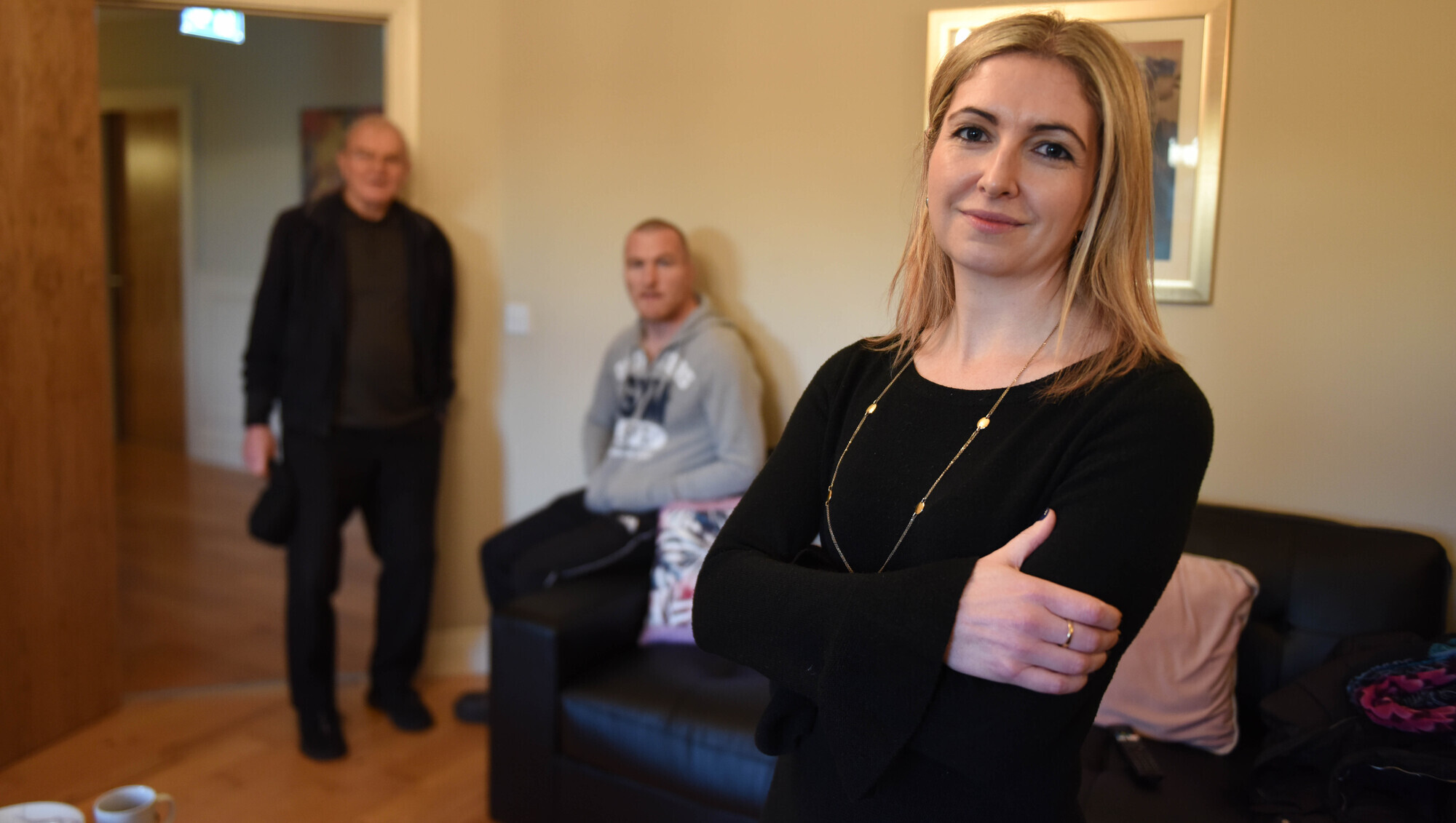
Catriona O'Toole, with her brother Greg and father Peter at the HSE provided residential accommodation Greg has just moved into. Picture: Moya Nolan

"There have been a few shocks,” Catriona O’Toole says. And then some.

Dr Catriona O’Toole is associate professor in Maynooth University’s Department of Education, and is the older sister to Greg — a man who was placed in prison on remand, primarily due to a lack of alternatives; someone often in distress, a man who has repeatedly rubbed his head so furiously he has created a bald patch, and who during one court appearance was so disorientated by what was going on that he walked over to his family and simply handed them his shoes, asking that they take them home.

Greg, says Catriona, is a sensitive and kind man with various passions, and longtime difficulties — namely, an intellectual disability and pronounced mental health problems. But then last year some of his mental health supports were withdrawn. According to Catriona, the HSE decided that the intellectual disability was the overriding concern; except in his native Co Wicklow, those in disability services believed differently — that Greg’s mental health concerns were paramount. He “fell between the two stools,” she says.

“Ultimately, he is a kind, sensitive man who has a lot to give,” she continues.

“It is very hard to see to loved one, a family member with restraints or cuffs on, it is really tough.”

She remembers seeing him in a cell, silent, confused. She recalls an appearance in court where his clothes were torn, where he was upset. When he handed them his shoes.

“I’m not sure if I have fully processed it,” Catriona says.

She traces everything back to the removal of the services that Greg had come to depend on for stability and support, the little checks and balances that kept everything tipping along. When they were taken away, her brother lost something tangible but which he could not articulate, and all the attempts to have the matter addressed seemed to go nowhere.

“You get to a point where you think ‘I am not making any headway here, I have written all the letters I can write, nothing is changing, nothing is happening’,” Catriona says.

“I know from talking to people that there is this wider issue. Greg’s is not an isolated case. It’s not him on his own, though it feels like that for families, you feel that isolation. That is the way the services make you feel. Everybody must be out there thinking they are in a unique situation — the reality, I know, is far from that.”

 Catriona O'Toole, with her father Peter and brother Greg at the HSE provided residential accommodation Greg has just moved into. 
Catriona O'Toole, with her father Peter and brother Greg at the HSE provided residential accommodation Greg has just moved into. 

Game of pass the parcel

Greg is now 42, and according to his father, Peter, up until last year he had his own car and was pursuing his passion for motorbikes. He is and has always been his own person, the fifth of seven children who grew up in Co Wicklow near Bray. According to Catriona, Greg had difficulties from a young age and underwent some assessments as a child but he proceeded through mainstream school and did an Applied Leaving Certificate. On finishing second level he worked, consistently — on building sites for contractors, in a factory, at a meat plant. He travelled, including to Australia, where Catriona says he parachuted out of a plane. He was trackside at Grand Prix races. “He has a great sense of fun and adventure,” Catriona says.

Greg was not assessed as having an intellectual disability until he was an adult, and he was hit by the grief of his mother’s death when he was 20. It was the first real sign of a wobble, leading to erratic behaviour and ultimately a court appearance for an incident in which there was considerable damage caused to the family car and home. It also led to an admission to a psychiatric hospital and subsequent support services.

“Over the years he would have received various diagnosis,” Catriona says. “Learning difficulties, but also mental health — schizophrenia, bipolar was there for a particular while. It highlights the subjective element of mental health diagnoses, that our systems need to move beyond diagnosis.”

Two assessments of his cognitive function, at different stages over the past 10 years, seemed to steer him towards disability services, yet the family believe his mental health needs were ever-present. Unfortunately, some 18 months ago, things changed again.

According to both Peter and Catriona, there was a move by the HSE for Greg to be dealt with by disability services, with the result that mental health supports he had become familiar with, such as regular visits by a social worker, psychologist and community nurse, stopped. Peter says those mental health professionals would have checked that Greg was taking his medication, and Catriona says the face-to-face nature of the interactions also benefitted her brother. When they stopped, he spiralled.

“Medication has a place but they can’t be in lieu of providing social support, a network of support and tackling the root causes of distress,” she says.

Catriona says that Greg did not seem to fit the profile for an integrated service, in which both his disability and mental health needs would be addressed, but she believes that is exactly what he needed. Instead, she says it became a game of pass the parcel, that because Greg did not tick all the boxes for either service, he was stuck between mental health and disability services, with both suggesting he was not their responsibility.

“They were passing it from one to the other,” she says. “All the while we have all these lovely policies, integrated, trauma-informed, reducing harm, peer recovery models — but that is not what is happening.

“There is no compassion in the system, no humanity in the system.

“Mental health services are saying we think the root of the problem is intellectual disability, but intellectual disability [services] say meanwhile he doesn’t quite fit our profile either.

“We talk about this ‘no wrong door’ approach to services and service organisation, that provide people with links to appropriate services. I think in Greg’s case it was actually there was no right door because he wasn’t fitting neatly into these boxes of mental health or intellectual disability. But he clearly has mental health needs and around disability as well.

“He did not fit neatly into those categories. I think that is quite similar for other people where there is dual diagnoses.

“He wasn’t able to articulate how he felt but I sense from him and from his distress and demeanour that he felt a sense of abandonment and confusion and he didn’t understand necessarily why suddenly people are withdrawing from his life.

“He felt that as an abandonment. For someone who has a history of loss, l think that is going to hit harder.”

Joe Maguire, Greg’s solicitor, has represented him over many years, and echoes Catriona’s view. “There was a big support put in place for him before and then he got so well with the supports and all the help that it all fell apart when they removed it,” he says. “This happens regularly with people with mental health issues.

“You would never see Greg at all, then next thing Greg is hanging around Bray,” he continues. “The family became seriously concerned. The family believed the father was going to die from stress or overwork for Greg.”

And that is when they applied for the protection order. While regularly used in domestic violence cases, they can seem like a last resort for families worried about the behaviour of a loved one — that at least if something goes wrong, the gardaí will quickly respond. However, that does not mean it is an easy decision.

“I don’t think his behaviour was under his own control,” Catriona says. “He was just really, really agitated, he might bang doors or break things and that’s just a threatening environment for Dad to be in.

“If there was a case where Dad was feeling unsafe in the house the guards could be called and they would respond quickly. It was Dad’s decision and I think it was the right decision.”

Greg found himself on remand in Cloverhill Prison. According to Joe Maguire: “He has been remanded in custody to Cloverhill Prison because there was nowhere else for him to go. He was remanded initially for a psychiatric assessment because the Judge was aware that he had been recently discharged from Newcastle Hospital, which is the local psychiatric hospital.”

Catriona says: “Greg would never be violent, he has never harmed another person, but he can get so agitated, so distressed, he’s crying, shouting, banging doors, breaking things in the house, pacing — that’s very hard to live with.

“When he is distressed it was kind of a threatening situation.

“I would have called guards and they came that time. Greg was sitting down, he had calmed somewhat, they cuffed him and brought him away. That is very traumatic for everyone involved, particularly Greg, but it was very hard for Dad to watch — it’s the last thing he wants. It is the last thing.

“Some of the huge harm that has been caused by withdrawal of services, I don’t think they fully comprehend. We would have called the social worker if we had concerns before, if he was starting to escalate, we had that, we could contact the mental health nurse, they would see him. With that withdrawal [of services] we had nobody.

“We are on our own here. ‘If you have a concern about him, phone the guards’ — it was really hard to hear, to be honest.”

Prison used to fill gaps in mental health services

Some months ago, the Irish Examiner wrote about the story of Kay Barrett, a Co Cork woman with a history of serious mental illness and who ended up in prison due to the breach of a safety order. Her family had secured the court order so as to offer some kind of protection to Kay’s father, with whom she was living, but repeated breaches meant she ended up in Limerick Prison. Kay’s family stressed that had the mental health supports Kay needed been available to her, she would never have ended up in the criminal justice system. Due to what unfolded in her case at the start of this year, both Kay’s solicitor and the Judge described prison at that time as being “the lesser of two evils”.

The Irish Penal Reform Trust and the Jesuit Centre for Faith and Justice were among the organisations to criticise what they saw as the criminal justice system having to intervene in and effectively manage gaps in the mental health system. IPRT executive director Saoirse Brady said at the time: “There is significant unmet mental health need in prison. People with severe mental health issues who have been assessed as needing hospital treatment, for whom prison is not appropriate, are often left on waiting lists of over a year to access treatment.

“What we have now is a damning situation where the State is allowing the prison system to be used to fill gaps in mental health services.”

At various parts of the mental health spectrum there have been problems. Earlier this month the High Court heard claims that a former prisoner with a serious mental illness has been left in a “medical no man’s land” over the HSE’s failure to provide him with necessary mental health services since his release three years ago. And back in September, Galway District Court heard that keeping a man in Castlerea Prison was the only way of ensuring he would continue to receive the vital mental health support and treatment he needed. It prompted Judge Mary Fahy to remark:

 “That is a serious indictment on this country; that I would have to impose a sentence because the services are not there.”

Since that case, and Kay’s and Greg’s difficulties, a report by the government-appointed ‘High-Level Taskforce to consider the Mental Health and Addiction challenges of those who come into contact with the criminal justice system’ has been published. Chaired by former government minister Kathleen Lynch, it delivered a blueprint for how the system could work — a more humane, empathetic approach that, if it is delivered, would see fewer people ending up in garda stations or prisons.

Kathleen Lynch firmly believes that the recommendations contained in the report come with a five-year timeframe for implementation. She sees it as a three-part process: prevention and diversion, detention and how people are dealt with who are already committed to the prison system, and then the journey out of prison. The former Cork North Central TD says there must be consequences for people who commit serious crimes, but says there are others who come into contact with gardaí primarily because they are unwell.

“Most of the crime, in terms of that low level stuff, is from people who need treatment and who are not getting treatment and cause disruption to other people’s lives, including their own,” she says.

The taskforce report makes 61 recommendations, including for a new approach regarding how gardaí respond to some situations in which the person at the centre of a garda callout is fundamentally, or even temporarily, mentally unwell.

Late last month, and to little fanfare, a separate report was published outlining exactly how this would work. It has another snappy title — the Report on a Roundtable Symposium with International Collaborators to Explore the Feasibility of Implementing a Community Safety Co-response Model in Ireland — but its findings could potentially impact on scenarios such as those faced by Greg O’Toole and Kay Barrett.

The report was written by Supt Andrew Lacey, who is based in Limerick city, Dr Alan Cusack of the Centre for Crime, Justice and Victim Studies (CCJVS) at the School of Law at the University of Limerick, and Bláithín O’Shea. Supt Lacey “had unique access to internal garda research data encompassing two years of incident analysis”, it says, and the contents of the report are ultimately based on an international roundtable symposium held at UL last April, and a follow-up interagency practitioner workshop, which involved gardaí and the HSE, held in August.

Pilot project

The key aspect of the report is a pilot community safety co-response model, known as Community Access Support Teams (CAST), which will run in Limerick from next year. Fundamentally, it will mean specialist police officers dealing with incidents involving suspected mental ill-health, either alone or alongside mental health and addiction professionals, such as a psychiatric nurse or social worker. According to the report: “Police officers should not be the de facto responder to mental health crises. However, the multi-agency approach will frequently see intervention at the police custody stage”, adding “There was a consensus that having more clinicians on the co-response team would give rise to better interventions and care.”

Mental health PULSE incidents in the Limerick Division in 2019 and 2020 were analysed, with 1,035 incidents identified as mental-health-related that required gardaí to attend. In addition, 136 gardaí responded to a questionnaire, some of whom were involved in multiple incidents across those 1,035 incidents. The findings are intriguing and instructive. For example: where arrests were made, 77% of respondents stated that if there had been an alternative to arrest, they would have used it. In addition, 64% of respondents felt that a co-response model would give rise to better outcomes, 79% of respondents felt current legislation relating to mental health was inadequate, and 31% of respondents stated they would be interested in applying for the pilot co-response team.

The report also took data for one month in the Limerick division and found that 221 incidents were directly suited to the CAST model and that 102 incidents were classed as acute mental health presentations. In the same four-week period there were 257 contacts made with the out-of-hours Crisis Service team, with more than a fifth of those individuals making more than one presentation. It also found that 72% of the mental-health-related PULSE incidents occurred outside the hours of 7am and 5pm, that more than half of the individuals involved were aged between 30 and 60, and that alcohol abuse and drug dependency “featured prominently in the incidents”.

Currently, under section 12 of the Mental Health Act 2001, a member of An Garda Síochána can make a decision to take a person believed to be suffering from a mental disorder into custody. The report outlines the growing use of Section 12 detentions as “a last resort for An Garda Síochána”. Nationally, the number of Section 12 arrests has risen each year from 4,002 in 2018 to 6,315 in 2021, and while the Limerick figures in the same period have fluctuated, it still increased from 174 to 252 arrests between 2018 and 2020, before dropping back somewhat last year to 234.

For more granular detail, Supt Lacey looked at one month of Section 12 arrests in Limerick. A total of 22 incidents were identified and in 13 of them, “attending gardaí were aware that there was a mental health concern in respect of the call prior to arrival.”

In 16 of the incidents, attending gardaí made a decision to arrest under the Mental Health Act in less than 10 minutes, although in others it was over 90 minutes before a garda station assessment was completed.

In all-bar-four incidents, attending gardaí stated that the individual arrested was not referred for assessment to a psychiatric setting, while alcohol or drugs was a factor in just seven of the 22 arrests. And after 15 of the incidents, attending gardaí had no interaction or follow-up with the individual or their family.

The Irish Examiner understands that those figures do not include arrests for the breach of safety, protection or barring orders — the kind of triggers that were a factor in the detention of Greg in Wicklow and Kay in Cork. Kathleen Lynch says of these orders in the context of mental health: “Families mostly do something [like that] with the best intentions.” But, she adds, “judges have very few options.” According to Keith Adams, Penal Policy Advocate in the Jesuit Centre for Faith and Justice: “I understand that it is a case of last resort for families, due to inadequate State services, but if the ‘offending’ is related to just being unwell, the person is just being lined up for prison.”

Breaches of such orders do open up the prospect of prison, but Kathleen Lynch believes it should be open to direct people towards treatment, if possible. Catriona O’Toole says that her family felt they had to do something to protect their father, Peter. Greg had never been violent towards anyone, but Peter — who has lived with Gregory, as he calls him, in the family home on and off for years — says he was banging doors, breaking and throwing things. And so the call had to be made. However, someone familiar with the proposed pilot project in Limerick said that while the new measures would not necessarily see the end of such orders being applied for or granted, it might lessen the need for them.

“If you are in earlier, intervention is better, you have better skilled people [involved], then you would like to think every situation that gardaí and the HSE are attending would have a better outcome,” they said.

The new pilot programme in Limerick — expected to get underway in the latter half of next year, and to operate for an initial nine-month period — will use a multi-agency support hub to link people in mental health crises to the appropriate community services. The individual familiar with the pilot programme also suggested that someone with an acute mental health issue who repeatedly comes to garda attention would be a candidate for the support hub, meaning that even if the order is in place, a breach would not necessarily mean immediate court appearances, if diversion elsewhere was a possibility.

Under the pilot there will be increased training, not just for the officers responding to the call-out alongside the HSE professional, but also for the CAD (Computer Aided Dispatch) centres, meaning those people receiving the calls can attempt to triage a case. And the report outlines how pre-hire ‘ride-alongs’ should be organised for healthcare applicants to provide the opportunity to see the realities of the role and decide if it is for them.

Kathleen Lynch is convinced that the pilot has a role to play, that it can work at a national level, and that the recommendations in the Taskforce report can be achieved. She says one area where the taskforce “dug their heels in” was over the issue of dual diagnosis.

“That pass the parcel business...,” she says. “What we look at is even triple diagnosis.” That is addiction to substances, with a mental illness, and/or an intellectual disability, and also sometimes personality disorder, a condition not currently covered by the Mental Health Act and for which treatment can only be accessed overseas.

It sounds like solutions are within touching distance, but there are many challenges to overcome before the pilot programme can be rolled out nationally, not least resources and dealing with ongoing recruitment issues. Yet the person familiar with how the Limerick CAST pilot is likely to work is full of praise of the HSE’s efforts so far in terms of engaging with it, and the evidence from other countries indicates it could be a game-changer. It needs to be. According to the Lacey/Cusack report: “It was clear from discussions with parties that a crisis that requires intervention by the gardaí brings with it extreme fear for the individual. The word ‘terror’ was used several times. Not only is the person in extreme mental distress, and possibly experiencing severe psychosis, but the intervention of the gardaí, or those ‘in uniform’, can add to their feelings of fear and exacerbate the situation.”

After Catriona had made the call to gardaí, officers arrived, just doing their job. But everyone’s perspective is different. For Peter O’Toole, watching his son being taken away was “very traumatic”.

“He was actually sitting at the table eating his dinner,” he recalls. “They barged in, two of them, put the handcuffs on him. He had no shirt on, he had very little clothes on him, short trousers. They put him in handcuffs and took him away.”

HSE response

In a statement, HSE Community Healthcare East said it cannot comment on individual cases as to do so would be a breach of patient confidentiality.

A HSE spokesperson said: “When service users require support/input from a number of divisions/services within the HSE, we endeavour to adopt an integrated, patient-centred approach involving all relevant services, and the service user, to enable the development of a comprehensive care plan that meets the service user’s individual needs. Involvement of the service user in this manner assures his/her will and preference is reflected within a care plan to which he/she consents.

“This approach seeks to ensure the provision of integrated and patient-centred healthcare as articulated in Sláintecare.”

More broadly, the HSE said that adults experiencing a mental illness, like a personality disorder, can be treated by a Community Mental Health Team where multidisciplinary teams can provide evidence-based care and treatment. There are currently 112 adult community mental health teams nationwide. Treatment for borderline personality disorder (BPD) may involve individual or group psychotherapy.

According to the HSE spokesperson: “Ninety percent of new /re-referred adults are offered an appointment within 12 weeks for adult community Mental Health services. Adults who have a mental illness and require inpatient care can be referred to any of the HSE’s acute inpatient mental health-approved centres around the country. Details on approved centres can be found here.

“Personality Disorder, as a stand-alone diagnosis, is not covered under the Irish Mental Health Act.

“The Mental Health Act 2001 outlines three exclusions from the definition of mental disorder. These exclusions are behaviour, conditions or circumstances that cannot on their own be considered mental disorder. Section 8(2) of the 2001 Act states that it is not lawful to admit a person involuntarily in an Approved Centre solely because that person is (a) suffering from a personality disorder (b) is socially deviant, or (c) is addicted to drugs or intoxicants.”

Fresh start

In recent times Kay Barrett’s situation has improved immeasurably. She is better and exploring different options. Her family say she has a new lease of life and new possibilities.

This month there was a happy ending for Greg and his family. The HSE had come under scrutiny from the two judges who heard the case in Bray District Court, Judge David Kennedy and Judge John O’Leary. The charge against him was withdrawn after the order was removed. In court Judge Kennedy said it was “most unfortunate” and it was a case that had “fallen between two stools”.

The HSE had outlined one potential solution at an earlier court hearing, but while it did not come to fruition an alternative that was agreeable to the family was finalised soon afterwards — Greg would move to a supported residential setting, once it was ready. By the middle of last week it was, and Greg began settling into his new home.

“That is the place that is available — we thought it would be a good fit for him,” Catriona says, adding that the family is happy with the care package on offer and cautiously optimistic about the next steps. So is Greg.

Peter O’Toole says of his son: “When he is good he’s a lovely lad. I do miss him, but at the same time I don’t miss what he was doing when he was here.

“I hope he gets back [to full health] is all.”

 Catriona O'Toole found herself tweeting into the void, wondering what she could do for her younger brother, someone she has always believed in. Picture: Moya Nolan
Catriona O'Toole found herself tweeting into the void, wondering what she could do for her younger brother, someone she has always believed in. Picture: Moya Nolan

According to Catriona: “I see it as a fresh start, the possibility for development, new relationships, new trust and a sense of community with people and a sense of belonging, and what would be really huge for him would be the stability, the security, the safety that a setting like that would provide. A bit of calm after things have been so turbulent, a return to a state of safety and calm.”

In Catriona’s own words, she has “agency” — she holds a PhD, she knows people, she is aware of the nuances of social justice, she has contacts and can call people, ask their advice. Yet last month she found herself tweeting into the void, wondering what she could do for her younger brother, someone she has always believed in.

“Employment would be great for him, social activities, past-times and hobbies,” she says.

“He is a really good climber. There are rocks out in Dalkey Quarry, he would have been climbing that.”

She remembers an afternoon they spent together around four years ago.

“There are climbing walls out in Finglas, where you can practice, and he was teaching me, getting us harnessed up. He was really protective as well as he was in the role of the teacher. He was really protective of me, it was just a lovely kind of switching of roles — that it’s not always me looking out for him.

“He was ready to catch me if I was going to fall.”

  • Additional reporting by Joyce Fegan

x

More in this section

Lunchtime News

Newsletter

Keep up with stories of the day with our lunchtime news wrap and important breaking news alerts.

Cookie Policy Privacy Policy Brand Safety FAQ Help Contact Us Terms and Conditions

© Examiner Echo Group Limited